
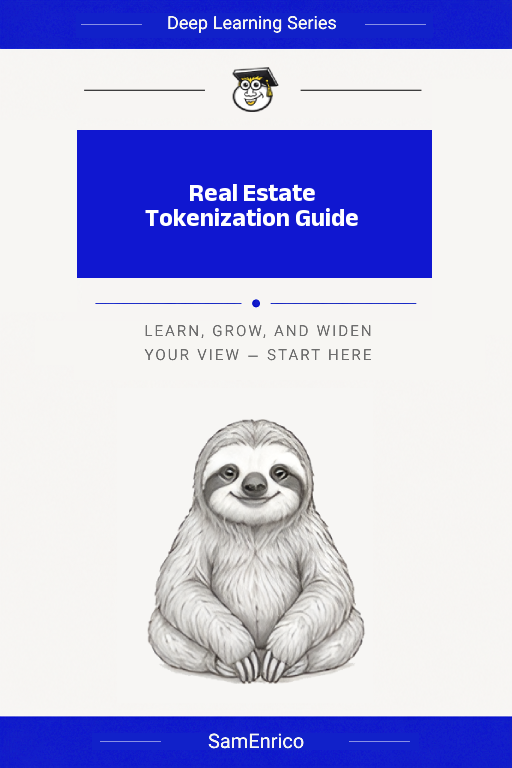
Non-FictionForecast & OutlookTokenization
Real Estate Tokenization Guide eBook
Discover blockchain-based fractional ownership, li
by Mojica Odis
Discover blockchain-based fractional ownership, liquidity for private real estate, and security tokens.
Formats
Free sample
Chapter 1: The Great Illiquidity...–- Imagine owning a $10 million office building. Now imagine needing cash in 48 hours. You cannot sell a single desk, one floor, or a parking spot without selling the entire asset. Your hands are tied. This is the dirty secret of the world’s largest asset class: real estate is a prison of illiquidity disguised as a treasure chest of wealth.Real estate has been the preferred store of value for kings, corporations, and families for millennia.
It is tangible. It produces income. It survives wars and inflations. But unlike a stock, which you can sell in one second with a tap on your phone, a building takes months—sometimes years—to convert back into spendable cash. The gap between what a property is worth on paper and what you can actually get for it on short notice is the single greatest friction in private wealth management.
And for most of history, everyone simply accepted this friction as unavoidable.This chapter dismantles that assumption. We will trace the 6,000-year history of property rights from clay tablets to digital ledgers, expose the failed experiments in fractional ownership that came before blockchain, and reveal why the 2008 financial crisis—not Bitcoin—was the true catalyst for real estate tokenization. By the end, you will understand that the current real estate market is not a natural state of affairs but a product of technological limits that no longer exist.The Prison of Physical Ownership Every real estate owner faces the same paradox: your wealth is locked in walls. A study by the National Bureau of Economic Research found that the average time to sell a commercial property in the United States is 11 months from listing to closing. Residential properties fare slightly better at 45 to 60 days in normal markets, but only if priced aggressively.
During the 2008 crisis, the average time on market for residential real estate exceeded 180 days, with nearly one-third of listings eventually delisting without a sale.Compare this to equities. You can sell $10 million of Apple stock in under one second at a known price. The bid-ask spread will be fractions of a penny. Settlement takes two days. The liquidity premium—the extra return investors demand for holding an illiquid asset—ranges from 3% to 7% annually in real estate, meaning you are effectively losing that much potential return compared to a liquid portfolio of equal risk.But illiquidity is only the most visible problem.
The deeper issue is fragmentation. When you own a building, you own an indivisible lump. You cannot sell the fifth floor while keeping the fourth. You cannot sell 10% of the rent stream for a year. You cannot borrow against just the parking garage.
The asset is a monolith, and monoliths are hard to price, hard to trade, and hard to exit.This indivisibility creates what economists call "lumpy assets." A 50millionofficetowerhasexactlyonebuyerpool:institutionalinvestorswith50 million office tower has exactly one buyer pool: institutional investors with 50millionofficetowerhasexactlyonebuyerpool:institutionalinvestorswith50 million in dry powder. Reduce that to 5millionfractions,andthebuyerpoolexpandsbyordersofmagnitude.Reduceitto5 million fractions, and the buyer pool expands by orders of magnitude. Reduce it to 5millionfractions,andthebuyerpoolexpandsbyordersofmagnitude.Reduceitto500 fractions, and suddenly millions of retail investors can participate. The technology to enable this has existed for decades in finance—mutual funds, REITs, and ETFs all solve the fragmentation problem. But each comes with a fatal flaw: middlemen.The False Dawn of REITs Real Estate Investment Trusts were created by the U.S.
Congress in 1960 to allow small investors to pool capital for commercial real estate. The structure is elegant: a company owns properties, sells shares to the public, and distributes 90% of taxable income as dividends. Today, REITs manage over $4 trillion globally. On paper, they solved fractional ownership.In practice, REITs introduced three new problems that tokenization promises to solve.First, the middleman tax. A typical REIT charges management fees between 1% and 3% of assets annually, plus acquisition fees, disposition fees, and performance fees.
These layers of intermediation can consume 30% to 50% of total returns over a decade. The people running the REIT get paid whether the property performs or not. Tokenization replaces these intermediaries with smart contracts—automated code that executes distributions and governance without taking a percentage.Second, the pricing mismatch. Publicly traded REITs trade on exchanges like stocks. Their price is determined by market sentiment, not property value.
During the 2008 crisis, REITs fell 68% on average while the underlying properties fell only 35%. Private REITs avoid daily pricing but lock investors in for years with strict redemption limits. Tokenization offers a middle path: tokens can trade on secondary markets but remain anchored to property fundamentals through oracles and appraisal mechanisms.Third, the transparency gap. REITs report financials quarterly, but investors cannot see which specific properties generate which returns. They cannot vote on asset sales or capital improvements.
They are passive passengers. Tokenized real estate flips this model. Every token holder can inspect the smart contract, verify rent collections, and vote on major decisions proportional to their stake.A 2023 study by the University of Cambridge examined 50 publicly traded REITs and found that executive compensation averaged 12.7% of net operating income. In the same year, the first generation of tokenized real estate platforms operated with expense ratios below 0.5% through automated smart contracts. The difference is not incremental—it is structural.The Whitepaper Revolution: Trust Without Intermediaries On October 31, 2008, an anonymous person or group using the name Satoshi Nakamoto published a nine-page whitepaper titled "Bitcoin: A Peer-to-Peer Electronic Cash System." The world focused on the currency aspect, missing the true innovation: a decentralized ledger that allows strangers to transact without trusting a bank, government, or any single intermediary.The breakthrough was cryptographic proof.
Instead of trusting a bank to record who owns what, Bitcoin uses a network of computers running identical software. Each transaction is verified by multiple nodes before being added to an append-only chain of blocks—hence "blockchain." To change a past transaction, an attacker would need to control more than half of the network's computing power, a feat so expensive as to be effectively impossible for any realistic asset.Ethereum, launched in 2015 by Vitalik Buterin, extended this concept. Where Bitcoin tracks simple ownership (Alice owns 5 BTC), Ethereum tracks programmable states. You can write code—called smart contracts—that executes automatically when conditions are met. If tenant pays rent, send dividends to token holders.
If 60% of votes approve, sell the property and distribute proceeds. The blockchain does not trust; it verifies.This is the foundation of real estate tokenization. You do not need to trust the property manager to send your dividend check. You do not need to trust the escrow agent to hold funds honestly. The code enforces the rules.
And the code cannot be bribed, cannot make accounting errors, and cannot disappear with the money.Yet the whitepaper revolution almost did not happen. In 2008, the world had just witnessed the collapse of Lehman Brothers, the bailout of AIG, and a $700 billion taxpayer rescue of the financial system. Trust in institutions hit an all-time low. According to the Edelman Trust Barometer, only 36% of Americans trusted banks in 2009, down from 68% in 2005. Bitcoin emerged not as a technological curiosity but as a political response.
The blockchain was not invented in a vacuum—it was invented in the ashes of the financial system.The 2008 Crisis: The…
This is the end of the free sample. Get the eBook to keep going. Buy now
About this book
Details
- Author
- Mojica Odis
- Publisher
- SamEnrico
- Language
- English
- Genre
- Non-Fiction, Forecast & Outlook, Tokenization
- Released
- 2026-06-01
- Pages (approx.)
- 150
- Available as
- eBook, Audiobook

Read better in the ZLOADR app
Your eBooks on your phone or tablet. Sign in with your SamEnrico account and start reading.
More by Mojica Odis
 Global Talent Competition ForecastMojica Odis$11.99
 Immigrant Childhood Self EsteemMojica Odis$11.99
 The Workaholism Laptop Free Evening GuideMojica Odis$11.99
 Gambling Addiction Relapse PlanMojica Odis$11.99
 Meat Moderation Longevity GuideMojica Odis$11.99
 Fenrir's Howl: The Wolf Who Swallowed the MoonMojica Odis$11.99
 Conventional Loan UnderwriterMojica Odis$11.99
 One Page Customer Journey HandbookMojica Odis$12.99
 Understanding Léri–weill DyschondrosteosisMojica Odis$17.99
 How to Start a Chair Seating Made of Cane or Wicker Business (Beginners Guide)Mojica Odis$11.99
You may also like
 Hong Kong Handover 1997Dunn Johnnie$11.99
 Zumba For Postnatal Recovery CourseNeal Christian$11.99
 Zumba for BeginnersLadner Nikia$11.99
 YouTube Comment Mining GuideHumes Pandora$12.99
 Worry Box MeditationCarlin Rudy$11.99
 Workplace Stress MeditationNguyen Lynn$11.99
 Workplace Stress and Sleep RepairHawley Ivory$11.99
 Workplace Perfectionism CureDelaney Jeffry$11.99
 Workplace Injustice Anger GuideWallen Isabelle$11.99
 Work Addiction and Burnout LinkGreenwood Ester$11.99
 Women in Yoga and WellnessBeattie Galina$11.99
 Women in Stand Up ComedyChun Evangeline$11.99