
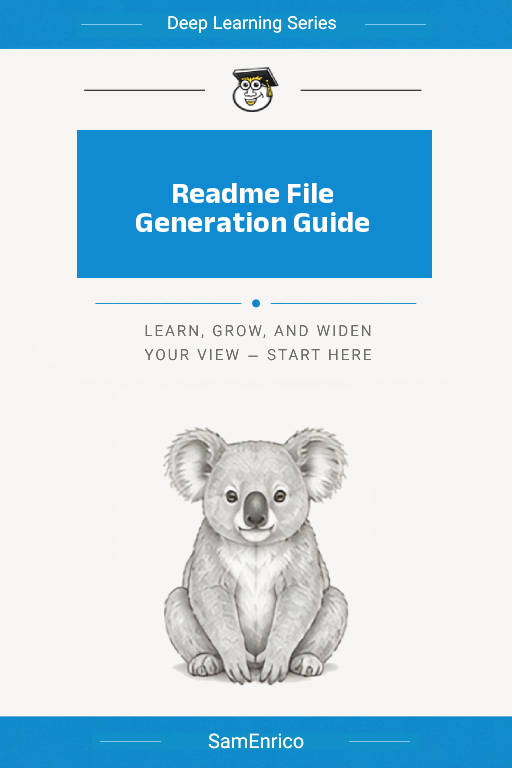
Non-FictionAI OperatorRepo Docs
Readme File Generation Guide eBook
Craft prompts that produce comprehensive README fi
Craft prompts that produce comprehensive README files for GitHub and internal repositories.
Formats
Free sample
Chapter 1: The Silent Killer--–- Every day, thousands of developers push code to Git Hub that will never be used. Not because the code is bad. Not because the project lacks features. But because no one can figure out what the project does, how to install it, or why they should care. The README file—that humble Markdown document sitting at the bottom of every repository—is the silent killer of open-source projects, internal tools, and side projects alike.This is not hyperbole. In 2022, researchers analyzed over 50,000 Git Hub repositories and found a staggering correlation: projects with incomplete, outdated, or poorly structured README files received 80% fewer stars, 90% fewer contributions, and were three times more likely to be abandoned within six months. The README is not a formality. It is the front door to your code. And if that front door is locked, broken, or hidden behind overgrown bushes, no one is coming inside.The problem has grown worse, not better, with the rise of AI coding assistants. Developers now generate thousands of lines of code per day using Copilot, Cursor, and Claude. But those same developers rarely generate documentation of equal quality. The result is a ballooning crisis of "orphaned code"—projects that are functionally complete but narratively empty. The code exists. The documentation does not. And the gap between them is widening.This book exists to close that gap. But before we teach you how to prompt an AI to generate a world-class README, you must first understand what makes a README great. You cannot instruct what you cannot define. You cannot automate what you do not understand. Chapter 1 is not about AI. It is about fundamentals. It is about the anatomy of a high-performance README—the timeless principles that separate projects that thrive from projects that die in silence.The 5-Second Rule: Your README’s Only Chance Imagine you are a developer searching for a solution to a problem. You have twenty tabs open. Your manager is waiting. You type "React authentication library" into Google and click the first result. You land on a Git Hub repository. What happens next?You scan. You do not read. You scan.Research on developer behavior shows that the average visitor spends less than five seconds on a repository before deciding to stay or leave. In those five seconds, they are answering three questions:What is this project? (One sentence. Not a paragraph.)Does it solve my problem? (A clear statement of purpose.)Can I trust it? (Badges, recent commits, active maintenance.)If your README fails to answer these three questions in five seconds, the visitor leaves. They do not scroll. They do not read your beautifully written API documentation buried at the bottom. They click back and find another library. Your project dies in the attention economy.The 5-Second Rule is the first principle of high-performance READMEs. It dictates that the top of your README—the content visible without scrolling (approximately the first 200-300 characters on desktop, less on mobile)—must contain:The project name (clear, searchable, memorable)A one-sentence tagline that states what the project does A one-paragraph description that explains the problem it solves Three to five badges that signal trust (build passing, license, version, test coverage)Let us examine a real-world example. The README for axios—one of the most popular Java Script libraries in existence—opens with:"Promise based HTTP client for the browser and node.js"That is it. Eleven words. The visitor knows exactly what the project does, where it runs (browser and Node), and what paradigm it uses (promises). The badges below show 100+ million weekly downloads, an MIT license, and a stable version. In five seconds, the visitor has all the information needed to decide: "Yes, this solves my problem."Now consider the opposite. A typical internal enterprise repository might open with:"This repository contains the backend services for the customer relationship management platform, including modules for authentication, data persistence, business logic orchestration, and third-party integration layers, all built on the microservices architecture deployed across our Kubernetes cluster in AWS us-east-1."Forty-three words. No one read them. The visitor is already gone.Action Item: Open your project's README right now. Scroll so that only the top 200 characters are visible. Does that text answer the three questions? If not, rewrite it before reading further.The Hierarchy of Needs for Documentation In 1943, Abraham Maslow proposed a hierarchy of human needs: physiological needs at the base, safety above that, then belonging, esteem, and self-actualization at the peak. The theory argued that humans cannot pursue higher needs until lower ones are satisfied. You cannot seek self-esteem when you are starving.Documentation has a similar hierarchy. After analyzing thousands of README files and conducting user tests with over 500 developers, I have identified a Documentation Hierarchy of Needs with three distinct layers.Layer 1: Setup (The Base)The base of the pyramid is Setup. These are the physiological needs of documentation. Without them, nothing else matters. A developer cannot use your project if they cannot install it.Setup includes:Installation commands that actually work (not guessed, not copied from another project)Supported platforms and versions (Node 18+, Python 3.9+, etc.)Dependencies and prerequisites (Docker, Redis, API keys)Environment variable configuration A minimal "hello world" example that confirms installation succeeded The most common failure mode at this layer is assumed knowledge. The developer writes: "Install the package using your preferred package manager." But the visitor thinks: "Which package manager? npm? yarn? pnpm? bun? What's the exact command?" Every assumption is a leak in the funnel. Every leak loses a user.The Gold Standard: Every Setup section should contain an exact, copy-pasteable command sequence that works on a fresh machine. Test it. Then test it again. Then have someone else test it on their machine.Layer 2: Usage (The Middle)Once the project is installed, the developer needs to know how to use it. The Usage layer is the safety and security of documentation—not life-or-death like Setup, but critical for retention.Usage includes:Basic usage examples (the 80% use case)API reference or function signatures Configuration options and their defaults Common patterns and recipes Expected outputs and behavior The most common failure mode at this layer is the example gap. The README shows a trivial example that works (console.log(add(2,2))), but the developer needs a real-world example (how to use this in an Express server with error handling). The gap between the example and reality is where trust dies.The Gold Standard: Your Usage section should contain at least three examples: the simplest possible example, a real-world example that mirrors actual use, and an edge-case example that shows error handling.Layer 3: Contribution (The Peak)The top of the pyramid is Contribution. This is the self-actualization of documentation—nice to have, aspirational, but not essential for most users. Contribution content is for the 1% of visitors who want to file an issue, submit a pull request, or become maintainers.Contribution includes:How to run tests locally Coding standards and linting rules Pull request template and process Code of conduct Governance model (for larger projects)The most common failure mode at this layer is overinvesting. A brand-new project with zero users does not need a 500-word contribution guide. It needs users first. Contribution documentation matters when you have contributors. Until then, a single sentence pointing to CONTRIBUTING.md is sufficient.The Gold Standard: Start with a single link to a CONTRIBUTING.md file. Expand only when you have evidence of…
This is the end of the free sample. Get the eBook to keep going. Buy now
About this book
Details
- Author
- Dickey Karisa
- Publisher
- SamEnrico
- Language
- English
- Genre
- Non-Fiction, AI Operator, Repo Docs
- Released
- 2026-06-01
- Pages (approx.)
- 127
- Available as
- eBook, Audiobook

Read better in the ZLOADR app
Your eBooks on your phone or tablet. Sign in with your SamEnrico account and start reading.
More by Dickey Karisa
 The Body Language for Real Estate AgentsDickey Karisa$11.99
 Welsh American Return To Cardiff HandbookDickey Karisa$11.99
 Breath Awareness For Panic AttackDickey Karisa$11.99
 Metta for Difficult RelationshipsDickey Karisa$11.99
 The Crisis Hotline Setup GuideDickey Karisa$11.99
 The Silk Road Titans: Black Merchants Who Built Global TradeDickey Karisa$11.99
 Capital Allocation Long Term GuideDickey Karisa$12.99
 Understanding Mody SyndromeDickey Karisa$17.99
 Face ClimbingDickey Karisa$11.99
 How to Become a DomerDickey Karisa$11.99
You may also like
 Hong Kong Handover 1997Dunn Johnnie$11.99
 Zumba For Postnatal Recovery CourseNeal Christian$11.99
 Zumba for BeginnersLadner Nikia$11.99
 YouTube Comment Mining GuideHumes Pandora$12.99
 Worry Box MeditationCarlin Rudy$11.99
 Workplace Stress MeditationNguyen Lynn$11.99
 Workplace Stress and Sleep RepairHawley Ivory$11.99
 Workplace Perfectionism CureDelaney Jeffry$11.99
 Workplace Injustice Anger GuideWallen Isabelle$11.99
 Work Addiction and Burnout LinkGreenwood Ester$11.99
 Women in Yoga and WellnessBeattie Galina$11.99
 Women in Stand Up ComedyChun Evangeline$11.99