
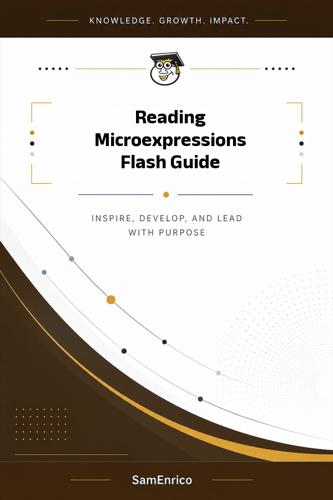
Reading Microexpressions Flash Guide eBook
Teaches identifying seven universal facial express
by Bynum Isaura
Teaches identifying seven universal facial expressions lasting less than a second.
Formats
Free sample
Chapter 1: The 1/25th Second...--–- The first time Carla saw her husband lie, she didn't know what she was looking at. He was sitting across the dinner table, telling her he'd been working late every night that week. His voice was steady. His eyes met hers. His smile was warm and familiar.
And yet, something in Carla's chest tightened. A whisper of wrongness she couldn't name. She dismissed it as paranoia, exhaustion, the stress of a new mortgage. Three months later, she discovered the affair. When she replayed that dinner conversation in her mind, she realized what her gut had caught but her conscious brain had missed: for exactly 1/15th of a second, between the words "I love you" and "you know that, right?" her husband's face had flickered with contempt.
One corner of his mouth had pulled up and back. Then the smile returned. The mask was flawless. But the Flash had betrayed him.This is not a book about magic tricks or psychic intuition. It is a book about the most reliable, scientifically validated window into human deception and genuine emotion: the microexpression.
And before you learn to spot them in others, you must understand what they are, why they exist, and why your brain is already wired to see them—whether you know it or not.The Gut Instinct Is Not a Ghost Every human being has experienced the sensation of knowing something is wrong without knowing why. You meet someone new, and despite their friendly words, you feel uneasy. Your partner says "nothing's wrong," but something feels off. A salesperson makes a compelling pitch, yet you hesitate to sign. Most people call this intuition.
Some call it a sixth sense. A few call it nonsense.The truth lies somewhere in between—and it is far more fascinating than magic.Your brain is constantly processing facial expressions at two speeds. The first is conscious and slow: you look at a face, you register the expression, you interpret it, you respond. This process takes roughly one to two seconds. The second is unconscious and lightning-fast: specialized neural circuits in your amygdala and fusiform face area detect and categorize facial expressions in as little as 33 milliseconds—about 1/30th of a second.
That is faster than you can blink. Faster than you can form a conscious thought. And crucially, it happens whether you want it to or not.What we call "gut instinct" is actually your unconscious brain successfully registering a microexpression that your conscious brain missed. The feeling of unease is not a ghost in your gut. It is a report from your visual system, delivered through your limbic system, informing you that someone's face revealed an emotion their words denied.
Carla's gut was not psychic. Her brain had seen the contempt flash. It just hadn't told her conscious mind what it saw—only that something was wrong.This book will close that gap.Defining the Microexpression: The 1/25th Second Tell Let us establish a precise definition that will guide every chapter that follows.A microexpression is a brief, involuntary, complete facial expression that occurs in response to an emotional stimulus, typically lasting between 1/2 of a second and 1/25th of a second (0.5 to 0.04 seconds). It involves the same muscle movements as a full macroexpression—the face you see when someone is openly happy, angry, afraid, surprised, disgusted, sad, or contemptuous—but it is compressed in time and often partially suppressed.Three features distinguish a microexpression from other facial movements:First, involuntariness. You cannot consciously choose to produce a microexpression.
They are generated by the limbic system, specifically the amygdala, which activates facial muscles via ancient neural pathways that bypass the voluntary motor cortex. By the time your conscious brain realizes an emotion has appeared on your face, the expression is already gone—or has been masked by a deliberate expression.Second, completeness. Unlike subtle expressions (which involve only partial muscle activation, like a slight eyebrow raise) or fragments (like a single twitch), a microexpression involves the full muscle pattern of its associated emotion. A fear microexpression includes raised and drawn eyebrows, tensed upper eyelids, and stretched lips—the entire configuration, just faster.Third, suppression context. Microexpressions occur when a person has an emotion they wish to conceal and attempts to do so.
The microexpression is the leakage that escapes before the mask can be applied. If no concealment attempt is made, the emotion will typically appear as a macroexpression (lasting several seconds). If the person feels no emotion, there is no microexpression to see.The duration range—1/2 to 1/25 of a second—deserves special attention because confusion about timing has plagued popular discussions of microexpressions. Some sources claim microexpressions last "less than 1/25 of a second." Others cite 1/15th of a second as the standard. Both are correct within the established range.
A 1/15th of a second microexpression (0.066 seconds) falls comfortably inside the 0.04 to 0.5 second window. Different emotions tend to cluster at different points within this range—surprise often appears closer to 1/25th of a second, while sadness may linger closer to 1/2 a second—but all qualify as microexpressions as long as they are brief, involuntary, and complete.Throughout this book, when you see a reference to "a 1/15th second flash of anger" or "a 1/25th second flash of surprise," understand that these are specific examples within the broader range established here. Consistency matters, and now you have the framework.The Flash Concept: Leakage Versus the Mask Every human interaction involving emotional concealment contains a fundamental tension between two opposing forces: what genuinely exists inside the person, and what they choose to show you.This book introduces a term to capture that tension: the Flash.A Flash, capitalized, is the technical concept describing the instantaneous duality of leakage and mask. It is not simply the microexpression itself, but the entire event—the involuntary escape of genuine emotion followed immediately by the deliberate construction of a false public face. Think of it as a two-frame film strip: Frame One is the leakage.
Frame Two is the mask. Together, they form the Flash.Leakage is the genuine emotion slipping out involuntarily. It is the truth your face tells before your brain can censor it. Leakage is always unconscious. You cannot stop it entirely; you can only learn to mask it more quickly.
The most skilled liars do not eliminate leakage—they shorten the gap between leakage and mask, producing microexpressions so brief that most observers miss them.The mask is the intended public face a person deliberately constructs. It may be a neutral expression (the "poker face"), a positive expression (the social smile of a flight attendant greeting passengers), or an entirely different emotion (masking fear with anger). The mask is always conscious, always deliberate, and always effortful—which is precisely why it fails under cognitive load.Here is the crucial insight that separates expert microexpression readers from novices: you are not looking for the microexpression in isolation. You are looking for the mismatch between the leakage and the mask. A flash of disgust followed immediately by a neutral face tells you someone was disgusted and tried to hide it.
A flash of fear replaced by a smile tells you someone was afraid and tried to appear happy. The individual…
This is the end of the free sample. Get the eBook to keep going. Buy now
About this book
Details
- Author
- Bynum Isaura
- Publisher
- SamEnrico
- Language
- English
- Genre
- Non-Fiction, Self-Help, Emotional Intelligence
- Released
- 2026-06-07
- Pages (approx.)
- 131
- Available as
- eBook, Audiobook

Read better in the ZLOADR app
Your eBooks on your phone or tablet. Sign in with your SamEnrico account and start reading.
More by Bynum Isaura
 Metta for Work StressBynum Isaura$11.99
 Rewire Your Inner VoiceBynum Isaura$11.99
 Anapanasati for Zoom FatigueBynum Isaura$11.99
 The Five Item Limit RuleBynum Isaura$11.99
 Carl Icahn ActivistBynum Isaura$11.99
 The Sanger Sequencing StoryBynum Isaura$11.99
 Whoopi Goldberg ViewBynum Isaura$11.99
 The Golden Voices: Black Opera’s Royal LegacyBynum Isaura$11.99
 The Yellow Jersey Heist: The Stolen Glory of the 1990s Tour de FranceBynum Isaura$11.99
 Introduction to Data Analytics and Business IntelligenceBynum Isaura$11.99
 Growing ColquhouniaBynum Isaura$11.99
 Collaborative Research Credit Without AuthorshipBynum Isaura$12.99
You may also like
 I Statements for AssertivenessEstrada Molly$11.99
 Water Recurring Dream GuideKoontz Bibi$11.99
 The Empathy WorkbookNaranjo Patrica$11.99
 Sustained Emotional Balance GuideMoran Dana$11.99
 NVC Feelings And Needs Inventory WorkbookHeck Anjanette$11.99
 Letting Go of Resentment GuideDudley Vinnie$11.99
 The Emotional Intelligence WorkbookHager Shalonda$11.99
 Emotional Resilience at WorkRoyal Jasper$11.99
 Meth Addiction Emotional Sobriety CourseMckee Verlie$11.99
 Emotional Triggers During TalksTalbot Ming$11.99
 Emotional Regulation in SobrietyKeane Creola$11.99
 Emotional Dream TrackingRoney Evelynn$11.99