
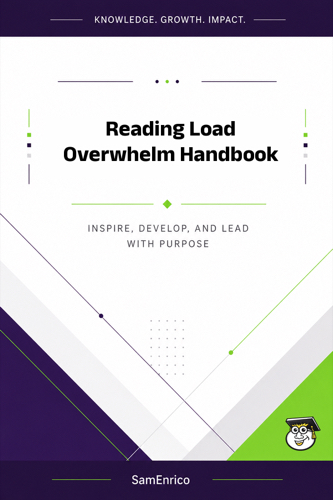
Non-FictionSelf-HelpReading ComprehensionStudy Skills
Reading Load Overwhelm Handbook eBook
Speed read, skim, and prioritize hundreds of pages
Speed read, skim, and prioritize hundreds of pages weekly without drowning in texts.
Formats
Free sample
Chapter 1: The 847 Unread Emails--–- The first time I saw a grown professional cry over text was not in a novel or a movie. It was in a glass-walled conference room on the forty-seventh floor of a Manhattan law firm, and the person crying was a fifty-three-year-old partner who billed $1,800 per hour. He had just opened his email inbox after a three-day deposition. The number on the screen was 847. He did not weep out of sadness.
He wept out of shame. "I used to be good at this," he whispered, scrolling past messages he would never open. "I used to be able to read everything."That moment stayed with me longer than any legal argument or business strategy I had ever witnessed. Because the partner was not stupid. He was not lazy.
He was not disorganized. He was simply drowning in text that had arrived faster than any human could possibly process. And the cruelest part of his suffering was that he blamed himself. He believed that somewhere, hidden beneath those 847 unopened messages, there was a version of himself who could have kept up if only he had tried harder, read faster, or sacrificed more sleep.This belief is a lie. And this book exists to prove it to you.The Problem You Did Not Create Let us begin with a confession that most productivity books are too proud to make: the amount of obligation reading required in modern knowledge work has grown at a rate that far exceeds any plausible improvement in human reading speed.
Consider the numbers. In 1985, the average white-collar professional received approximately twelve to fifteen text-based communications per day—memos, letters, internal reports, and perhaps a single fax. By 2005, the dawn of widespread email adoption, that number had climbed to sixty to eighty messages daily, plus attachments, plus web-based research. By 2024, according to data from the Radicati Group and Mc Kinsey, the average knowledge worker receives 120 to 150 emails per day, consumes the equivalent of 50 to 100 pages of text-based information (reports, Slack threads, PDFs, news alerts, internal wikis), and spends between 28 and 35 percent of their workweek just reading.That is between eleven and fourteen hours per week. For reading alone.
Before any analysis, decision-making, or creative work.Now add the psychological toll. Every unread message becomes a tiny debt. Every PDF left unopened accrues interest in the form of guilt. Every book on your nightstand that you swore you would finish becomes evidence of your inadequacy. The sheer weight of all this unprocessed text produces a phenomenon that psychologists at the University of California, Irvine have labeled "information fatigue syndrome"—a documented condition characterized by reduced attention span, impaired decision-making, and, in severe cases, physical symptoms including tension headaches and sleep disruption.You did not create this problem.
The problem was created for you by technology that eliminated all natural friction from text distribution. Fifty years ago, if someone wanted you to read something, they had to print it, fold it, stuff it in an envelope, affix a stamp, and wait two days for the postal service to deliver it. That friction meant that only truly important text survived the journey to your desk. Today, anyone with an internet connection can deposit an unlimited amount of text into your attention stream at zero cost and zero delay. The result is not a reading problem.
The result is a tragedy of the commons where your attention is the common resource, and everyone is grazing on it for free.The Two Kinds of Reading (And Why You Must Separate Them)Before we can solve the problem, we have to name it with precision. Most people believe that all reading is essentially the same activity—just moving your eyes across words, extracting meaning, moving on. This is wrong. Dangerous, even. Because it leads you to apply the same strategies to fundamentally different tasks.There are exactly two kinds of reading that matter for the purposes of this book.
The first is Recreational Reading. This is reading you choose to do for pleasure, curiosity, or personal enrichment. It includes novels, poetry, long-form journalism you actively want to read, memoirs, history books purchased with your own money, and any text you would continue reading even if no one was paying you or grading you. Recreational reading is slow, immersive, and voluntary. You re-read beautiful sentences.
You pause to think. You fall asleep with the book on your chest. Recreational reading does not cause overwhelm because you can always stop. There is no deadline. There is no boss.
There is no shame.The second kind is Obligation Reading. This is reading required by someone else—your employer, your professor, your client, your regulator, your professional association. It includes work reports, academic papers, legal documents, compliance manuals, email threads you are cc'd on, Slack messages from your manager, performance reviews, technical specifications, and any text that arrives with an implicit or explicit demand for your attention. Obligation reading is the source of overwhelm. It arrives whether you want it or not.
It accumulates overnight. It does not care if you are tired, busy, or already drowning.This book is about Obligation Reading only. If you never had to read anything for work, school, or professional obligation, you would not need this book. You could read at your natural pace, abandon books halfway through, and never feel a moment of guilt. But you do have obligations.
And those obligations produce text at a rate that will crush you unless you learn to read differently.Here is the radical claim that separates this book from every other speed-reading guide on the market: You do not need to read more. You need to read less. Much less.Every other book tells you that the solution to reading overwhelm is to increase your reading speed. Learn to read at 600 words per minute. Learn to scan faster.
Learn to process more text in less time. This advice is not merely unhelpful. It is actively harmful. Because if you double your reading speed but the volume of text arriving on your desk triples, you are still losing ground. The only sustainable solution is to reduce the amount of text you consume.
To discard the vast majority of obligation reading before it ever touches your eyeballs. To become ruthless about what deserves your attention.The 80/20 Principle Applied to Text In 1906, the Italian economist Vilfredo Pareto observed that 80 percent of the land in Italy was owned by 20 percent of the population. Over time, this observation generalized into the Pareto Principle, also known as the 80/20 Rule: for many outcomes, roughly 80 percent of the effects come from 20 percent of the causes. Twenty percent of your customers generate 80 percent of your revenue. Twenty percent of your tasks produce 80 percent of your results.
Twenty percent of your wardrobe gets 80 percent of the wear.This principle applies brutally to obligation reading. In virtually every text longer than a few pages—reports, books, academic papers, legal briefs, strategy documents—approximately 80 percent of the value is contained in 20 percent of the pages. The remaining 80 percent of pages contain examples, tangential arguments, background information, repetition, polite filler, and material included primarily to meet page-count requirements or to make the…
This is the end of the free sample. Get the eBook to keep going. Buy now
About this book
Details
- Author
- Dobbs Kanisha
- Publisher
- SamEnrico
- Language
- English
- Genre
- Non-Fiction, Self-Help, Reading Comprehension, Study Skills
- Released
- 2026-06-09
- Pages (approx.)
- 143
- Available as
- eBook, Audiobook

Read better in the ZLOADR app
Your eBooks on your phone or tablet. Sign in with your SamEnrico account and start reading.
More by Dobbs Kanisha
 Rub al Khali Solo CrossingDobbs Kanisha$11.99
 Construction Dust Lung ProtectionDobbs Kanisha$11.99
 Antwerp Heist Notarbartolo EscapeDobbs Kanisha$11.99
 Stress and Dry Mouth ConnectionDobbs Kanisha$11.99
 Iron Hands of the Silk Road: The Forgotten Automata of the Han DynastyDobbs Kanisha$11.99
 The Forgotten Canopy: Nongao’s Rainforest RevelationsDobbs Kanisha$11.99
 Snow Plow Operation (Vehicle Attachment)Dobbs Kanisha$11.99
 How to Become a Mva-reactor OperatorDobbs Kanisha$11.99
 Remote Team Building After ConflictDobbs Kanisha$12.99
 Pre Seed Term Sheet WorkbookDobbs Kanisha$12.99
 Understanding Fetal Diethylstilbestrol SyndromeDobbs Kanisha$17.99
You may also like
 Hong Kong Handover 1997Dunn Johnnie$11.99
 Zumba For Postnatal Recovery CourseNeal Christian$11.99
 Zumba for BeginnersLadner Nikia$11.99
 YouTube Comment Mining GuideHumes Pandora$12.99
 Worry Box MeditationCarlin Rudy$11.99
 Workplace Stress MeditationNguyen Lynn$11.99
 Workplace Stress and Sleep RepairHawley Ivory$11.99
 Workplace Perfectionism CureDelaney Jeffry$11.99
 Workplace Injustice Anger GuideWallen Isabelle$11.99
 Work Addiction and Burnout LinkGreenwood Ester$11.99
 Women in Yoga and WellnessBeattie Galina$11.99
 Women in Stand Up ComedyChun Evangeline$11.99