
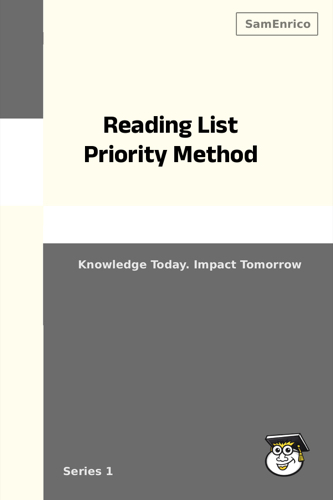
Reading List Priority Method eBook
Rank books and articles using importance for profe
Rank books and articles using importance for professional or personal growth.
Formats
Free sample
Chapter 1: The One Question...--The moment you decide to open this book, you are likely staring at a stack of unread books, a browser tab with seventeen saved articles, and a growing sense of guilt that you are falling behind. That guilt is not a sign of laziness. It is a sign that you have been operating without a filter.Let me ask you something. If I handed you a thousand books and told you that only three of them contained the exact knowledge you need to solve your most pressing professional problem right now, would you read them all? Of course not.
You would find a way to identify those three. You would ask an expert. You would scan for keywords. You would do whatever it took to avoid wasting weeks on the other nine hundred and ninety-seven.And yet, that is precisely what most readers do every single day. They accumulate.
They hoard. They tell themselves that someday they will get to that book on negotiation, that article on productivity, that biography of a great leader. But someday never comes because someday is not a strategy. The absence of a filter guarantees that everything remains equally important, which means nothing is important at all.This chapter introduces the single most powerful filter in the Reading List Priority Method. It is not a complicated spreadsheet.
It is not a proprietary algorithm. It is a single question. And until you answer it with brutal honesty, no book, no article, and no piece of content deserves a single minute of your attention.The Curse of the Generalist Reader Before we build the filter, we must understand the disease. The disease is what I call Generalist Reading Syndrome. It manifests as the belief that being well-read means being broadly read across many topics.
The generalist reader picks up a book on marketing, then a book on Stoic philosophy, then a memoir by a CEO, then a newsletter on artificial intelligence, then a guide to public speaking. Each of these seems valuable in isolation. But together, they form a fragmented, incoherent mess that produces no measurable progress in any single direction.Drawing from Gary Keller’s The One Thing, we recognize that extraordinary results come from narrowing your focus, not broadening it. Keller famously asked: “What is the one thing you can do such that by doing it everything else will be easier or unnecessary?” That question is uncomfortable because it forces you to choose. And choosing means abandoning the comforting illusion that you can do everything.The same principle applies to reading.
You cannot read the twenty best books on twenty different topics and expect to see meaningful growth in any of them. You can read three books on one topic, apply what you learn, and transform your career. But that requires a level of discipline that the generalist reader lacks.Simon Sinek, in Start With Why, taught us that people do not buy what you do; they buy why you do it. The same is true for reading. You do not read a book because of what it is.
You read a book because of why it serves your current purpose. Without a clear why, every book becomes a temptation rather than a tool.The Current Critical Challenge Defined Let me introduce the central concept of this book. I call it the Current Critical Challenge, or CCC for short. The CCC is a single, specific, time-bound problem that sits at the center of your professional or personal growth for the next ninety days.Notice the four components of that definition. First, it is a single problem.
Not two problems. Not three. One. Second, it is specific. Vague problems produce vague reading lists.
Third, it is time-bound. Open-ended challenges drift indefinitely. Fourth, it is critical. Not nice to have. Not interesting.
Critical.Here are examples of real CCCs from readers I have worked with:“I need to negotiate a twenty percent raise in my upcoming review, which is scheduled for ninety days from today.”“I must learn to manage a remote team of five people without burning out or losing productivity, and I have sixty days to establish a system before our next project launch.”“I need to overcome the procrastination that has delayed my book draft by six months, and I want to complete the first draft within ninety days.”“I have to deliver a keynote speech at an industry conference in forty-five days, and I have never spoken to more than twenty people at once.”Notice what each of these has in common. They are painful. They are specific. They have a deadline. And they cannot be solved by reading a single article or watching a You Tube video.
They require sustained, focused learning.Now contrast those with the kind of vague aspirations that most people mistake for priorities:“I want to be more productive.”“I want to learn about leadership.”“I should read more books.”These are not CCCs. They are fantasies. They have no deadline, no specific outcome, and no way to measure success. And because they lack specificity, they produce reading lists that are equally vague. You end up with a stack of books on productivity, leadership, and self-improvement, none of which directly address the actual problem you are avoiding.Why Ninety Days?You might wonder why the CCC is anchored to a ninety-day horizon.
The answer comes from research on goal setting and organizational behavior. Ninety days is long enough to make meaningful progress on a complex challenge, but short enough to create healthy urgency.A thirty-day window often forces superficial solutions. You cannot learn a new skill or change a behavioral pattern in thirty days. A one-year window, by contrast, invites procrastination. Ninety days is the sweet spot.
It is the horizon used by agile teams, startup accelerators, and executive coaching programs for exactly this reason.Furthermore, the ninety-day cycle forces you to regularly re-evaluate your priorities. What matters in January may not matter in April. Your CCC should change with your circumstances. That is not a failure of the system. That is the system working exactly as designed.
We will revisit this in Chapter Eleven when we discuss the Quarterly Audit.The CCC as a Filter Once you have articulated your CCC, it becomes a lens through which every potential book and article must pass. The question is simple: Does this material directly help me solve my Current Critical Challenge?Notice the word directly. This is where most readers fail. They allow indirect relevance to sneak in. A book on Stoic philosophy might be indirectly relevant to leadership, but if your CCC is negotiating a raise, Stoicism is a distraction.
A newsletter on industry trends might be interesting, but if your CCC is managing a remote team, that newsletter is stealing time from the one book that actually contains the answer.The filter has three possible outcomes:Yes. The material directly addresses your CCC. It goes onto the Priority List for further screening in later chapters.Maybe or Eventually. This is the danger zone. Most readers put these items on a “someday” list.
As we will see in Chapter Four, the “someday” list is where books go to die slowly. If a book…
This is the end of the free sample. Get the eBook to keep going. Buy now
About this book
Details
- Author
- Fitzpatrick Merrilee
- Publisher
- SamEnrico
- Language
- English
- Genre
- Non-Fiction, Self-Help, Reading, Learning
- Released
- 2026-06-08
- Pages (approx.)
- 126
- Available as
- eBook, Audiobook

Read better in the ZLOADR app
Your eBooks on your phone or tablet. Sign in with your SamEnrico account and start reading.
More by Fitzpatrick Merrilee
 Senior Grandparent Self Esteem GuideFitzpatrick Merrilee$11.99
 Networking ScorecardFitzpatrick Merrilee$11.99
 Hair Loss Due to Anabolic SteroidsFitzpatrick Merrilee$11.99
 Dark Souls Death Loop FixFitzpatrick Merrilee$11.99
 The Crown’s Wild Child: How Prince Harry’s Vegas Night Almost Toppled the MonarchyFitzpatrick Merrilee$11.99
 Serpentine Group MiningFitzpatrick Merrilee$11.99
 Understanding Mental Retardation Mietens–Weber TypeFitzpatrick Merrilee$17.99
 Promotion Business Case Review ProcessFitzpatrick Merrilee$12.99
 World Bank Social Protection CareersFitzpatrick Merrilee$12.99
 How to Become a Sponge BufferFitzpatrick Merrilee$11.99