
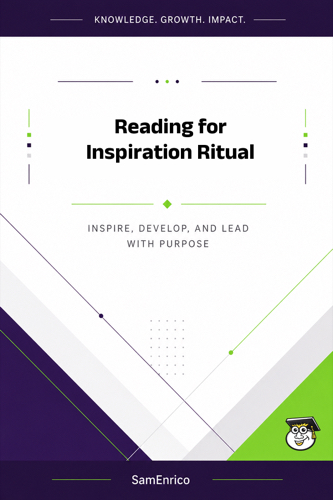
Non-FictionSelf-HelpReading Habits
Reading for Inspiration Ritual eBook
Feed your creativity with daily reading from diver
Feed your creativity with daily reading from diverse sources using this guide.
Formats
Free sample
Chapter 1: The Reader's Lie--–- You have forty-seven unread books on your nightstand. You feel guilty about every single one of them. You tell yourself you will get back to them next weekend, or during vacation, or when life finally slows down. But the pile grows. The guilt grows.
And somewhere underneath all that guilt, you have stopped believing that reading can actually change anything about your creative life.This is the Reader's Lie. It is not that you do not read enough. It is that you have been taught to measure yourself by the wrong metric entirely. You have been told that finishing books is the goal, that speed is a virtue, that a well-read person is someone who has accumulated a long list of completed titles. And because you cannot keep up—because no one can keep up with the fire hose of information, the stack of recommendations, the queue of "should reads"—you have concluded that you are failing at reading.But what if finishing books has nothing to do with it?What if the most creatively productive readers in history were not the ones who finished the most books, but the ones who asked the best questions of the books they actually opened?This chapter exists to dismantle the Reader's Lie and replace it with something far more useful: the recognition that you are not a passive recipient of words.
You are an active creator who uses the raw material of text to generate something new. The same book can be entertainment or fuel—depending entirely on the posture you bring to it. A novel read to escape becomes a different book than that same novel read to study character motivation, narrative structure, or emotional pacing. You do not need to read more. You need to read differently.The Cultural Script That Failed You Let us name the enemy clearly.
From elementary school onward, you were handed a cultural script about reading that goes something like this: Good readers finish books. Great readers finish many books. The best readers devour books quickly and remember everything. Reading is a race, and the finish line is the back cover.This script is everywhere. Book clubs shame you if you have not completed the monthly selection.
Social media overflows with "my year in books" posts where the number is the status symbol. The phrase "I could not finish it" is delivered as a confession of failure, not a statement of discernment. Even the language we use—"devouring," "plowing through," "making a dent"—suggests reading is a battle against the page, and the page is winning.The script has a hidden cost. When you measure yourself by completion, you optimize for speed over depth, for coverage over curiosity, for the satisfaction of closing a cover over the messy, generative work of staying open to what a book might become in your hands. You become a finisher, not a creator.
And finishing, as it turns out, is dramatically overrated.Consider this: The average CEO reads four to five books per month. The average American reads twelve books per year. The average creative professional—writer, designer, artist, entrepreneur—reads somewhere in between. But when researchers have looked at the reading habits of highly original thinkers, a strange pattern emerges. They do not finish most of the books they start.
They skim. They skip. They abandon. They read the first chapter of ten books and the last chapter of five. They treat books as raw material, not as tests of endurance.This is not laziness.
It is strategy.The Posture of the Creative Reader The difference between a passive reader and a creative reader is not speed, memory, or even intelligence. It is posture. Posture is the internal orientation you bring to the act of reading—the set of questions you are asking, the attitude you are holding, the relationship you are establishing with the text.A passive reader sits beneath the author. The author speaks; the reader listens. The author knows; the reader learns.
The relationship is hierarchical, and the reader's job is to absorb, remember, and comply. This posture produces consumption, not creation. It is useful for studying for a test or following instructions. It is useless for generating original ideas.A creative reader sits across from the author. The relationship is conversational, even confrontational.
The author proposes; the reader responds. The author offers; the reader takes, transforms, and extends. The creative reader asks different questions entirely: not "What is this telling me?" but "What can I make with this?" Not "Is this correct?" but "What happens if I believe this for an hour?" Not "How do I remember this?" but "How do I use this right now?"This shift in posture changes everything. Neuroimaging studies have shown that when readers approach a text with a creative intention—with the goal of generating new ideas rather than simply absorbing information—different neural networks activate. The default mode network, associated with mind-wandering and creative connection-making, lights up.
The central executive network, associated with focused attention and task completion, takes a back seat. You are not just reading differently. You are thinking differently. Your brain is literally firing along different pathways.The creative reading posture has three core attitudes, each of which can be cultivated with practice.Curiosity is the first attitude. Curiosity seeks what surprises you, not what confirms what you already believe.
The passive reader reads to validate; the creative reader reads to be disrupted. When you encounter a sentence that makes you uncomfortable or an idea that contradicts your worldview, the passive reader flinches and moves on. The creative reader leans in and asks, "What if this is true? What would that break? What would that make possible?"Abundance is the second attitude.
Abundance is the belief that there is enough inspiration for everyone—that you are not stealing from a finite pool when you take an idea and transform it. Passive readers hoard information. They worry about plagiarism, about getting it right, about giving proper credit. Creative readers know that ideas multiply when shared. They take, they combine, they transform, and they give back something new.
There is no scarcity of inspiration. There is only scarcity of attention.Generosity is the third attitude. Generosity is the assumption that the author has something to offer you, even if you disagree with them, even if you dislike their style, even if you would never recommend their book to a friend. The passive reader dismisses authors who do not align with their tastes. The creative reader asks, "What can this author teach me that no one else can?" You do not have to agree with a book to learn from it.
You only have to be generous enough to look for the gift it contains.These three attitudes—curiosity, abundance, generosity—are not personality traits you either have or lack. They are muscles. They atrophy when unused and strengthen when exercised. And they are exercised every single time you open a book and choose, deliberately, to read as a creator rather than a consumer.The Reader's Mirror: A Self-Assessment Before you can change how you read, you need to know how you currently read. The Reader's…
This is the end of the free sample. Get the eBook to keep going. Buy now
About this book
Details
- Author
- Wakefield Belle
- Publisher
- SamEnrico
- Language
- English
- Genre
- Non-Fiction, Self-Help, Reading Habits
- Released
- 2026-06-07
- Pages (approx.)
- 122
- Available as
- eBook, Audiobook

Read better in the ZLOADR app
Your eBooks on your phone or tablet. Sign in with your SamEnrico account and start reading.
More by Wakefield Belle
 Meeting Participation Self EsteemWakefield Belle$11.99
 AA Preamble and TraditionsWakefield Belle$11.99
 Emotional Intelligence for AthletesWakefield Belle$11.99
 Chiropractic for AthletesWakefield Belle$11.99
 The Life of Hillel the ElderWakefield Belle$11.99
 Recurring Dreams of SnakesWakefield Belle$11.99
 The Latin America Growth OutlookWakefield Belle$11.99
 Trance For NegotiationWakefield Belle$11.99
 The Turkana Boy: A Fossil That Rewrote Human HistoryWakefield Belle$11.99
 Embers of the Big Burn: How 1910 Forged America’s Firefighting FutureWakefield Belle$11.99
 The Bear Trap: The Soviet-Afghan War's Hidden Graveyard (1979-1989)Wakefield Belle$11.99
 The Mineral Guide to TurquoiseWakefield Belle$11.99
You may also like
 Hong Kong Handover 1997Dunn Johnnie$11.99
 Zumba For Postnatal Recovery CourseNeal Christian$11.99
 Zumba for BeginnersLadner Nikia$11.99
 YouTube Comment Mining GuideHumes Pandora$12.99
 Worry Box MeditationCarlin Rudy$11.99
 Workplace Stress MeditationNguyen Lynn$11.99
 Workplace Stress and Sleep RepairHawley Ivory$11.99
 Workplace Perfectionism CureDelaney Jeffry$11.99
 Workplace Injustice Anger GuideWallen Isabelle$11.99
 Work Addiction and Burnout LinkGreenwood Ester$11.99
 Women in Yoga and WellnessBeattie Galina$11.99
 Women in Stand Up ComedyChun Evangeline$11.99