
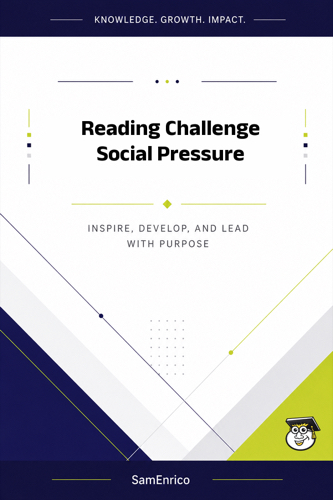
Reading Challenge Social Pressure eBook
Stop feeling inadequate about your reading pace co
Stop feeling inadequate about your reading pace compared to bookstagrammers.
Formats
Free sample
Chapter 1: The Curated Trap--You open Instagram. The screen glows. There it is—a perfectly flat composition of ten newly released hardcovers, their spines aligned like soldiers, a speckled ceramic mug steaming on the side, a cream-colored blanket cascading artfully into the frame, and a single dried eucalyptus sprig for texture. The caption reads: “Finished all these in a week! Which one should I read next?
#Book Haul #Reading Rush #Bookstagram.”Your stomach drops. Not a dramatic, movie-style drop. A quiet one. The kind you feel in your chest before you even name it. You haven’t finished one book this month.
You are still on page 147 of a novel you started six weeks ago. You liked that novel—genuinely liked it—but now, looking at this stranger’s ten-book week, your page 147 feels like a confession of failure.You scroll. Another post: a reader posing with a stack of classics, War and Peace visible at the bottom. “Tackled this in a weekend! #Never Said It Was Easy.” Another: a beautifully lit shelf with the caption “My TBR pile is out of control (50 books!) but I’ll finish them by December.” Another: a “yearly goal” tracker showing 87 books read since January.
It is only June.You put your phone down. You do not open your current book. Instead, you scroll again. And then again. And somewhere in that loop, you think: What is wrong with me?This is the curated trap.The Problem That Has No Name (But Now It Does)Let us name it.
Call it curated anxiety—the specific, socially manufactured fear that your reading life is inadequate because it does not photograph well. Not because you are not learning. Not because you are not enjoying yourself. Not because you are not growing. But because it does not look good on a screen.Curated anxiety is different from ordinary ambition.
Ambition says, “I want to read more because I love stories.” Curated anxiety says, “I need to read more because everyone else seems to be.” One comes from inside; the other is injected from the outside. One expands you; the other contracts you.And here is the thing about curated anxiety that makes it so pernicious: it does not announce itself as anxiety. It announces itself as motivation. “Look at all these inspiring readers!” the algorithm seems to say. “Don’t you want to be like them?” But somewhere between inspiration and envy, a switch flips.
You stop feeling energized by someone else’s passion and start feeling diminished by their highlight reel.This chapter is going to help you see that switch. And then, more importantly, it is going to help you decide which side of it you want to live on.Why Your Stomach Dropped (The Science of Social Comparison)Let us get honest about what happened when you saw that ten-book haul. Your stomach dropped not because you are weak or jealous or small. Your stomach dropped because your brain is wired for social comparison. That wiring kept your ancestors alive—knowing whether you were keeping up with the tribe was a matter of life and death.
But in the context of Bookstagram, it is a liability.Psychologists call this upward social comparison—measuring yourself against someone you perceive as better than you in a specific domain. And here is the cruel trick: upward social comparison is most damaging when the comparison domain is something you care about deeply. If you did not care about reading, you would scroll past that ten-book haul without a flicker of feeling. But you do care. That is why it hurts.Research on social media and reading behavior confirms what you already feel in your body.
A 2019 study published in the Journal of Media Psychology found that participation in book-centric social media communities was statistically linked to increased stress around reading quantity and speed—not reading enjoyment, not reading comprehension, but quantity and speed. The platforms reward volume and visual perfection. They do not reward sitting with a difficult passage for twenty minutes. They do not reward rereading a sentence because it was beautiful. They do not reward the quiet, private, unphotographable act of having your mind changed by a paragraph.The platform is not evil.
It is simply optimized for something other than your flourishing. The algorithm is not a villain; it is a machine that has learned that you scroll longer when you feel slightly inadequate. That is not malice. That is math. But the math is not on your side, and it is time to admit that.Inspiration vs.
Envy: The Crucial Distinction Not all comparison is toxic. Some of it is how we learn, grow, and discover new things. The distinction between healthy and unhealthy comparison is the difference between inspiration and envy. They feel similar in the body, but they lead to completely different places.Inspiration feels like: “Oh, that’s amazing. I want to try something like that.
I feel energized by their passion.” Inspiration expands your sense of possibility. You close the app and pick up your own book—not because you feel behind, but because you feel excited.Envy feels like: “Why can’t I do that? What’s wrong with me? I’ll never catch up.” Envy contracts your sense of self. You close the app and do not pick up your book—because now your book is associated with inadequacy, not pleasure.Here is the challenge: the same post can trigger inspiration in one person and envy in another.
The difference is not in the content; it is in your current state of vulnerability. If you are already tired, stressed, or doubting yourself, even a well-intentioned post can land as a blow. If you are grounded and secure, the same post might genuinely motivate you.This book cannot change the algorithm. But it can help you become more aware of which state you are in before you scroll. And that awareness is the first step toward breaking the curated trap.The Perfect Reader Does Not Exist Let us say something radical.
Something that might feel uncomfortable but needs to be said.The “perfect reader” on your feed does not exist.What you are seeing is a carefully constructed aesthetic. It excludes the dog-eared pages. It excludes the books abandoned after fifty pages because they were boring or badly written or simply not right for that moment in your life. It excludes the weeks when life got in the way—when a child was sick, a deadline loomed, a relationship ended, or you were simply too tired to hold a book open. It excludes the truth that many high-volume readers are skimming, not absorbing.
It excludes the secret that some of those “I finished this in two days” posts are exaggerations, strategic omissions, or outright fabrications.Does that mean everyone on Bookstagram is lying? No. Many are genuine. Some genuinely read very quickly. Some have jobs, lifestyles, or sleep schedules that allow for massive reading volume.
Some are retired. Some have no children. Some have finished their graduate degrees and are finally reading for pleasure. Some are in seasons of life that you are not in, and that is fine.But here…
This is the end of the free sample. Get the eBook to keep going. Buy now
About this book
Details
- Author
- Medina Reginald
- Publisher
- SamEnrico
- Language
- English
- Genre
- Non-Fiction, Self-Help, Reader Mental Health
- Released
- 2026-06-12
- Pages (approx.)
- 143
- Available as
- eBook, Audiobook

Read better in the ZLOADR app
Your eBooks on your phone or tablet. Sign in with your SamEnrico account and start reading.
More by Medina Reginald
 Transcendental Meditation for CouplesMedina Reginald$11.99
 Lunch Break BreathMedina Reginald$11.99
 Heavy Metal Detox Lifestyle GuideMedina Reginald$11.99
 Bipolar Disorder CourseMedina Reginald$11.99
 Laser Resurfacing Age Spot ManualMedina Reginald$11.99
 Pet Dander Exposure ReductionMedina Reginald$11.99
 Osteoarthritis Weight Loss GuideMedina Reginald$11.99
 Hope and Meaning RebuildingMedina Reginald$11.99
 The Whistling Tunnels: Echoes of the Centralia Mine FireMedina Reginald$11.99
 The Laughing Man: The Untold Horror of John Wayne Gacy’s Carnival of DeathMedina Reginald$11.99
 The Hippocratic Oath: Ancient Greece's Medical RevolutionMedina Reginald$11.99
 How to Start a Hobby in Collecting CoinsMedina Reginald$11.99