
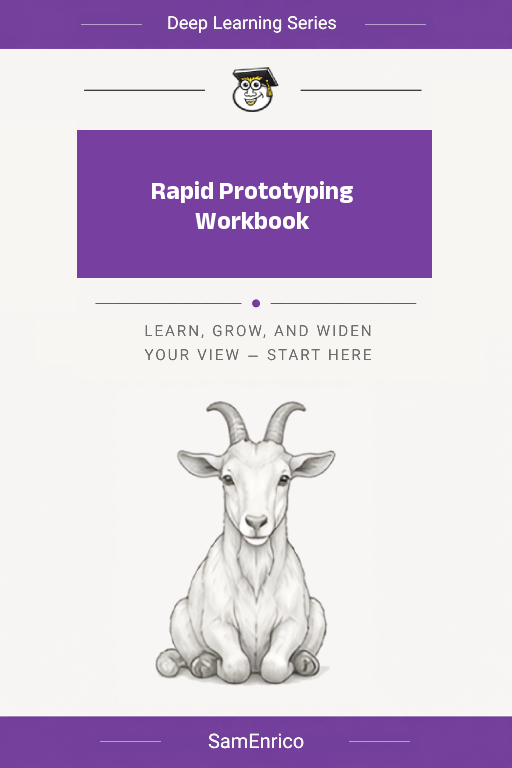
Non-FictionStartup GuideRapid Prototyping
Rapid Prototyping Workbook eBook
Iterate from idea to testable MVP in under two wee
Iterate from idea to testable MVP in under two weeks using Bubble for web and FlutterFlow for mobile with user feedback loops and version control basics.
Formats
Free sample
Chapter 1: The Speed Trap--Most people think their big idea fails because they can’t build it. They spend months learning to code, hiring developers, or saving for a technical co-founder. Then, when the product finally launches, nobody uses it. The founder feels betrayed. The developers feel blamed.
The money feels wasted.But here is the truth that separates successful rapid prototypers from everyone else: your idea almost never fails because you built it poorly. It fails because you built the wrong thing, and you spent too long discovering that fact.I have watched hundreds of founders, product managers, and solo creators fall into this trap. They spend three months building a polished, feature-rich application. They test it meticulously. They fix every bug they can find.
Then they release it to the world, and the world responds with a collective shrug. Five users sign up. Two of them never return. One complains about a missing feature that was never part of the plan. And the founder says, “If only I had built it better.”No.
If only you had tested it sooner.Welcome to the two-week MVP. This chapter rewires how you think about speed, quality, and learning. By the time you finish these pages, you will understand why iteration velocity is your only competitive advantage in 2025, why “done is better than perfect” requires a critical distinction most books ignore, and how to distinguish between functional bugs that generate learning and blocking bugs that destroy trust. You will also learn the Three Gates framework that every feature must pass before you invest a single hour of build time.Let me start with a story.The Six-Month Mistake A few years ago, a founder came to me with an idea for a mobile app that connected freelance photographers with local businesses. He had raised fifty thousand dollars from friends and family.
He had hired a development agency. Six months later, the agency delivered a beautiful application with profile pages, messaging, booking calendars, payment processing, and a review system. It was, by every technical measure, a success.The founder launched with great fanfare. He posted on Product Hunt, Linked In, and every photography forum he could find. Seventy-three people downloaded the app in the first week.
Forty-two created accounts. Eleven posted their photography services. Zero businesses booked a single photographer through the platform.The founder was devastated. He blamed the agency. He blamed the marketing.
He blamed the timing. But when I looked at his analytics, the problem was obvious: the businesses he wanted to reach never saw the app because they were not searching for freelance photographers on a new platform. They were posting requests on Facebook groups and Craigslist. The founder had built a solution for a problem that did not exist, and he had spent six months and fifty thousand dollars learning that lesson.If he had built a two-week MVP, here is what he would have learned for free: create a shared Google Sheet with three columns—photographer name, hourly rate, and availability. Post that spreadsheet link in five Facebook groups.
See if any business owners clicked it. See if any added their name. That spreadsheet would have taken two hours to build. It would have generated the same learning as the six-month app, but it would have cost almost nothing and preserved his runway for the next idea.That is the power of speed. That is the promise of this book.Why Speed Wins in 2025The no-code revolution has changed the economics of building software.
Five years ago, creating a functional web application required a team of engineers, weeks of development, and thousands of dollars. Today, one person with no coding experience can build the same application in days using Bubble, Flutter Flow, or any of the dozens of no-code tools that have emerged.But here is what most people miss: when the cost of building something drops, the value of building the right thing increases. If everyone can build an app in two weeks, your only advantage is building the app that people actually want. And the only way to know what people want is to test your assumptions quickly and repeatedly.This is what I call iteration velocity: how fast you can take an idea, turn it into a testable prototype, gather feedback from real users, and change direction based on what you learn. In 2025, iteration velocity is the only competitive advantage that matters.Think about it this way.
You have two competing teams. Team A spends three months building a feature-complete product based on their initial assumptions. Team B spends two weeks building a scrappy prototype, tests it with five users, learns that their pricing model is wrong, spends another week adjusting, tests again, and finally launches after six weeks. Team B has run three complete learning cycles in the time Team A ran one. Team B has validated (or invalidated) three sets of assumptions.
Team B knows more about what users actually want, even if their code is messier and their design is uglier.Which team would you bet on?The Done Is Better Than Perfect Distinction You have heard the mantra before: “Done is better than perfect.” It appears on inspirational posters, startup blogs, and Linked In posts. But taken literally, this advice is dangerous. Shipping a completely broken product does not generate learning; it generates frustration, bad reviews, and lost trust.The critical distinction is between functional bugs and blocking bugs.Functional bugs are imperfections that do not prevent the user from completing their core task. A slow-loading page is a functional bug. An ugly button color is a functional bug.
Awkward wording in an error message is a functional bug. These bugs generate valuable feedback because users will tell you they are annoying, but they will still be able to test your core hypothesis. You can ship functional bugs freely.Blocking bugs are failures that prevent the user from completing their core task. A checkout button that does nothing is a blocking bug. A login flow that crashes is a blocking bug.
A data loss event that deletes a user’s work is a blocking bug. A raw error code like “404” or “Type Error: null” that confuses and alienates the user is a blocking bug. You must never ship blocking bugs. They destroy trust, end testing sessions prematurely, and contaminate your feedback with frustration rather than insight.Throughout this book, you will ship functional bugs. You will fix blocking bugs before they reach users.
This distinction is the difference between learning fast and losing users forever.Let me give you a concrete example. Imagine you are testing a food delivery app. The functional bugs might include: the font is hard to read on mobile, the loading spinner takes two seconds to appear, and the confirmation email goes to spam. Users can still order food. They will complain about the font, but they will complete the order.
You learn that the core hypothesis—people want to order food from this restaurant—is valid.The blocking bugs would include: the checkout button does nothing when clicked, the app crashes when entering a credit card, or the order never arrives at the restaurant. Users cannot complete the…
This is the end of the free sample. Get the eBook to keep going. Buy now
About this book
Details
- Author
- Burchfield Robbi
- Publisher
- SamEnrico
- Language
- English
- Genre
- Non-Fiction, Startup Guide, Rapid Prototyping
- Released
- 2026-06-01
- Pages (approx.)
- 132
- Available as
- eBook, Audiobook

Read better in the ZLOADR app
Your eBooks on your phone or tablet. Sign in with your SamEnrico account and start reading.
More by Burchfield Robbi
 Bedtime Body Scan GuideBurchfield Robbi$11.99
 The Australian Outback BossBurchfield Robbi$11.99
 Antwerp Heist Belgian Police LeaksBurchfield Robbi$11.99
 Perimenopause Mood Swings GuideBurchfield Robbi$11.99
 Oil Rig Worker Stress GuideBurchfield Robbi$11.99
 The Last Olympian: The Untold Story of the 1904 Marathon That Changed Sports ForeverBurchfield Robbi$11.99
 The Frozen Cartographers: Mapping the Arctic’s Hidden Rivers (15th-16th Century)Burchfield Robbi$11.99
 How to Become a Disc JockeyBurchfield Robbi$11.99
 Remote Watercooler GuideBurchfield Robbi$12.99
 Understanding Fetal Prostaglandin SyndromeBurchfield Robbi$17.99
 Split Testing AnalystBurchfield Robbi$11.99
You may also like
 Hong Kong Handover 1997Dunn Johnnie$11.99
 Zumba For Postnatal Recovery CourseNeal Christian$11.99
 Zumba for BeginnersLadner Nikia$11.99
 YouTube Comment Mining GuideHumes Pandora$12.99
 Worry Box MeditationCarlin Rudy$11.99
 Workplace Stress MeditationNguyen Lynn$11.99
 Workplace Stress and Sleep RepairHawley Ivory$11.99
 Workplace Perfectionism CureDelaney Jeffry$11.99
 Workplace Injustice Anger GuideWallen Isabelle$11.99
 Work Addiction and Burnout LinkGreenwood Ester$11.99
 Women in Yoga and WellnessBeattie Galina$11.99
 Women in Stand Up ComedyChun Evangeline$11.99