
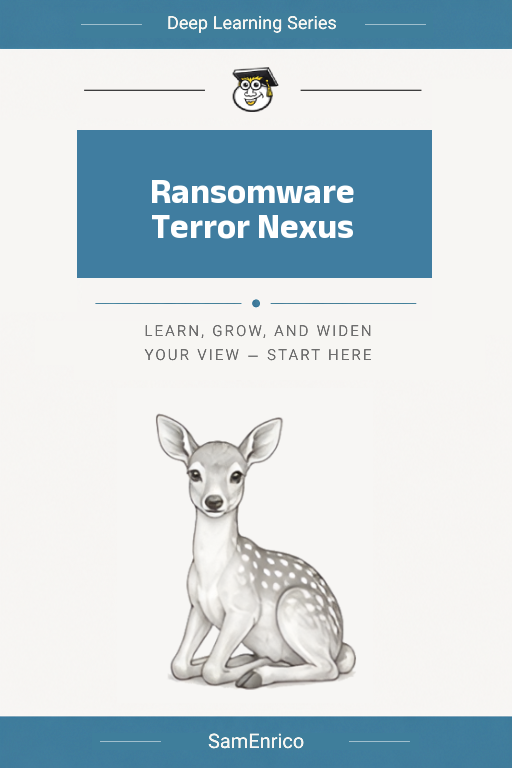
Non-FictionCrisis ManagementCyber
Ransomware Terror Nexus eBook
Respond to terrorist-related ransomware attacks th
Respond to terrorist-related ransomware attacks threatening employee data and safety. Backup systems, avoid paying, and coordinate with cyber security teams.
Formats
Free sample
Chapter 1: The Terror Test...--The message arrived at 2:14 AM on a Tuesday. Sarah Chen, the night shift IT director at Midwest Memorial Hospital, was reviewing log files when a Slack notification from an unknown user popped up. The display name read "AL-MUJAHID." The message was chillingly simple: "Your employee database is encrypted. We have home addresses for all 847 night shift staff. Pay 12 Bitcoin within 6 hours or we release addresses to our Telegram channel.
Our brothers are waiting." Sarah's first instinct was to dismiss it as a hoax. Then she tried to open the HR system. It was unresponsive. She tried the backup server. Also encrypted.
Then she checked her own employee record in a cached browser tab. Her home address, her children's school, and her personal cell number were all highlighted in red in a screenshot attached to the message. This was not a hoax. This was a terrorist ransomware attack, and the target was not the hospital's money — it was the safety of every person on the night shift.Welcome to the new asymmetric battlefield. Terrorist organizations have discovered that ransomware offers everything they once sought from bombs and hostages: fear, disruption, media attention, and deniable leverage — all without the risk of sending a fighter across a border.
But unlike traditional hostage-taking, where a single person is at risk, terrorist ransomware can hold hundreds or thousands of employees and their families hostage simultaneously, with no physical presence required. The attacker can be sitting in a café in a non-extradition country, sipping coffee while threatening to send armed individuals to your employees' homes unless you pay. And here is the brutal truth that most cybersecurity books will not tell you: the rules that apply to criminal ransomware do not apply here. You cannot negotiate. You cannot pay.
And if you have not prepared, you will be forced to make impossible choices in minutes, not days.This chapter is the gateway to the entire book. Before you can respond to a terrorist ransomware attack, you must first recognize one. The difference between criminal ransomware and terror-linked ransomware is not academic — it determines every subsequent action: whether you call the FBI immediately or handle it internally, whether you can consider paying (you cannot), whether you need to activate employee safety protocols, and whether the legal consequences of a wrong decision include federal charges for financing terrorism. By the end of this chapter, you will understand exactly how terrorist groups recruit cybercriminals, how they operationalize ransomware as a weapon of terror, and — most critically — you will be able to take the "Terror Test," a seven-question diagnostic that will tell you, with high confidence, whether you are facing criminals or terrorists. If you are a CEO, CISO, HR director, or security lead, this chapter may be the most important thirty minutes of reading you will ever do.The Convergence of Two Worlds For most of the past decade, ransomware was the province of profit-driven cybercriminals.
Groups like Conti, REvil, and Dark Side operated like underground businesses: they had HR departments, affiliate programs, customer support (yes, actual help desks for victims who paid), and even arbitration processes when disputes arose between affiliates. Their goal was simple: encrypt data, demand payment in cryptocurrency, provide a decryption key upon payment, and move to the next victim. They avoided targeting hospitals during the pandemic (for a while), they sometimes provided discounts to struggling small businesses, and they generally tried to maintain a reputation for "honorable" extortion — because their business model depended on victims believing that payment would actually work.Terrorist organizations, however, operate under a completely different logic. For groups like Hamas, Hezbollah, Islamic State (ISIS), and state-backed terror units from hostile nations, the goal is not profit — it is terror. Profit is a means to an end, not the end itself.
When a terrorist group seizes your employee data, they are not interested in a quiet transaction where everyone walks away. They are interested in fear, publicity, operational disruption, and the demonstration of power. They want your employees to know that their homes are known, their families are exposed, and their safety depends on the group's goodwill — a goodwill that, by definition, does not exist. Moreover, terrorist groups have no reputation to protect. They will leak your data whether you pay or not, because leaking data spreads fear, and spreading fear is the mission.The convergence began around 2020 when cybercriminals started offering Ransomware-as-a-Service (Raa S) on dark web forums that were already frequented by terrorist facilitators.
For a few hundred dollars in cryptocurrency, anyone could purchase a ransomware kit that included encryption tools, payment portals, and even negotiation scripts. Terrorist groups, always looking for cheap, high-impact, deniable weapons, recognized the opportunity immediately. Why send a fighter with a suicide vest when you can send an encrypted email that paralyzes a hundred-person company and terrorizes every employee simultaneously?The hospital case that opened this chapter is real — though the names and specific details have been changed to protect the victims. In that incident, the attackers were later traced to a group that had previously claimed responsibility for cyberattacks on behalf of a designated foreign terrorist organization. The hospital did not pay.
Instead, they called the FBI within forty-five minutes, isolated their safety networks, and coordinated with local police to provide extra patrols around the homes of every threatened employee. No one was physically harmed. But the psychological damage was severe: seven nurses resigned within a month, and the hospital spent over $800,000 on home security systems, credit monitoring, and trauma counseling. The attack cost the hospital nearly a million dollars — but paying would have cost them more, both legally and morally.Criminal vs. Terrorist: The Critical Distinctions To understand whether you are facing a criminal ransomware group or a terrorist-linked actor, you must examine four dimensions of the attack: motive, targeting, extortion method, and post-payment behavior.
These are not theoretical distinctions — they are operational indicators that should drive your response.Motive. Criminal ransomware groups want money. Their communications will focus on payment amounts, deadlines, and technical instructions for transferring cryptocurrency. They may threaten to leak data, but the threat is a negotiating tactic, not an ideological imperative. Terrorist groups, by contrast, often include political or religious language in their ransom notes.
They may demand not just money but also specific actions — shutting down a pipeline, canceling an event, releasing a prisoner, or making a public statement. If the ransom note includes phrases like "in the name of Allah," "free our brothers," or "stop the bombing of innocent Muslims," you are likely dealing with a terrorist nexus. Even without explicit language, if the demanded action goes beyond money, treat it as terrorism.Targeting. Criminal ransomware groups typically target any organization that can pay. They use broad scanning techniques to find vulnerabilities and do not usually care about the specific industry or employee base.
Terrorist groups, however, are strategic. They target organizations that amplify their message: hospitals (to maximize suffering and media attention), energy facilities (to cause cascading infrastructure failures), transportation hubs (to create chaos), or any organization with a large, easily terrorized employee base. If your organization has a symbolic value — a major hospital, a famous company, a government…
This is the end of the free sample. Get the eBook to keep going. Buy now
About this book
Details
- Author
- Chester Rusty
- Publisher
- SamEnrico
- Language
- English
- Genre
- Non-Fiction, Crisis Management, Cyber
- Released
- 2026-06-01
- Pages (approx.)
- 151
- Available as
- eBook, Audiobook

Read better in the ZLOADR app
Your eBooks on your phone or tablet. Sign in with your SamEnrico account and start reading.
More by Chester Rusty
 Combat Medic Stress RecoveryChester Rusty$11.99
 The Smell Of Mama's GardenChester Rusty$11.99
 Time Distortion InductionChester Rusty$11.99
 NVC For Dementia CareChester Rusty$11.99
 The Forbidden Manuscript: Chaucer’s Banned Book and the Birth of English LiteratureChester Rusty$11.99
 How to Become a Paint-brush MakerChester Rusty$11.99
 How to Produce a Big Green Egg SmokerChester Rusty$11.99
 Transplant CoordinationChester Rusty$11.99
You may also like
 Hong Kong Handover 1997Dunn Johnnie$11.99
 Zumba For Postnatal Recovery CourseNeal Christian$11.99
 Zumba for BeginnersLadner Nikia$11.99
 YouTube Comment Mining GuideHumes Pandora$12.99
 Worry Box MeditationCarlin Rudy$11.99
 Workplace Stress MeditationNguyen Lynn$11.99
 Workplace Stress and Sleep RepairHawley Ivory$11.99
 Workplace Perfectionism CureDelaney Jeffry$11.99
 Workplace Injustice Anger GuideWallen Isabelle$11.99
 Work Addiction and Burnout LinkGreenwood Ester$11.99
 Women in Yoga and WellnessBeattie Galina$11.99
 Women in Stand Up ComedyChun Evangeline$11.99