
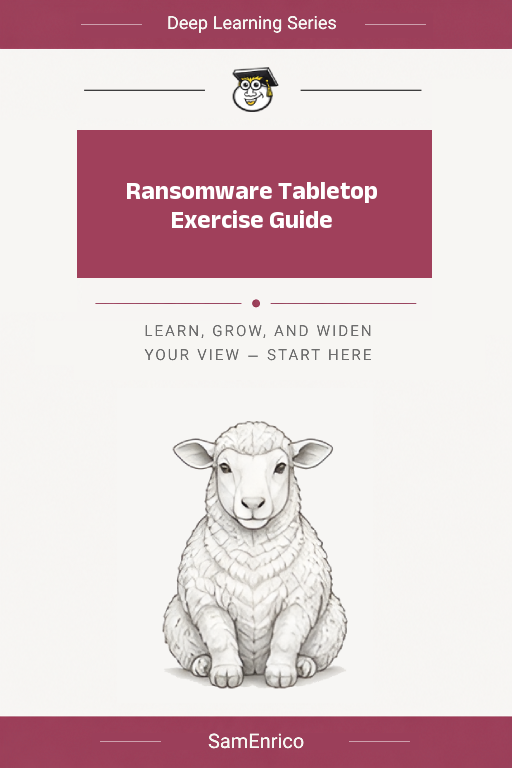
Ransomware Tabletop Exercise Guide eBook
Run mock ransomware scenarios with executive teams
by Mcarthur Hui
Run mock ransomware scenarios with executive teams annually, practicing negotiation decisions and recovery steps before real attacks strike.
Formats
Free sample
Chapter 1: The 2 AM Truth--The call always comes at 2 AM.Not at 10 AM when the CEO is fresh, the legal team is available, and the coffee is hot. At 2 AM, when judgment is foggy, the board is asleep, and the attacker has been waiting for this exact moment of vulnerability. The screen turns red. A text file appears on every monitor. The words are chillingly simple: "Your network is encrypted.
Your backups are gone. You have 48 hours. The price is $4 million."In that moment, all the technical checklists, all the compliance audits, all the "we have backups" assurances evaporate. What remains is a single question, naked and unforgiving: Do we pay, or do we watch the company die?This is not a theoretical exercise. In 2023 alone, ransomware attacks cost organizations over 1.1billioninreportedpayments—andthatfigureexcludestheuncountedattackswherecompaniespaidsilently,hopingnoonewouldfindout.Theaverageransompaymentcrossed1.1 billion in reported payments—and that figure excludes the uncounted attacks where companies paid silently, hoping no one would find out.
The average ransom payment crossed 1.1billioninreportedpayments—andthatfigureexcludestheuncountedattackswherecompaniespaidsilently,hopingnoonewouldfindout.Theaverageransompaymentcrossed1.5 million. The average downtime stretched to 24 days. And the average company that paid still spent over $1 million on recovery.But here is the truth that no vendor will tell you and no insurance carrier will admit: Most of those companies could have survived with far less damage if they had run one thing—a single, well-designed tabletop exercise with their executive team. Not a technical drill. Not a compliance check.
A real, uncomfortable, conflict-driven simulation of the 2 AM call.This book is that simulation, written down.The Fatal Flaw of Technical Drills Most organizations believe they are prepared because they run technical drills. The IT team isolates a server. The security operations center follows a playbook. The backups are tested quarterly. Everyone nods.
The checkbox is marked. Confidence rises.That confidence is a lie.A technical containment drill answers one question: "How do we isolate the infected server?" That is a valuable question, but it is not the question that decides whether your company survives. The survival question is different: "Do we pay $4 million to avoid bankruptcy, or do we refuse and accept that we may never recover our data?"No technical drill prepares you for that question because that question is not technical. It is strategic. It is financial.
It is psychological. And most executives have never rehearsed answering it under pressure.Consider the manufacturing CEO who ran flawless technical drills for three years. His IT team could isolate a compromised server in eleven minutes. His backups were tested every month. He had a 47-page incident response plan.
When the ransomware hit at 2 AM, the IT team executed perfectly. The infected server was isolated in nine minutes. The backups were ready.Then the attacker did something the technical drill had never simulated. They sent a message directly to the CEO's personal phone: "Your backups are encrypted too. Your backup service account was a domain admin.
We have been inside your network for six months. We have your customer data, your financials, and your CEO's emails. Pay $4 million or we release everything."The CEO had never rehearsed that moment. He had never debated the ethics of payment. He had never calculated the bleed rate of downtime.
He had never scripted the conversation with his insurer. He spent six hours calling lawyers who called other lawyers. By sunrise, the attacker had doubled the ransom. The company paid $8 million. The board fired the CEO anyway—not for paying, but for indecision.A technical drill would not have saved him.
A tabletop exercise might have.The Three Goals of an Executive Ransomware TTXA properly designed ransomware tabletop exercise has three specific goals that no technical drill can achieve. These goals define everything in this book.Goal One: Decision Speed Under Ambiguity In a real ransomware attack, you will never have 100 percent of the facts. You will not know exactly when the attacker entered. You will not know precisely what data was stolen. You will not know whether the backups are truly clean.
You will not know if the attacker is still inside your network.You will have fragments. Hints. Contradictory reports from panicked team members.The CEO who waits for certainty waits forever. By the time you have all the facts, the attacker has leaked your data, doubled the ransom, or moved on to your customers. The tabletop exercise trains executives to make high-stakes decisions with 60 percent confidence—because 60 percent confidence delivered in two hours is better than 100 percent confidence delivered in two days.The exercise creates artificial time pressure.
The facilitator injects ambiguous information. The team must decide. Did they make the right call? It does not matter. What matters is that they made a call, documented their reasoning, and moved forward.
Indecision is the only unforgivable sin.Goal Two: Negotiation Pressure Under Duress Most executives have negotiated with vendors, partners, and employees. None of those negotiations involved a criminal who has already demonstrated the ability to destroy your company. The psychology is different. The tactics are different. The stakes are different.A ransomware negotiator is not a procurement specialist.
They are a psychological warfare expert who has done this hundreds of times. They know the false deadlines that make CEOs panic. They know the name-dropping tactics that make legal teams freeze. They know that a CEO who has never heard "Your data will be leaked in 12 hours" will often make catastrophic offers.The tabletop exercise simulates the chat window. A facilitator plays the attacker using real language taken from leaked ransomware gang conversations.
The executive team must respond. They will make mistakes. They will offer too much too soon. They will fall for false deadlines. They will reveal their fear.And then they will debrief those mistakes in a safe environment, before the real attacker appears.Goal Three: Recovery Realism Under Pressure Every organization has a recovery time objective written in some document.
Four hours. Eight hours. Twenty-four hours. These numbers are almost always fiction.The recovery time objective is what the IT team promises when things are calm. The actual recovery time is what happens when the backups are corrupted, the key staff member is on vacation, and the offsite tapes are physically located three hours away.
The tabletop exercise tests the actual restore time by forcing the team to walk through every step—locating backups, verifying integrity, restoring a single critical system, testing for backdoors.The result is almost always humbling. The promised four hours become four days. The team discovers that the backup service account had unnecessary privileges. The offsite tapes were never tested. The restore procedure requires a manual step that no one documented.These discoveries are not failures.
They are gifts. They are problems discovered in a simulation rather than a catastrophe.The Quick TTR Worksheet: A Preview Before you go any further, take sixty seconds to run a calculation. This is a preview of the full Time to Recover worksheet in Chapter 6, but it will tell you immediately whether your company is at risk.Answer three questions:First, what is your company's revenue per hour of critical operations? If you do not know, take your annual revenue, divide by 365, divide by 12 (assuming twelve hours of critical operations per day). Be honest.
Use a conservative estimate.Write that number here: $______ per hour.Second, how many hours would it take to rebuild your critical…
This is the end of the free sample. Get the eBook to keep going. Buy now
About this book
Details
- Author
- Mcarthur Hui
- Publisher
- SamEnrico
- Language
- English
- Genre
- Non-Fiction, Crisis Management
- Released
- 2026-06-01
- Pages (approx.)
- 134
- Available as
- eBook, Audiobook

Read better in the ZLOADR app
Your eBooks on your phone or tablet. Sign in with your SamEnrico account and start reading.
More by Mcarthur Hui
 My Thousand Character LivesMcarthur Hui$11.99
 Forgiveness in Blended FamiliesMcarthur Hui$11.99
 Lyme Disease Self Talk GuideMcarthur Hui$11.99
 Voiceover LinkedIn Profile OptimizerMcarthur Hui$11.99
 Poker Tournament AddictionMcarthur Hui$11.99
 Journalist War Zone StressMcarthur Hui$11.99
 Grief and Family After Pet LossMcarthur Hui$11.99
 Anger and Blame Language ShiftMcarthur Hui$11.99
 The Black Prince of Cricket: Kumar Shri Ranjitsinhji's Triumph Against EmpireMcarthur Hui$11.99
 Galahad's Last Lesson: The Unfinished Quest of the Pure KnightMcarthur Hui$11.99
 How to Produce Mobile PhonesMcarthur Hui$11.99
 How to Produce Assurance ServicesMcarthur Hui$11.99
You may also like
 Hong Kong Handover 1997Dunn Johnnie$11.99
 Zumba For Postnatal Recovery CourseNeal Christian$11.99
 Zumba for BeginnersLadner Nikia$11.99
 YouTube Comment Mining GuideHumes Pandora$12.99
 Worry Box MeditationCarlin Rudy$11.99
 Workplace Stress MeditationNguyen Lynn$11.99
 Workplace Stress and Sleep RepairHawley Ivory$11.99
 Workplace Perfectionism CureDelaney Jeffry$11.99
 Workplace Injustice Anger GuideWallen Isabelle$11.99
 Work Addiction and Burnout LinkGreenwood Ester$11.99
 Women in Yoga and WellnessBeattie Galina$11.99
 Women in Stand Up ComedyChun Evangeline$11.99