
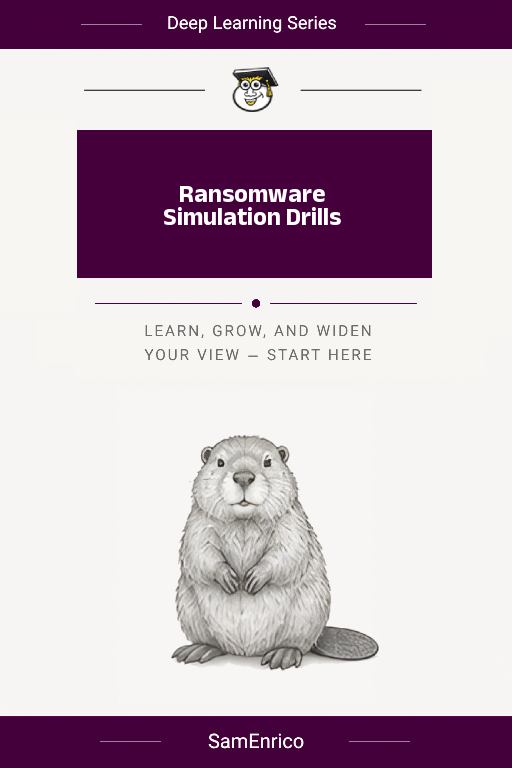
Non-FictionCrisis ManagementTraining
Ransomware Simulation Drills eBook
Run tabletop exercises and technical simulations t
Run tabletop exercises and technical simulations to test your incident response and negotiation skills.
Formats
Free sample
Chapter 1: The $9.36 Million Placebo--The email arrived at 2:14 PM on a Tuesday. Subject line: "Urgent – Finance Server." The helpdesk technician, a sharp twenty-four-year-old named Marcus with eight months on the job, opened the ticket and read the description: "Server slow. Files won't open. Users in accounting reporting error messages."Marcus did what he was trained to do. He remoted into the server, checked the event logs, saw nothing obvious, and ran a quick antivirus scan.
The scan came back clean. He noted in the ticket: "No malware detected. Advised user to reboot." Then he closed the ticket and moved to the next alert.Four hours later, the CFO called the CIO directly. "Why can't I open the quarterly forecast?"Twenty minutes after that, a junior analyst in accounts payable found a file she had never seen before. It was named README.txt and it sat in the root directory of the finance share.
She opened it.The message was simple. "Your network has been encrypted. Your data has been stolen. Contact us within 48 hours or your files will be published and your decryption key will be destroyed."By 7:00 PM, every server in the company was either encrypted or shut down as a precaution. By midnight, the CEO was on a call with lawyers, the cyber insurance carrier, and an incident response firm that quoted a $200,000 retainer.
By morning, the company's stock had dropped 12 percent. And Marcus, the helpdesk technician, sat in his cubicle staring at his screen, wondering why the antivirus scan had shown nothing.The company had a plan. A fifty-seven-page incident response plan, reviewed by external consultants, approved by the board, and stored in a shared drive that everyone knew how to find. The plan had a section on ransomware. It had a flowchart.
It had contact numbers. It had never been tested.The recovery took eighty-three days. The ransom demand was 4.2million.Thecompanypaid4.2 million. The company paid 4.2million.Thecompanypaid1.8 million after negotiation. The total cost, including downtime, legal fees, regulatory fines, and customer churn, was $9.36 million.The plan sat in the shared drive.
Unchanged. Unread. Perfectly useless.The Most Expensive Lie in Business This chapter is about a lie. Not a malicious lie, not a deceitful lie, but a comfortable lie that organizations tell themselves every single day. The lie sounds like this: "We have a plan."The phrase "we have a plan" has become the corporate equivalent of a security blanket.
It is said with confidence in board meetings. It is written into compliance documents. It is printed in binders that sit on shelves gathering dust. And it is almost always wrong.Not because the plan is badly written. Often, the plan is excellent.
It has been reviewed by experts. It follows industry frameworks like NIST or SANS. It contains detailed procedures for everything from initial triage to public relations. The problem is not the plan. The problem is the assumption that a written document equals a capable organization.Consider the difference between a recipe and a meal.
A recipe for beef bourguignon is a beautiful thing. It lists ingredients, temperatures, and timing. But a recipe does not feed you. The act of cooking feeds you. And cooking requires practice, judgment, and the ability to adapt when the onions burn or the wine is corked.A ransomware plan is a recipe.
A ransomware simulation is the kitchen.The 9.36millionfigureinthischapter′stitleisnotahypothetical.Itistheaveragecostofaransomwarerecoveryaccordingtothe2025IBMCostofa Data Breach Report,adjustedfordowntime,lostbusiness,remediation,andlong−termbranddamage.Thatnumberhasrisen89percentinfiveyears.Buthereisthenumberthatmattersmore:organizationsthatrunregularsimulationsreducethataveragecostbyapproximately9.36 million figure in this chapter's title is not a hypothetical. It is the average cost of a ransomware recovery according to the 2025 IBM Cost of a Data Breach Report, adjusted for downtime, lost business, remediation, and long-term brand damage. That number has risen 89 percent in five years. But here is the number that matters more: organizations that run regular simulations reduce that average cost by approximately 9.36millionfigureinthischapter′stitleisnotahypothetical.Itistheaveragecostofaransomwarerecoveryaccordingtothe2025IBMCostofa Data Breach Report,adjustedfordowntime,lostbusiness,remediation,andlong−termbranddamage.Thatnumberhasrisen89percentinfiveyears.Buthereisthenumberthatmattersmore:organizationsthatrunregularsimulationsreducethataveragecostbyapproximately248,000 per incident.Two hundred forty-eight thousand dollars is the price of a mid-sized sedan, a year of college tuition, or a modest house down payment. It is also roughly the cost of running five comprehensive simulation exercises, including facilitator fees and staff time.
The return on investment is not subtle.Yet most organizations never run a single simulation. According to the same report, only 34 percent of companies test their incident response plans through tabletop exercises. Only 12 percent run technical simulations. The other 88 percent are flying blind, trusting that a document on a shared drive will somehow transform into action when their servers start encrypting at 2 AM.This book exists to close that gap.The Procedure vs. Capability Problem Let us define two terms that will appear throughout this book, because understanding their difference is the foundation of everything that follows.Procedure is what is written down.
It is the step-by-step instruction: "In the event of suspected ransomware, isolate the affected host by disconnecting its network cable or disabling its network port." That sentence is clear. It is unambiguous. It can be printed in a manual and reviewed by a lawyer.Capability is what a human being can actually do under pressure. Capability asks: Can the SOC analyst identify the correct cable in a crowded server rack? Can they reach it without disrupting other critical systems?
Can they do this while the CEO is screaming for updates, the attacker is deleting logs, and the analyst has not slept in eighteen hours?Procedure is knowledge. Capability is performance. And stress transforms performance.This is not a metaphor. It is neuroscience. When the human brain perceives a threat, the amygdala activates the sympathetic nervous system.
Heart rate increases. Cortisol floods the bloodstream. The prefrontal cortex, responsible for complex reasoning and impulse control, literally reduces its activity. In plain English: smart people do stupid things when they are scared.A study published in the Journal of Emergency Medicine found that experienced paramedics made 47 percent more errors in simulated high-stress scenarios than in low-stress versions of the same calls. Their knowledge had not changed.
Their skills had not degraded. But their performance collapsed because they had never practiced the specific skill of remaining systematic while a simulated patient stopped breathing.Ransomware is the same. Your team's knowledge is not the issue. Their practiced capability under stress is the only thing that matters.I have watched a senior network architect with twenty years of experience forget his own administrator password during a ransomware simulation. I have watched a calm, methodical incident commander freeze for ninety seconds, unable to speak, because the Red Team injected a curveball he had not anticipated.
I have watched a legal team argue for ten minutes about whether a disclosure was required while the attacker's leak site timer ticked down.These were not incompetent people. They were experts who had never practiced under realistic pressure.What This Book Is (And Is Not)Before we go further, let me be explicit about what this book will and will not do.This book is not a general introduction to ransomware. It will not teach you how to write a basic incident response plan from scratch. It will not spend two hundred pages on the history of crypto-lockers or the…
This is the end of the free sample. Get the eBook to keep going. Buy now
About this book
Details
- Author
- Hillman Carie
- Publisher
- SamEnrico
- Language
- English
- Genre
- Non-Fiction, Crisis Management, Training
- Released
- 2026-06-01
- Pages (approx.)
- 156
- Available as
- eBook, Audiobook

Read better in the ZLOADR app
Your eBooks on your phone or tablet. Sign in with your SamEnrico account and start reading.
More by Hillman Carie
 Sports Fan Anger GuideHillman Carie$11.99
 IBS And Ehlers DanlosHillman Carie$11.99
 Gacy Psychopathy ChecklistHillman Carie$11.99
 DIY vs Professional ServicesHillman Carie$11.99
 Varenicline Smoking CessationHillman Carie$11.99
 Kosovar Albanian EscapeHillman Carie$11.99
 Zinc For Immune SupportHillman Carie$11.99
 Night Stalker Child SurvivorHillman Carie$11.99
 The Lost Scrolls of the Iron Fist: The 18th Century Martial Arts Heist That Changed HistoryHillman Carie$11.99
 The Ghost of the Grand Bazaar: The 1890s Con Artist Who Outwitted IstanbulHillman Carie$11.99
 A Collector's Handbook to the Citroën Citroen SmHillman Carie$11.99
 Factoring in High Inflation Economies HandbookHillman Carie$12.99
You may also like
 Hong Kong Handover 1997Dunn Johnnie$11.99
 Zumba For Postnatal Recovery CourseNeal Christian$11.99
 Zumba for BeginnersLadner Nikia$11.99
 YouTube Comment Mining GuideHumes Pandora$12.99
 Worry Box MeditationCarlin Rudy$11.99
 Workplace Stress MeditationNguyen Lynn$11.99
 Workplace Stress and Sleep RepairHawley Ivory$11.99
 Workplace Perfectionism CureDelaney Jeffry$11.99
 Workplace Injustice Anger GuideWallen Isabelle$11.99
 Work Addiction and Burnout LinkGreenwood Ester$11.99
 Women in Yoga and WellnessBeattie Galina$11.99
 Women in Stand Up ComedyChun Evangeline$11.99