
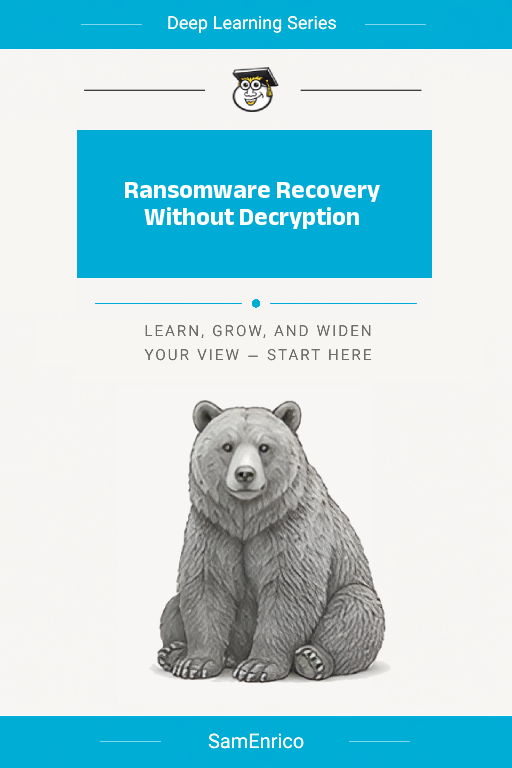
Ransomware Recovery Without Decryption eBook
Rebuild systems from known-clean states using conf
by Marble Andre
Rebuild systems from known-clean states using configuration management, accepting some data loss rather than paying for potentially faulty keys.
Formats
Free sample
Chapter 1: The $5 Million Mistake...--The phone rang at 2:17 AM. Not the normal ringtone—the emergency line, the one reserved for the kind of news that ends careers. Mark, the CIO of a mid-sized manufacturing firm with $400 million in annual revenue, fumbled for his phone. On the other end, his head of IT infrastructure spoke four words that would haunt him for the next eighteen months: "We've been ransomwared. Bad."By 3:00 AM, Mark had learned the scope.
Every critical system—ERP, production scheduling, inventory management, customer portals—was encrypted. The attackers had spent three weeks inside the network, methodically mapping every backup location, every disaster recovery site, every shadow copy. When they finally pulled the trigger, they didn't just encrypt production data. They encrypted the backups too. All of them.
The only copy of the company's existence that remained untouched was a set of six-month-old tapes stored in a safety deposit box ninety miles away.The ransom demand: $5 million in Bitcoin. The deadline: seven days, after which the decryption keys would be destroyed and the exfiltrated customer data would be leaked to competitors and regulators.Mark did what most CIOs in his position would do. He panicked. Then he called the cyber insurance carrier. Then he called a negotiator.
Then he authorized payment.The money was wired—converted to Bitcoin, sent to a wallet controlled by a group operating out of Eastern Europe. The keys arrived twelve hours later. The decryption process began with hope and ended with disaster. Of the 4,700 encrypted servers and workstations, the keys successfully decrypted fewer than half. For the rest, the decryption process either failed outright (the keys didn't match) or, worse, corrupted the partially-encrypted files further.
The attackers had used a ransomware variant with a known flaw: if the decryption process was interrupted—by a reboot, by a network disconnect, by anything—the keys became permanently useless. The company had paid $5 million for the privilege of making their situation worse.Mark's firm ultimately rebuilt from those six-month-old tapes, losing half a year of transactional data, paying an additional $2 million in recovery services, and spending eleven weeks in a partial shutdown. They lost three major customers who couldn't tolerate the downtime. They paid a regulatory fine for the data breach they couldn't prevent. And Mark lost his job.The attackers, by the way, hit the same company again eight months later.
Because paying a ransom doesn't buy immunity. It buys a spot on a list called "Companies That Pay."The Central Lie of Ransomware Response If you take nothing else from this book, take this: Decryption is a trap. Not a strategy, not a backup plan, not a valid option. A trap.The cybersecurity industry has spent years building an elaborate mythology around ransomware decryption. Vendors sell "decryption appliances" that cost six figures.
Consultants offer "negotiation services" that promise to lower the ransom. Insurers maintain "approved vendor lists" of negotiators and decryption specialists. Entire conferences are dedicated to the art of dealing with ransomware attackers.All of it misses the point. All of it assumes something that is demonstrably false: that paying the ransom will reliably restore your data.This chapter will dismantle that assumption. Not with opinions, but with data, math, and case studies.
By the time you finish reading, you will understand why decryption—especially paid decryption—is the most dangerous path you can take, and why the only mathematically certain recovery path lies in rebuilding from known-clean states.But first, we need to understand the scale of the problem.The Hard Numbers: Why Decryption Fails Let's start with the data. In 2023, the ransomware response firm Coveware analyzed 1,200 incidents where victims paid ransoms and received decryption keys. The results were damning:Only 64% of paying victims recovered all their data. The other 36% either received faulty keys, received keys that worked partially, or received nothing at all after payment.That means more than one in three organizations that paid the ransom—organizations that followed the "conventional wisdom," that hired negotiators, that had cyber insurance, that did everything "right"—ended up with encrypted data and no money. They paid the criminals, got nothing in return, and still had to rebuild from scratch.But the numbers get worse.Among the victims who did receive working keys, the average recovery time using those keys was 18 days.
Eighteen days of attempting decryption, verifying files, re-running failed batches, dealing with corrupted outputs, and discovering that some files were only partially restored. In many cases, organizations spent weeks believing they were recovering, only to discover that the decrypted data was unusable—corrupted databases, truncated files, garbled configurations.Meanwhile, organizations that abandoned decryption entirely and rebuilt from known-clean backups or fresh images had an average recovery time of 52 hours. That's not a typo. Rebuilding was more than seven times faster than decrypting.The math is simple: decryption is slower, less reliable, and more expensive than rebuilding. Yet most organizations default to decryption because of fear, because of the ransom timer, because of the belief that paying will make the problem go away.It won't.The Anatomy of a Failed Decryption To understand why decryption fails so often, we need to understand how modern ransomware actually works.
The Hollywood version—attacker sends key, you type it in, files magically unlock—is a fantasy.Real-world ransomware encryption is a messy, asynchronous, error-prone process. Attackers don't have unlimited compute time inside your network; they are racing against detection. So they cut corners. They use fast-but-unreliable encryption libraries. They encrypt files in parallel without proper error handling.
They skip verification steps to save time.The result is that many ransomware variants produce corrupted ciphertext even before you attempt decryption. The attacker's own encryption process introduces errors—truncated files, mismatched blocks, missing headers. When you later apply the decryption key, those errors become fatal. You can't decrypt what was never properly encrypted in the first place.Consider the case of Ryuk, a ransomware variant that was responsible for $150 million in ransom payments between 2018 and 2021. Ryuk used a hybrid encryption scheme: a fast symmetric cipher for the file contents, wrapped in an asymmetric cipher for the key.
Theoretically sound. In practice, Ryuk's implementation had a critical flaw: it didn't verify that the encrypted file had been written completely before moving to the next file. If a power fluctuation occurred, if the disk was slow, if the network lagged, the encryption process would mark the file as "complete" after writing only half the data.When victims later received Ryuk decryption keys, they would attempt to decrypt these incomplete files. The decryption algorithm, expecting a full ciphertext block, would read garbage and produce garbage. The result was a file that was encrypted, partially overwritten, and now double-corrupted by the decryption attempt.One victim, a hospital in upstate New York, lost 40% of their patient records this way.
The files were encrypted. The keys worked perfectly. But the encryption process itself had been flawed, and no key in the world could fix that.The Double Extortion Trap Even if decryption works perfectly—even if every file is restored, every database intact, every configuration recovered—you are still not safe.Welcome to the world of double extortion ransomware.The attackers don't just encrypt your data anymore. Before they deploy…
This is the end of the free sample. Get the eBook to keep going. Buy now
About this book
Details
- Author
- Marble Andre
- Publisher
- SamEnrico
- Language
- English
- Genre
- Non-Fiction, Crisis Management
- Released
- 2026-06-01
- Pages (approx.)
- 158
- Available as
- eBook, Audiobook

Read better in the ZLOADR app
Your eBooks on your phone or tablet. Sign in with your SamEnrico account and start reading.
More by Marble Andre
 AA NA Meeting Etiquette And Participation HandbookMarble Andre$11.99
 Discussing Infertility With Loved OnesMarble Andre$11.99
 Goal Setting for Product DevelopmentMarble Andre$11.99
 Recording Hypnotic Age RegressionMarble Andre$11.99
 Parent Loss and Children GuideMarble Andre$11.99
 Marjane Satrapi BioMarble Andre$11.99
 Explaining Suicide to ChildrenMarble Andre$11.99
 Equifax Customer Support NightmareMarble Andre$11.99
 The Poet and the Peacock: The Rivalry That United EgyptMarble Andre$11.99
 Velvet and Vengeance: The Scandal That Shook the Medici CourtMarble Andre$11.99
 A Collector's Handbook to the Peugeot 305Marble Andre$11.99
 Growing AnacyclusMarble Andre$11.99
You may also like
 Hong Kong Handover 1997Dunn Johnnie$11.99
 Zumba For Postnatal Recovery CourseNeal Christian$11.99
 Zumba for BeginnersLadner Nikia$11.99
 YouTube Comment Mining GuideHumes Pandora$12.99
 Worry Box MeditationCarlin Rudy$11.99
 Workplace Stress MeditationNguyen Lynn$11.99
 Workplace Stress and Sleep RepairHawley Ivory$11.99
 Workplace Perfectionism CureDelaney Jeffry$11.99
 Workplace Injustice Anger GuideWallen Isabelle$11.99
 Work Addiction and Burnout LinkGreenwood Ester$11.99
 Women in Yoga and WellnessBeattie Galina$11.99
 Women in Stand Up ComedyChun Evangeline$11.99