
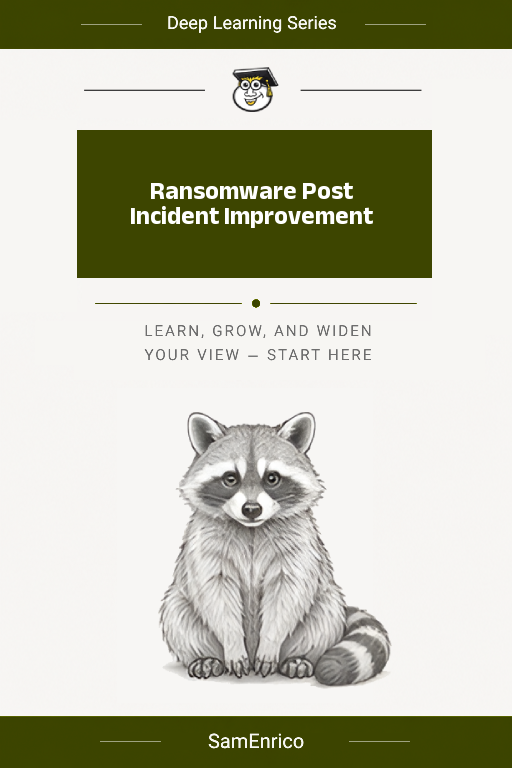
Ransomware Post Incident Improvement
Conduct post-mortem within 30 days of recovery, im
by Boucher Rory
Conduct post-mortem within 30 days of recovery, implementing security controls that would have prevented the initial compromise vector.
Formats
About this book
Free sample
Chapter 1: The Cortisol Crash--The moment the last decrypted file verifies—when the green checkmark appears and the recovery lead exhales for what feels like the first time in seventy-two hours—a dangerous clock begins ticking. Not the attacker's countdown timer demanding payment. That one has stopped. This new clock is silent, invisible, and far more insidious. It measures the time until your organization forgets what just happened.The war room is a disaster.
Empty coffee cups form brittle towers. Whiteboards are covered in scrawled IP addresses, kill chain diagrams, and the names of systems that no longer exist in their original form. The incident response team, running on a diet of energy drinks and adrenaline, stares at the restored screen with the hollow exhaustion of soldiers emerging from a trench. The CEO appears in the doorway, delivers a brief thank you, and announces that "normal operations will resume in the morning." Everyone nods. Everyone wants to go home.
Everyone believes the nightmare is over.That belief is the most dangerous vulnerability you will ever face.The Cortisol Crash is a physiological reality. For the duration of an active ransomware incident, your body floods with cortisol and adrenaline—stress hormones that sharpen focus, suppress fatigue, and enable sustained high performance under extreme pressure. These hormones are evolutionary gifts designed for short-term survival threats like escaping a predator or fighting in battle. They are not designed for the multi-day marathon of incident response. When the threat ends, cortisol levels plummet.
The result is not relief. It is collapse.In the hours and days following recovery, incident responders experience a predictable sequence: exhaustion, emotional numbness, irritability, and a powerful psychological drive to avoid anything that reminds them of the trauma. This is not weakness. It is biology. And it is the single biggest enemy of long-term security.The organizations that fail—that pay the second ransom, that lose customer trust, that see their executives named in shareholder lawsuits—are rarely the ones with weak technical controls.
They are the ones that surrendered to the Cortisol Crash. They told themselves they would "do the post-mortem later." They…
This is the end of the free sample. Get the eBook to keep going. Buy now
Contents
- Chapter 1
- Chapter 2
- Chapter 3
- Chapter 4
- Chapter 5
- Chapter 6
- Chapter 7
- Chapter 8
- Chapter 9
- Chapter 10
- Chapter 11
- Chapter 12
Details
- Author
- Boucher Rory
- Publisher
- SamEnrico
- Language
- English
- Genre
- Non-Fiction, Crisis Management
- Released
- 2026-05-30
- Pages (approx.)
- 155
- Available as
- eBook, Audiobook

Read better in the ZLOADR app
Your eBooks on your phone or tablet. Sign in with your SamEnrico account and start reading.
More by Boucher Rory
 Voice Actor First Generation StoryBoucher Rory$11.99
 Methamphetamine Skin Sores GuideBoucher Rory$11.99
 Networking at WeddingsBoucher Rory$11.99
 In Law Anger ManagementBoucher Rory$11.99
 Teen Dream Building GuideBoucher Rory$11.99
 Deep Work Focus GuideBoucher Rory$11.99
 Chiropractor Practice StressBoucher Rory$11.99
 Neonatal Death SupportBoucher Rory$11.99
 The Healing Hands of the Nile: The Royal Physicians of Pharaonic EgyptBoucher Rory$11.99
 The Siege of Azov: The Ottomans' Naval Gambit (1696)Boucher Rory$11.99
 How to Start a Conveyer Belts Made of Plastic Business (Beginners Guide)Boucher Rory$11.99
 How to Produce Moisturizing ProductsBoucher Rory$11.99
You may also like
 Hong Kong Handover 1997Dunn Johnnie$11.99
 Zumba For Postnatal Recovery CourseNeal Christian$11.99
 Zumba for BeginnersLadner Nikia$11.99
 YouTube Comment Mining GuideHumes Pandora$12.99
 Worry Box MeditationCarlin Rudy$11.99
 Workplace Stress MeditationNguyen Lynn$11.99
 Workplace Stress and Sleep RepairHawley Ivory$11.99
 Workplace Perfectionism CureDelaney Jeffry$11.99
 Workplace Injustice Anger GuideWallen Isabelle$11.99
 Work Addiction and Burnout LinkGreenwood Ester$11.99
 Women in Yoga and WellnessBeattie Galina$11.99
 Women in Stand Up ComedyChun Evangeline$11.99