
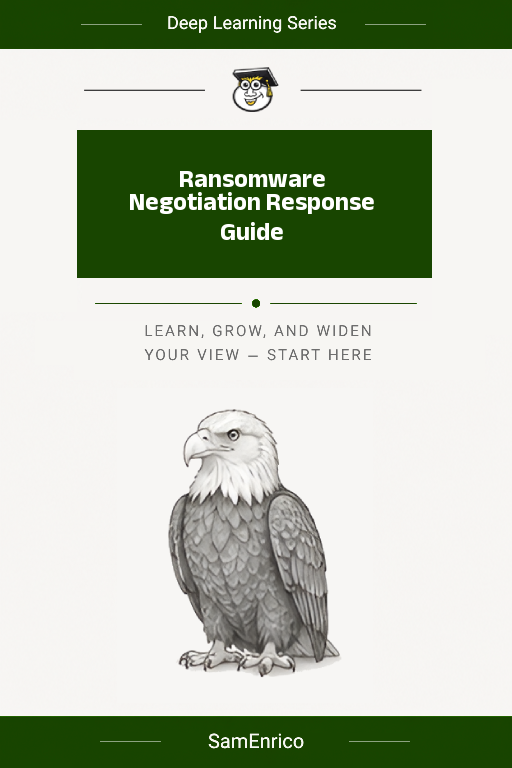
Non-FictionCrisis ManagementCyber Extortion
Ransomware Negotiation Response Guide eBook
Decide whether to pay, negotiate ransom amounts, a
by Rooney Gema
Decide whether to pay, negotiate ransom amounts, and communicate with attackers while protecting your business.
Formats
Free sample
Chapter 1: The Double Heist--It begins, as these things almost always do, with a click.Not a dramatic click. Not the kind of click you see in movies, where a shadowy figure in a hoodie mashes a keyboard while green code cascades down a black screen. No, the click that ends companies is almost painfully mundane. It is an executive assistant in accounting, three minutes before lunch, opening what appears to be a routine invoice from a known vendor. The PDF opens.
Nothing happens. Or so it seems. The assistant closes the document, sighs at the unremarkable Tuesday, and walks away from her desk.Behind her, a string of code no longer than a tweet has just executed a series of commands that will, within hours, cost her employer twelve million dollars.This is not hyperbole. This is the exact sequence of events that preceded the collapse of a forty-seven-year-old manufacturing company in the American Midwest, a company that had survived the savings and loan crisis, the dot-com bust, the 2008 recession, and a global pandemic. It did not survive a Tuesday in March when an assistant named Cheryl opened the wrong PDF.
By Friday, the company's servers were dark. By the following Wednesday, the attackers had leaked the CEO's personal emails—including the ones where he privately referred to his largest client as "a nightmare." By the end of the quarter, the company was acquired for scrap value by a private equity firm that paid pennies on the dollar for the intellectual property that Cheryl had, unknowingly, helped unlock.The attackers, meanwhile, had already moved on. They were negotiating with a hospital in Ohio by the time the manufacturing company's board held its final vote.This chapter is about understanding what those attackers stole that day. It is not just about files. It is about leverage.
It is about the fundamental shift in the ransomware business model that has turned a relatively straightforward technical problem—encrypted files—into an existential business crisis. To understand why the decision to pay or not pay is so agonizingly difficult, you must first understand what you are actually buying when you send that Bitcoin. And the answer, as you are about to discover, is far more complicated than "your data back."The Evolution of a Crime: From Locks to Leaks Let us go back a decade. In the early days of ransomware—the mid-2010s—the crime was simple. Attackers infiltrated a network, deployed encryption software, and demanded payment in exchange for a decryption key.
That was it. The victim's data was locked, not stolen. The attacker had no interest in the content of the files; they cared only about the value of the key. This was, in a strange way, an honest crime. If you paid, you almost always got your files back.
The attackers had a reputation to maintain. After all, if word spread that they took money and didn't decrypt, future victims would have no incentive to pay.Then, around 2019, everything changed.A group calling itself Maze did something unprecedented. After encrypting a victim's network, they also exfiltrated a copy of the victim's most sensitive data—customer records, internal emails, financial spreadsheets, source code. And then they made a new threat: if the ransom was not paid, they would publish that data on a public website. They called it the "Name and Shame" blog.
The industry called it double extortion. Within eighteen months, every major ransomware operation had copied the model.The logic was brutal and brilliant. Single extortion gave victims a way out: restore from backups. If you had good backups, you could laugh at the encryption and move on with your day. But double extortion removed that option.
Because even if you could restore every file from your immutable, air-gapped, perfectly maintained backups, you could not un-leak your trade secrets. You could not un-publish your CEO's embarrassing emails. You could not un-send your customer database to the dark web.The attackers had discovered something profound: data is not just an asset. It is also a hostage.The Two Problems: A Distinction That Will Save Your Company This is the single most important concept in this entire book. If you remember nothing else, remember this.
A ransomware attack is not one problem. It is two separate problems, and they require separate solutions.Problem One: The Encryption Problem Your files are locked. You cannot access your financial system, your customer relationship management database, your manufacturing controls, your email. Your business is frozen. This problem is solved by one of two things: a decryption key (which you pay for) or clean backups (which you restore from).
Either solution gets your operations running again. The encryption problem is painful, but it is fundamentally mechanical. It is about bits and bytes.Problem Two: The Exposure Problem Your data has been copied. The attackers have a complete archive of your most sensitive information. They know your customers' names, addresses, and credit card numbers.
They have read your board's private strategy documents. They have seen the spreadsheets where you calculated your profit margins on every product line. They have, in some cases, watched through your own security cameras. This problem is not solved by backups. It is not solved by a decryption key.
It is solved only by convincing the attackers to delete their copy—and trusting that they actually do it.The encryption problem is about business continuity. The exposure problem is about business survival.Most executives, when they first learn of a ransomware attack, focus entirely on the encryption problem. They ask: "How do we get our files back?" They call their IT director. They ask about backups. They consider paying the ransom.
But by the time they think to ask, "What data did they steal?" the attackers have already posted a sample on their leak site.This chapter is here to ensure you ask the second question first. Not second. First.The Name and Shame Economy: How Leak Sites Became Stock Exchanges Let me describe the ecosystem you are now competing against. Modern ransomware groups operate what are essentially publicly traded companies, except their stock price is the credibility of their threat.The "Name and Shame" blog is not a random website. It is a sophisticated, branded operation.
Groups like Lock Bit, Clop, Black Cat (also known as ALPHV), and the now-defunct Maze built websites that look, frankly, more professional than many corporate intranets. These sites list current victims, countdown clocks showing when data will be published, and sample data dumps to prove authenticity. Some groups have press contacts. Some have bug bounties. Some have customer support chat windows.Here is how it works.
After exfiltrating your data, the attackers give you a deadline—typically five to fourteen days. They tell you that if the ransom is not paid by that date, they will publish everything. But they do not just publish it all at once. They apply pressure incrementally. On day one of the deadline, they might post your company's name on the blog with a warning.
On day three, they might release a small sample of stolen files—perhaps a few emails or a single spreadsheet. On day five, they might contact your…
This is the end of the free sample. Get the eBook to keep going. Buy now
About this book
Details
- Author
- Rooney Gema
- Publisher
- SamEnrico
- Language
- English
- Genre
- Non-Fiction, Crisis Management, Cyber Extortion
- Released
- 2026-05-29
- Pages (approx.)
- 134
- Available as
- eBook, Audiobook

Read better in the ZLOADR app
Your eBooks on your phone or tablet. Sign in with your SamEnrico account and start reading.
More by Rooney Gema
 Pre Suasion Strategy GuideRooney Gema$11.99
 Gacy Property Search WarrantRooney Gema$11.99
 Dubai Student FreelancingRooney Gema$11.99
 Education Spending GenerationsRooney Gema$11.99
 Congolese Rebel EscapeRooney Gema$11.99
 Workplace IBS AccommodationsRooney Gema$11.99
 Bipolar in the WorkplaceRooney Gema$11.99
 Circadian Rhythm Athlete GuideRooney Gema$11.99
 The Lion Mathematicians of Timbuktu: Unlocking the Secrets of the StarsRooney Gema$11.99
 The Boto Cor-de-Rosa: Amazon’s Shape-Shifting River SpiritRooney Gema$11.99
 A Collector's Handbook to the Citroën Citroen C4Rooney Gema$11.99
 Understanding Periodic ParalysesRooney Gema$11.99
You may also like
 Hong Kong Handover 1997Dunn Johnnie$11.99
 Zumba For Postnatal Recovery CourseNeal Christian$11.99
 Zumba for BeginnersLadner Nikia$11.99
 YouTube Comment Mining GuideHumes Pandora$12.99
 Worry Box MeditationCarlin Rudy$11.99
 Workplace Stress MeditationNguyen Lynn$11.99
 Workplace Stress and Sleep RepairHawley Ivory$11.99
 Workplace Perfectionism CureDelaney Jeffry$11.99
 Workplace Injustice Anger GuideWallen Isabelle$11.99
 Work Addiction and Burnout LinkGreenwood Ester$11.99
 Women in Yoga and WellnessBeattie Galina$11.99
 Women in Stand Up ComedyChun Evangeline$11.99