
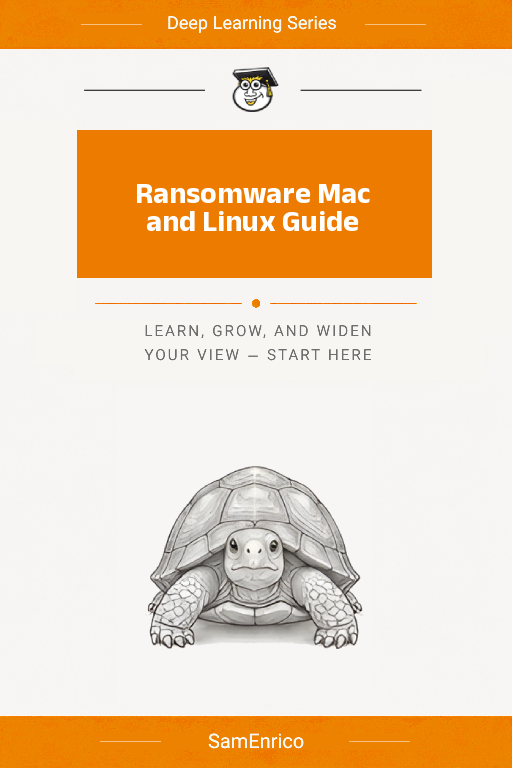
Ransomware Mac and Linux Guide eBook
Handle ransomware variants targeting non-Windows s
Handle ransomware variants targeting non-Windows systems with specialized removal tools.
Formats
Free sample
Chapter 1: The 3AM Phone Call...--The vibration of your phone against a wooden nightstand sounds like a buzzsaw at 3:00 AM. You groggily reach for it, expecting a wrong number or a server alert that can wait until morning. Then you see the message: "All customer data inaccessible. Ransom note on all servers. Critical."Your heart doesn't just race – it drops into a cold pit in your stomach.
By the time you've stumbled to your home office and pulled up your terminal, thirty-two Linux web servers are showing the same red directory listing. Fourteen mac OS workstations used by your creative team have icons replaced with skulls. Files that existed twelve hours ago now have extensions you've never seen: .TURTLERANSv0, .encrypted, .evq.The ransom note is simple. It always is. "Your files have been encrypted.
Pay 15 Bitcoin to this address within 72 hours or the price doubles. We do not negotiate. We do not offer discounts. We do not respond to emails." There is no signature, no contact information, no customer support chat – only the cold certainty that someone, somewhere, has taken everything you were responsible for protecting.You have just entered the nightmare that this book was written to end.For years, you were told that Mac and Linux systems were immune to ransomware. You heard it at conferences, read it in blog posts, and repeated it to your own teams.
"Windows is the target," they said. "Linux is too secure. Mac users don't get malware." Those words now feel like a cruel joke as you stare at encrypted customer databases, corrupted design files, and a ticking clock that measures both the ransom demand and your remaining career.This book exists because that advice was not just wrong – it was dangerously, catastrophically wrong. The threat landscape has shifted beneath your feet. Ransomware groups have discovered what security researchers have known for years: Mac and Linux systems run the world's most valuable infrastructure.
Every cloud server, every CI/CD pipeline, every developer workstation, every creative agency's NAS – all of it runs on Unix-like operating systems. And all of it is now in the crosshairs.The Myth of Immunity: How We Got Here The belief that Mac and Linux systems are immune to ransomware has roots in historical reality, which makes it even harder to abandon. For the first two decades of ransomware's existence – from the AIDS Trojan in 1989 to the explosion of Crypto Locker in 2013 – Windows was virtually the exclusive target. There were practical reasons for this: Windows dominated the desktop market, Windows Server ran most corporate file shares, and Windows' permission model (with its legacy of users running as administrators) made encryption easier.But the world changed while we weren't paying attention.By 2020, Linux powered 96% of the world's top one million web servers, 100% of the cloud's hypervisors (AWS, Azure, Google Cloud all run on Linux), and the majority of development environments through Docker and Kubernetes. Mac, meanwhile, had captured over 20% of the North American desktop market – and nearly 80% of the creative professional market (designers, video editors, musicians, and developers who prefer Unix-like environments).Ransomware gangs noticed.
And they adapted.The Families You Need to Know As of this writing, there are five ransomware families that every Mac and Linux administrator must recognize instantly. They are not theoretical or rare – they have been observed in the wild, have active variants in development, and have claimed real victims.Turtle emerged in 2022 as the first truly cross-platform ransomware written in Rust. It targets both mac OS and Linux systems, uses AES-256-GCM encryption (secure enough that no public decryptor exists), and appends the extension .TURTLERANSv0 to every encrypted file. Turtle's signature move is its persistence mechanism: it installs a systemd service on Linux and a Launch Daemon on mac OS that re-encrypts any files restored from backup within 15 minutes of decryption. This means that even if you have backups, simple restoration without eradication leads to immediate reinfection.Linux.Encoder is the elder statesman of Linux ransomware, first appearing in 2015.
It is also the most instructive case study in amateur mistakes. Early versions used a hardcoded AES key embedded in the binary itself – security researchers extracted the key within 48 hours of its discovery, released a free decryptor, and rendered the variant harmless. Later versions improved their cryptography, but Linux.Encoder remains notable for its attack vector: it almost always arrives through unpatched Jenkins servers, Word Press plugins, or exposed Docker APIs. If you are hit with Linux.Encoder, your first question should be: "What web application did I forget to update?"Evil Quest (also known as Thief Quest) represents the evolution of mac OS ransomware beyond simple file encryption. Discovered in 2020, Evil Quest is a hybrid threat: it encrypts user documents while simultaneously installing a keylogger, exfiltrating browser passwords and cryptocurrency wallets, and establishing reverse shells for remote access.
Its ransom note includes threats to leak stolen data if payment is not made – a double extortion tactic borrowed from Windows ransomware like Maze and REvil. Evil Quest spreads through pirated software, cracked applications, and malicious Homebrew formulas. If you are infected with Evil Quest, file recovery is only half the battle; assume your credentials are compromised.Bash 2.0 is what happens when a script kiddie discovers ransomware. Written entirely in Bash script (yes, a shell script), it uses XOR encryption with a hardcoded key (0x42 – the ASCII value of the letter B). It appends no extension but instead prepends a !
character to every encrypted filename. Bash 2.0 is not sophisticated, but it is effective against unprepared administrators because it spreads through shared SSH keys – if one server is compromised, Bash 2.0 reads ~/.ssh/id_rsa and uses it to jump to every server listed in ~/.ssh/known_hosts. A single infected developer workstation can become patient zero for an entire infrastructure.Lock Bit for Linux , released in 2024, represents the professionalization of cross-platform ransomware. Lock Bit is a Ransomware-as-a-Service (Raa S) operation – the developers sell or rent the ransomware to affiliates who execute the attacks. Lock Bit for Linux uses properly implemented Cha Cha20 encryption (no public decryptor), includes a professional HTML ransom note with a TOR negotiation portal and live chat support, and offers a "free decryption of one file as proof." Its Linux variant targets ESXi hypervisors specifically, encrypting entire virtual machine disk files (.vmdk) and leaving bare-metal servers inaccessible.
If you manage a VMware environment running on Linux hosts, Lock Bit is your nightmare.How They Get In: The Three Attack Vectors Understanding how ransomware arrives is as important as knowing how to remove it. Across all observed Linux and Mac ransomware incidents, three attack vectors account for over 85% of infections. Secure these, and you eliminate most of your risk.Phishing – The Developer's Blind Spot Developers pride themselves on technical sophistication, which makes them uniquely vulnerable to phishing. They believe they cannot be tricked, so they do not maintain the paranoid suspicion that keeps other users safe. Attackers exploit this by sending "package updates" that appear to come from Git Hub, npm, Py PI, or Homebrew.A typical attack: a developer receives an email that appears to be from Git Hub, warning that their account will be suspended unless they install a "security patch." The email includes…
This is the end of the free sample. Get the eBook to keep going. Buy now
About this book
Details
- Author
- Faulkner Deandra
- Publisher
- SamEnrico
- Language
- English
- Genre
- Non-Fiction, Crisis Management, OS
- Released
- 2026-06-01
- Pages (approx.)
- 140
- Available as
- eBook, Audiobook

Read better in the ZLOADR app
Your eBooks on your phone or tablet. Sign in with your SamEnrico account and start reading.
More by Faulkner Deandra
 Anger De escalation for Social WorkersFaulkner Deandra$11.99
 Gambling in SeniorsFaulkner Deandra$11.99
 Baby Boomer vs Gen Z HobbiesFaulkner Deandra$11.99
 Alphabet Peg System WorkbookFaulkner Deandra$11.99
 Fear of Failure Breakthrough GuideFaulkner Deandra$11.99
 Quit Smoking for DiabetesFaulkner Deandra$11.99
 Payroll Deduction Giving GuideFaulkner Deandra$11.99
 Biotin Hair Skin GuideFaulkner Deandra$11.99
 Gilgamesh and the Lost Tablet of UrukFaulkner Deandra$11.99
 The Vanishing Heiress: The Hunt for the Missing Duchess of WindsorFaulkner Deandra$11.99
 How to Produce Sorting and Stacking ToysFaulkner Deandra$11.99
 A Collector's Handbook to the Cord 812Faulkner Deandra$11.99