
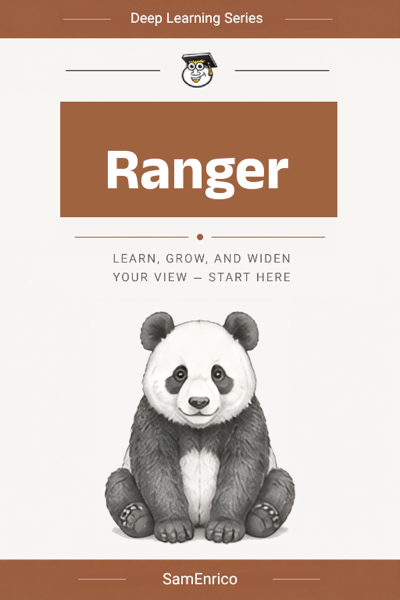
Ranger eBook
A Coursebook on Ranger
A Coursebook on Ranger
Formats
Free sample
Chapter 1: The Shadow That Remains...--The first lesson of the Ranger is not written in any handbook. It is whispered in the dark, carved into the memory of every candidate who has ever stood at the edge of a tree line and watched civilization continue as if nothing dangerous existed beyond the campfire’s glow. That lesson is this: you are already invisible, and you do not even know it.Most people walk through their lives in a state of profound unawareness. They look but do not see. They hear but do not listen.
They pass within inches of critical details—a scuff mark on a doorframe, a footprint that does not belong, a shadow that moves against the wind—and their brains file these observations under “irrelevant” before they ever reach conscious thought. The Ranger operates in the opposite direction. Where the civilian seeks comfort, the Ranger seeks pattern. Where the ordinary soldier seeks decisive battle, the Ranger seeks decisive observation. Where the knight charges forward with armor gleaming and banner flying, the Ranger stands in the grey area between conflict and peace, watching, waiting, and striking only when the strike cannot be traced back to a hand.This chapter dismantles the romantic fantasy of the Ranger as a supernatural figure.
It is a fantasy that has been carefully cultivated by storytellers for generations. From the hooded mysterious figures of John Flanagan’s Ranger’s Apprentice series to the silent, deadly operators of Hollywood’s imagination, the public has come to believe that Rangers possess something akin to magic—an invisibility cloak, a sixth sense, an unerring instinct that cannot be taught. The truth is both more mundane and more extraordinary: the Ranger’s power is not magic. It is method.The Two Faces of the Ranger Before any aspiring Ranger can begin the journey, they must understand that the word “Ranger” carries two distinct meanings. These meanings are not contradictory, but they are different enough that confusing them will lead to frustration, misdirected effort, and potentially dangerous misunderstandings in the field.The first meaning is the fictional Ranger—the solitary figure made famous by Flanagan’s beloved series.
Will Treaty, Halt, Gilan, and the other Rangers of Araluen are romanticized embodiments of the archetype: they operate alone or in pairs, carry longbows and saxe knives, move through forests like ghosts, and solve problems through stealth, intelligence, and precisely applied violence. They are mentors to young apprentices. They are the thin grey line between the kingdom and the darkness beyond the map’s edge. Their isolation is a feature, not a bug. They are trusted because they are unknowable.The second meaning is the military Ranger—the product of the United States Army Ranger School and, for those who meet the highest standard, the 75th Ranger Regiment.
These Rangers operate in squads of four to twelve men. They carry M4 carbines, M249 squad automatic weapons, night vision devices, and sixty to one hundred pounds of mission-specific equipment. They are not solitary. They are not mysterious. They are highly trained, intensely disciplined professionals who specialize in direct action raids, airfield seizures, and reconnaissance in denied territory.
Their isolation is a tactical necessity, not a romantic ideal. They are trusted because they have bled beside one another in places most Americans cannot find on a map.Why does this distinction matter? Because this book will draw from both traditions. The fictional Ranger provides the ethos—the quiet confidence, the moral clarity, the willingness to operate in the grey area where knights cannot go and thieves should not go. The military Ranger provides the method—the battle drills, the patrol bases, the tracking techniques, the leadership principles forged in the swamps of Florida and the mountains of Georgia and the mountains of Afghanistan.
To learn only one is to have only half the weapon.The Core Thesis: Magic vs. Method Let us examine the fantasy first, because it is the fantasy that draws most people to the Ranger path.In The Ruins of Gorlan, the first book of Flanagan’s series, a young orphan named William—Will—watches a Ranger named Halt ride into the castle courtyard. Will is captivated not by Halt’s weapons or his horse, but by his presence. Halt wears a mottled grey-green cloak that seems to drink the light. His face is partially hidden by a cowl.
He speaks little, observes everything, and when he leaves, people are not entirely certain he was ever there. Will later learns that the cloak is not magical—it is simply a masterwork of camouflage, dyed in irregular patterns that break up the human silhouette. The longbow is not enchanted—it is a weapon that requires years of practice to master. The tracking skill is not a gift—it is the product of thousands of hours of careful observation.Flanagan did something unusual in his portrayal of the Rangers: he demystified them even as he romanticized them. The books repeatedly emphasize that the Rangers’ power comes from discipline, not destiny.
Will succeeds because he practices, because he pays attention, because he refuses to give up when failure would be easier. He fails often. He is not the best archer, not the best tracker, not the best fighter. But he is the most persistent—and persistence, more than talent, is the foundation of the Ranger method.Now contrast this with the reality of Ranger Assessment Phase—known as RAP week—at Fort Benning, Georgia. RAP week is the first major hurdle for any soldier seeking to attend Ranger School.
It is five days of physical and mental evaluation designed to separate those who want to be Rangers from those who are prepared to be Rangers. The attrition rate consistently exceeds fifty percent. In some classes, it approaches seventy percent.What fails these candidates? Is it a lack of physical fitness? Sometimes, but the physical standards are published well in advance.
Any candidate who arrives unable to complete the push-ups, sit-ups, pull-ups, or five-mile run has simply failed to prepare. Is it a lack of tactical knowledge? Rarely, because tactical knowledge can be taught. The single greatest predictor of success in RAP week is not athleticism or intelligence—it is resilience. It is the ability to continue functioning when you are cold, wet, hungry, exhausted, and convinced that you cannot take one more step.The candidates who quit are not the ones who fail the physical tests.
The candidates who quit are the ones who look at the terrain ahead—the dark water, the endless ruck march, the screaming instructors, the sleep deprivation—and decide, in a moment of clarity, that the prize is not worth the price. They are not wrong. The prize is expensive. But the Ranger pays the price anyway, not because the price is fair, but because the price is the only path to the other side.Defining the Shadow This book uses a specific term to describe the Ranger’s operational space: the Shadow. The Shadow is not a place.
It is not a cloak. It is a condition—a state of being in which the Ranger exists at the edge of perception, seen only when they choose to…
This is the end of the free sample. Get the eBook to keep going. Buy now
About this book
Details
- Author
- Coughlin Talia
- Publisher
- SamEnrico
- Language
- English
- Genre
- Non-Fiction, Informative, Educational
- Released
- 2026-06-02
- Pages (approx.)
- 148
- Available as
- eBook, Audiobook

Read better in the ZLOADR app
Your eBooks on your phone or tablet. Sign in with your SamEnrico account and start reading.
More by Coughlin Talia
 Remote Retreats Documentation GuideCoughlin Talia$11.99
 Social Listening Mapping CourseCoughlin Talia$11.99
 Single Tasking Deep Work MethodCoughlin Talia$11.99
 Posture Study Alertness GuideCoughlin Talia$11.99
 Polish Resistance Cemetery DropsCoughlin Talia$11.99
 The Silk Road Queen: The Untold Empire of the 'White Widow'Coughlin Talia$11.99
 The Phantom ScriptCoughlin Talia$11.99
 Understanding Chromos ChromosomaCoughlin Talia$17.99
 Department Budget KPI TrackingCoughlin Talia$12.99
 JEE Weak Topic ImprovementCoughlin Talia$12.99
 10 Ways to Use Cherry Tomatoes (Recipe Book)Coughlin Talia$11.99