
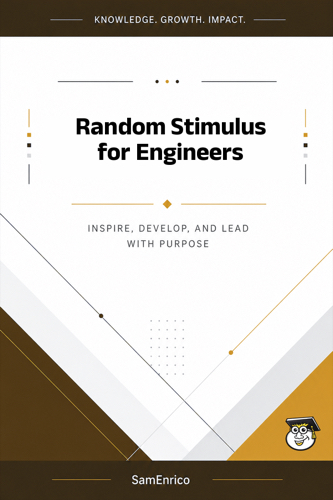
Free sample
Chapter 1: The Hidden Betrayer...–- Every engineering discipline has a secret enemy. Not the obvious one—not tight budgets, missed deadlines, or the marketing team’s impossible promises. Those are visible, measurable, and you already know how to fight them. No, the hidden betrayer is far more insidious because it wears the mask of virtue. It whispers that you are being thorough, disciplined, and professional.
It rewards you with clean test reports, green checkmarks, and the quiet satisfaction of a job done right. Its name is determinism, and it has been lying to you since your very first engineering course.This book is about why determinism fails, why randomness is not your enemy but your most powerful ally, and how to wield randomness as a precision tool rather than fearing it as chaos. By the end of this chapter, you will understand why the most thorough directed test suites in the world routinely miss catastrophic bugs, why the Intel Pentium FDIV bug cost nearly half a billion dollars despite passing tens of thousands of directed tests, and why the very definition of “random” in engineering requires a distinction that most textbooks ignore. You will also learn the single most important concept that underpins every subsequent chapter: the difference between unconstrained randomness (which is useless and dangerous) and constrained randomness (which is the foundation of modern verification).But first, we need to talk about trust—specifically, why you cannot trust your own testing instincts.The Myth of Exhaustive Testing Imagine you are responsible for verifying a modest System-on-Chip. Not a server-class CPU with billions of transistors, just a small microcontroller with a 32-bit processor, 64 kilobytes of memory, a handful of peripherals, and a simple bus interconnect.
How many possible states does this system have? The answer is a number so large that it has no practical meaning. Each flip-flop and memory bit can be 0 or 1, so the total number of distinct states is 2 raised to the power of the number of storage elements. For even a tiny 32-bit processor with 1,000 flip-flops and 64KB of memory (524,288 bits), the number of states is approximately 2 to the 525,000th power. That is not a number you can simulate.
It is not a number you can sample in a human lifetime with any conceivable computing infrastructure. The universe does not contain enough atoms to represent that number.This is the state-space explosion problem, and it will appear…
This is the end of the free sample. Get the Audiobook to keep going. Buy now
About this book
Details
- Author
- Gentry Nery
- Publisher
- SamEnrico
- Language
- English
- Genre
- Non-Fiction, Self-Help
- Released
- 2026-06-07
- Pages (approx.)
- 136
- Available as
- eBook, Audiobook

Listen in the VoxFlicks app
Audiobooks and audio dramas wherever you go. Sign in with your SamEnrico account and press play.
More by Gentry Nery
 CrossFit WOD Strategy GuideGentry Nery$11.99
 Anki For Law StudentsGentry Nery$11.99
 The OKR Habit TrackerGentry Nery$11.99
 Forgiving an AlcoholicGentry Nery$11.99
 Email Interruption ManagementGentry Nery$11.99
 Peruvian Jungle ShamanGentry Nery$11.99
 Mindfulness for PregnancyGentry Nery$11.99
 The Midnight Railroad: The Untold Story of Harriet Tubman’s Last Secret MissionGentry Nery$11.99
 Blood and Silk: The Opium Wars of the TriadsGentry Nery$11.99
 How to Produce Enema Kits and SuppliesGentry Nery$11.99
 The Essential Guide to InspirationalGentry Nery$11.99
 US Business Credit Trade Lines PrimerGentry Nery$12.99
You may also like
 Hong Kong Handover 1997Dunn Johnnie$11.99
 Zumba For Postnatal Recovery CourseNeal Christian$11.99
 Zumba for BeginnersLadner Nikia$11.99
 YouTube Comment Mining GuideHumes Pandora$12.99
 Worry Box MeditationCarlin Rudy$11.99
 Workplace Stress MeditationNguyen Lynn$11.99
 Workplace Stress and Sleep RepairHawley Ivory$11.99
 Workplace Perfectionism CureDelaney Jeffry$11.99
 Workplace Injustice Anger GuideWallen Isabelle$11.99
 Work Addiction and Burnout LinkGreenwood Ester$11.99
 Women in Yoga and WellnessBeattie Galina$11.99
 Women in Stand Up ComedyChun Evangeline$11.99