
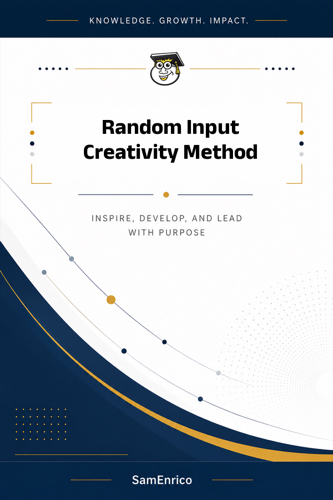
Random Input Creativity Method eBook
Stimulate fresh ideas using unrelated stimuli with
Stimulate fresh ideas using unrelated stimuli with this group creativity handbook.
Formats
Free sample
Chapter 1: The Innovation Paradox--–- Every executive I have ever met believes they want creativity. They say it in annual reports, repeat it in strategy meetings, and post it on motivational posters in beige conference rooms. "We need fresh thinking." "Let's think outside the box." "Innovation is our top priority."And nearly every one of them is lying.Not maliciously. Not even consciously. But lying all the same.
Because the moment a genuinely fresh idea appears—the kind of idea that does not fit neatly into existing spreadsheets, approved budgets, or quarterly forecasts—the same executives recoil as if they have seen a snake. The idea is too risky. Too unproven. Too weird. Come back when you have something more practical.This is the Innovation Paradox: the organizations that most desperately need new ideas are biologically and culturally wired to reject them.I have spent the last fifteen years watching this paradox destroy good ideas and good people.
I have sat in hundreds of meetings where the stated goal was creativity and the unstated goal was the quiet preservation of the status quo. I have watched brilliant, passionate people learn to keep their best ideas to themselves because the punishment for novelty was swift and the reward for conformity was safe.This book is not for those people. They have already been broken by the system, and no handbook will fix that.This book is for the ones who are still fighting. The facilitators, team leads, and frustrated individual contributors who know there is a better way to generate ideas but have not yet found the tools to do it consistently. The ones who have tried traditional brainstorming and watched it fail.
The ones who have been told to "think outside the box" without being given a key to the door.The Random Input Creativity Method is that key. It is not a philosophy or a mindset or a set of vague principles about being more open to possibility. It is a procedure. A sequence of specific, repeatable steps that force the brain out of its comfortable patterns and into the uncomfortable territory where genuinely new ideas live.But before we can learn the procedure, we must understand why it is necessary. We must understand why the brain—your brain, my brain, the brains of everyone in your organization—actively resists the very thing it claims to want.The Machine That Hates Surprise The human brain is the most sophisticated pattern-recognition system in the known universe.
It takes approximately one hundred milliseconds to recognize a face, two seconds to assess a stranger's emotional state, and less time than that to register whether a situation feels safe or threatening.This speed comes at a cost. The brain does not process reality in real time. It processes reality through prediction. It constantly forecasts what will happen next based on what has happened before, and it penalizes deviations from those forecasts with a burst of neural static called "prediction error."Prediction error is uncomfortable. It triggers a cascade of physiological responses: increased heart rate, heightened alertness, a subtle but unmistakable feeling of wrongness.
Your brain is telling you, in the most direct language it has, that something does not fit.This is an extraordinary survival mechanism. If you are walking through the savanna and the grass rustles in a way that does not match your prediction of wind, that prediction error might save your life. It might be a lion.But this same mechanism is catastrophic for creativity. Because every genuinely new idea is, by definition, something that did not fit your prediction. Every breakthrough is a prediction error.
And your brain is designed to make prediction error feel terrible.This is the first and most important truth of this book: your brain is not on your side when it comes to creativity.It is not your partner in innovation. It is not your ally in fresh thinking. It is a conservative, pattern-matching machine that has been optimized over millions of years to keep you alive in a world of predators and scarce resources. It does not care if you have a brilliant idea. It cares if you survive until dinner.The Three Barriers to New Thinking The brain's resistance to novelty operates through three distinct barriers.
Each one is powerful on its own. Together, they form an almost impenetrable wall between you and the ideas you need.Barrier One: The Associative Horizon Every thought exists within a network of related thoughts. When you focus on a problem, your brain automatically activates a horizon of associated concepts. If you are thinking about customer service, your associative horizon might include words like "phone," "email," "complaint," "resolution time," and "satisfaction survey."The associative horizon is useful. It allows you to think fluidly within a domain without constantly rebuilding context.
But it is also a prison. Because anything outside the horizon is rendered invisible. Your brain does not just ignore unrelated concepts. It actively suppresses them as noise.This is why you can stare at a problem for hours and never think of a solution from a different industry, a different discipline, or a different century. Those solutions exist.
They are just outside your associative horizon, and your brain has been trained to treat them as irrelevant.Barrier Two: The Familiarity Heuristic The second barrier is a cognitive bias that causes you to prefer familiar ideas over novel ones, even when the familiar ideas are objectively worse. The familiarity heuristic is not a logical calculation. It is a feeling. Familiar ideas feel right. Novel ideas feel wrong.Neuroscience has demonstrated that this feeling has a chemical basis.
Familiar stimuli trigger a small release of dopamine, the neurotransmitter associated with reward and pleasure. Novel stimuli trigger a small release of cortisol, the neurotransmitter associated with stress and anxiety.This means that when you evaluate a familiar idea and a novel idea side by side, you are not making a neutral comparison. Your brain is literally drugging you to prefer the familiar idea. You feel that the familiar idea is better because it feels better, not because it actually is better.Barrier Three: Social Conformity The third barrier is the group. Human beings are exquisitely sensitive to social signals.
We have dedicated neural circuitry for detecting approval and disapproval, inclusion and exclusion, safety and threat.When you offer a novel idea in a group setting, you are not just offering an idea. You are taking a social risk. You are exposing yourself to potential judgment, ridicule, or dismissal. And your brain knows this. It has learned from countless past experiences that novel ideas are more likely to be rejected than accepted.The result is self-censorship.
You do not share your best ideas because your brain has already calculated the social cost and decided it is not worth paying. The ideas never see the light of day. They die in the dark, and no one ever knows they existed.Why Traditional Brainstorming Fails Given these three barriers, it is remarkable that anyone still uses traditional brainstorming. The method, popularized by Alex Osborn in the 1950s, seems reasonable on its surface. Gather a group, state a problem, generate as many ideas…
This is the end of the free sample. Get the eBook to keep going. Buy now
About this book
Details
- Author
- Carrington Mariam
- Publisher
- SamEnrico
- Language
- English
- Genre
- Non-Fiction, Self-Help, Lateral Thinking
- Released
- 2026-06-06
- Pages (approx.)
- 149
- Available as
- eBook, Audiobook

Read better in the ZLOADR app
Your eBooks on your phone or tablet. Sign in with your SamEnrico account and start reading.
More by Carrington Mariam
 Historical Trauma AngerCarrington Mariam$11.99
 EQ Negotiation Tactics GuideCarrington Mariam$11.99
 Green Beret Vietnam War StoryCarrington Mariam$11.99
 The Last Voyage of the Belgica: Trapped in the Ice of the UnknownCarrington Mariam$11.99
 The Tower of Ten Thousand Shadows: The Yokai Architect's CurseCarrington Mariam$11.99
 Understanding Fuhrmann–rieger–de Sousa SyndromeCarrington Mariam$17.99
 How to Become a Director Of PhotographyCarrington Mariam$11.99
 Printed Catalog Launch HandbookCarrington Mariam$12.99
 Chinese Student EngagementCarrington Mariam$12.99
 Bike Rack Installation (Anchored)Carrington Mariam$11.99
You may also like
 Reverse Brainstorming Group GuideGaddy Celinda$11.99
 Collaborative Lateral Thinking GuideWithrow Ellamae$11.99
 Six Thinking Hats MethodSimons Ardath$11.99
 Reverse Thinking MethodDavenport Antwan$11.99
 Assumption Reversal Team GameHuber September$11.99
 Six Thinking HatsCaraballo Barabara$11.99
 Building on Bad IdeasFrancisco Felica$11.99