
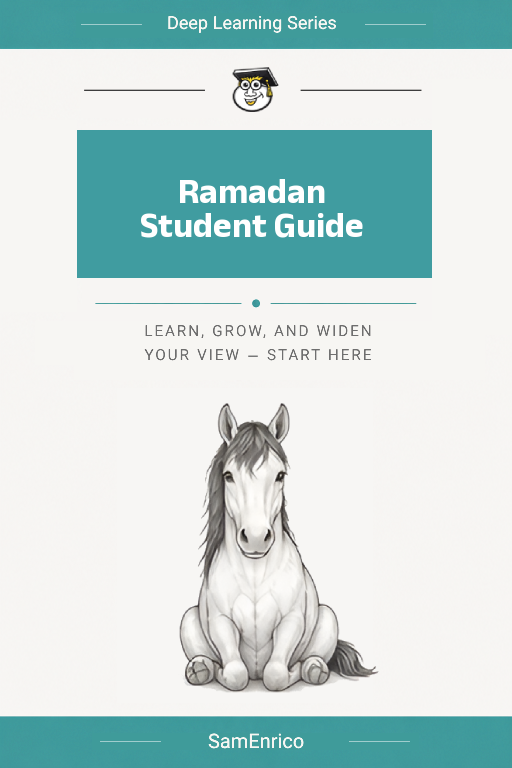
Non-FictionStudent's ShortcutReligious Observance
Ramadan Student Guide eBook
Adjust to Ramadan schedule including eating restri
Adjust to Ramadan schedule including eating restrictions, adjusted work hours, and campus closures.
Formats
Free sample
Chapter 1: The 40% Rule--–- You are sitting in a lecture hall, it is 2:47 PM, and the professor has just called on you. You have not eaten since 4:30 this morning. Your mouth is dry, your stomach is audibly gurgling, and the words on the Power Point slide have blurred into a watercolor painting. You know the answer. You studied this.
But the connection between your memory and your mouth has been severed by a combination of dehydration, low blood sugar, and the specific type of exhaustion that only comes from fasting while trying to be a student. You mumble something incoherent. The professor moves on. Your roommate, sitting two seats over, shoots you a look of pity. You feel something worse than hunger.
You feel incompetent.If this scenario makes you nod your head, you have already discovered the central lie that most Ramadan books tell students. The lie is this: Fasting is purely spiritual, and if you are struggling academically, you are simply not trying hard enough. The truth, which this entire book is built upon, is far more nuanced. Fasting while enrolled in a full course load, potentially working a part-time job, and living away from your family is not the same as fasting at home. It is a different beast entirely.
And the strategies that work for your parents or your imam will actively sabotage your GPA if applied without modification.This chapter introduces the foundational framework that resolves the single biggest contradiction in student Ramadan guides: the tension between spiritual growth and academic performance. Some books will tell you to push through every hardship as a test of faith. Others will give you a long list of excuses to break your fast. Both are wrong because both are absolute. The truth lives in a specific, measurable threshold that we will call, for the duration of this book, The 40% Rule.Understanding this rule is not optional.
It is the lens through which every other chapter—every decision about sleep, food, prayer, social life, and work—must be filtered. Get this wrong, and you will spend the entire month feeling guilty no matter what you do. Get this right, and you will navigate Ramadan not as a battlefield between your soul and your transcript, but as an integrated whole.The Student-Ramadan Gap Let us name the problem before we solve it. At home, Ramadan follows a predictable, family-centered rhythm. Iftar happens when the adhan sounds, and food appears on the table.
Suhoor is a communal event, often with a parent waking you up. Taraweeh is a short walk to the local mosque. The schedule is built around the fast, not around external obligations.On campus, the opposite is true. The academic calendar does not care about the lunar calendar. Your midterm is scheduled for the 15th of Ramadan because that is when the lecture hall was available.
The dining hall closes at 7 PM, which may be an hour before Maghrib depending on the season. Your roommate, who is not Muslim, will microwave leftover fish at 2 PM. The library reduces its hours during spring break, which may overlap with the last ten days of Ramadan. The student union food court is a minefield of smells.This is what we call the Student-Ramadan Gap—the distance between the ideal spiritual environment described in most books and the messy, secular, institutional reality of campus life. The gap is not small.
And pretending it does not exist is a recipe for burnout, academic failure, or spiritual disillusionment. Often all three.Consider the following data points, which are based on surveys of Muslim students across North American and European campuses. Sixty-three percent report a significant drop in their GPA during Ramadan semesters compared to non-Ramadan semesters. Seventy-eight percent report missing at least one prayer per week because they could not find a private space. Forty-one percent have seriously considered not fasting on an exam day.
And eighty-two percent wish they had received practical guidance before the month began, rather than spiritual platitudes.This book exists because of that 82 percent. Not to replace the spiritual dimensions of Ramadan—they are vital—but to build a scaffold around them that allows a student to actually practice their faith without destroying their academic future in the process.The Lunar Calendar Problem Before we dive into the 40% Rule, we need to understand the underlying clockwork that makes Ramadan so unpredictable for students. The Islamic calendar is lunar, meaning it is approximately 11 days shorter than the solar Gregorian calendar that governs your university. Consequently, Ramadan shifts backward by 10 to 11 days each year.This has profound implications for your academic career. Over a standard four-year degree, Ramadan will cycle through every season and, more importantly, through every phase of the academic calendar.
In your freshman year, it might fall during the quiet weeks of February. In your sophomore year, it might land squarely on final exams in December. In your junior year, it could overlap with the chaos of mid-March midterms. And in your senior year, it might coincide with thesis deadlines in April.There is no escaping this. You cannot petition the university to move Ramadan.
You cannot ask the moon to rise earlier. What you can do is stop treating each Ramadan as a surprise and start treating it as a predictable variable that you can plan for—if you know your academic calendar in advance. This book includes a planning worksheet in the appendix that allows you to map the dates of Ramadan against your syllabus for the next three years. Do that now. Do not wait until the month begins.The Failure of Absolutes Most existing Ramadan literature falls into one of two absolutist camps, and both fail the student.The first camp, which we will call the Spiritual Maximalist position, argues that fasting is an unbreakable obligation and that any difficulty—including academic difficulty—is simply a test from Allah.
According to this view, if you fail an exam because you were fasting, that failure is actually a spiritual success because you prioritized your deen over your dunya. The problem with this position is that it ignores the clear Islamic principle of rukhsah (concessions) and the equally clear command to not destroy yourself with your own hands (Quran 2:195). Allah does not require you to fail your degree as a proof of your piety. That is not Islam; that is self-harm dressed in religious language.The second camp, which we will call the Concession Maximalist position, argues that students are essentially travelers and therefore eligible for every possible concession. According to this view, any hint of difficulty justifies breaking the fast, and students should simply make up the days after graduation.
The problem with this position is that it drains Ramadan of its transformative power. The hunger, the thirst, the discipline of controlling your base desires—these are not bugs in the system. They are features. Fasting is meant to be difficult in the same way that exercise is meant to be difficult. If you skip every workout that makes you sweat, you will never get stronger.The 40% Rule is the third way.The 40% Rule Defined Here is the rule in its simplest form: Training applies to…
This is the end of the free sample. Get the eBook to keep going. Buy now
About this book
Details
- Author
- Olivares Renato
- Publisher
- SamEnrico
- Language
- English
- Genre
- Non-Fiction, Student's Shortcut, Religious Observance
- Released
- 2026-05-29
- Pages (approx.)
- 149
- Available as
- eBook, Audiobook

Read better in the ZLOADR app
Your eBooks on your phone or tablet. Sign in with your SamEnrico account and start reading.
More by Olivares Renato
 High-Risk Region Executive Retreat DrillsOlivares Renato$11.99
 Senator Judicial Philosophy GuideOlivares Renato$11.99
 Seasonal Dysthymia GuideOlivares Renato$11.99
 Self Hypnosis Dental PainOlivares Renato$11.99
 Post Entry Amendment GuideOlivares Renato$11.99
 Whispers from the Sky: The Untold Story of the 1972 Soviet Space DogOlivares Renato$11.99
 The Fire Below: Ferdinand von Hochstetter and the Birth of Australian VolcanologyOlivares Renato$11.99
 Security Project ManagerOlivares Renato$11.99
 Supply Chain Risk RegisterOlivares Renato$12.99
 How to Become a Cell CleanerOlivares Renato$11.99
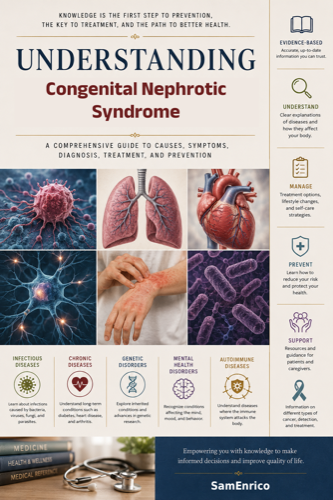 Understanding Congenital Nephrotic SyndromeOlivares Renato$17.99
You may also like
 Hong Kong Handover 1997Dunn Johnnie$11.99
 Zumba For Postnatal Recovery CourseNeal Christian$11.99
 Zumba for BeginnersLadner Nikia$11.99
 YouTube Comment Mining GuideHumes Pandora$12.99
 Worry Box MeditationCarlin Rudy$11.99
 Workplace Stress MeditationNguyen Lynn$11.99
 Workplace Stress and Sleep RepairHawley Ivory$11.99
 Workplace Perfectionism CureDelaney Jeffry$11.99
 Workplace Injustice Anger GuideWallen Isabelle$11.99
 Work Addiction and Burnout LinkGreenwood Ester$11.99
 Women in Yoga and WellnessBeattie Galina$11.99
 Women in Stand Up ComedyChun Evangeline$11.99