
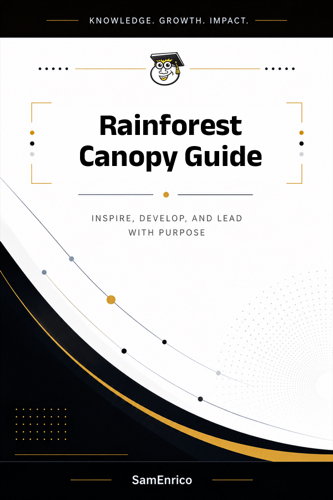
Non-FictionSelf-HelpRainforest
Rainforest Canopy Guide eBook
Rests in treetops, hearing rain and monkey calls.
Rests in treetops, hearing rain and monkey calls.
Formats
Free sample
Chapter 1: The Vertical Escape...--The ticket was one-way. I remember staring at it in the fluorescent glare of the airport terminal, my thumb pressed against the cheap thermal paper as if testing whether it was real. Los Angeles International to Quito, Ecuador. No return flight booked. No hotel reserved.
No plan except a name scrawled on a napkin—a guide a coworker had mentioned three years ago at a holiday party, someone who took small groups into the Amazon canopy. I had saved the napkin in a desk drawer, buried under quarterly reports and performance reviews, as if some future version of myself might need an escape hatch. That future version was now sitting in Gate 27B, wearing hiking boots I had bought the day before, carrying a backpack that weighed more than I did.Six months earlier, I had been standing in a different kind of terminal. Not an airport—a hospital corridor, fluorescent lights again but colder, more clinical. The kind of light that shows you every flaw in your skin, every crack in your composure.
I was waiting for test results after a car accident that should have killed me. A drunk driver on the 405, a spinout at seventy miles per hour, the sickening crunch of metal folding like paper. I walked away with bruised ribs and a concussion. The other driver walked away too, escorted by police, his face blank and unrepentant. But something else didn't walk away.
Something inside me had come loose.The doctors called it post-traumatic stress. My soon-to-be-ex-wife called it the final straw. She had been calling it other things for years—distant, unavailable, married to my job—but the accident was the excuse she needed. By the time I was cleared to return to work, she had already moved out. The apartment we had shared for twelve years became a museum of absence: empty hooks where her coats hung, a second bathroom with no toothbrush, a bed that felt obscenely large.
I threw myself into work with the fervor of a man trying to outrun his own shadow. Sixty-hour weeks. Eighty-hour weeks. I was a senior vice president at a logistics firm, which meant I spent my days optimizing supply chains and my nights staring at spreadsheets until my eyes blurred. The company gave me a bonus for my dedication.
They did not ask if I was okay.No one asked if I was okay.That is not entirely true. My assistant, a young woman named Priya who had more emotional intelligence than everyone in the C-suite combined, asked me three times over the course of two months. Each time I deflected with a joke about mergers and acquisitions. Each time she nodded and did not believe me. On the fourth time, she slid a folded piece of paper across my desk.
It was the napkin. She had remembered the holiday party conversation. "His name is Mateo," she said. "He runs expeditions in the Yasuní rainforest. You mentioned him once.
I called him. He has a spot opening next month."I laughed. I actually laughed. "I don't know the first thing about the rainforest.""No," she agreed. "But you don't know the first thing about being happy either.
At least one of those things is fixable."That was three weeks ago. Now I was on a twin-propeller plane descending through cloud cover, the windows streaked with condensation, the woman beside me clutching a rosary and whispering prayers in Spanish. The pilot announced our approach to Coca, a small town that served as the gateway to the Amazon. Below us, the patchwork of farmland gave way to something darker, denser, more alive. The rainforest.
It looked like a green ocean, rolling and infinite, with rivers cutting through it like silver veins. I pressed my forehead against the cold window and felt something I had not felt in months: a small, fragile flicker of anticipation.The landing was rough. The airstrip was a single strip of asphalt carved out of the jungle, and the plane braked hard, throwing us against our seatbelts. The rosary woman crossed herself three times. I unbuckled and grabbed my bag, stepping out into air so thick with humidity it felt like breathing underwater.
The heat was immediate and overwhelming, a physical presence that wrapped around me like a wet blanket. My glasses fogged instantly. I wiped them on my shirt, which was already damp with sweat, and looked around.Coca was not a town so much as a staging ground. A few dusty streets, a market selling rubber boots and machetes, a dock where motorized canoes idled in brown water. The people moved with a purpose I recognized—the efficiency of those who worked in extreme conditions.
No one lingered. No one window-shopped. You got what you needed and you left, because the jungle was always waiting, always watching, always ready to reclaim anything left unattended for too long.I found Mateo at a café that consisted of four plastic tables and a propane stove. He was shorter than I expected, maybe five-foot-six, with skin leathered by decades of sun and a face that seemed permanently amused. His hair was gray and pulled back in a short ponytail.
His hands were the hands of a climber—thick calluses, strong fingers, nails trimmed to the quick. He stood when I approached and extended his right hand. His grip was precise, not crushing but not tentative either. An evaluation disguised as a handshake."You're late," he said."My flight was delayed.""Flights are always delayed." He sat back down and gestured to the empty chair across from him. "Sit.
Eat. We leave in two hours. You will not eat again until tomorrow."I sat. A woman appeared with a bowl of soup and a plate of rice and beans. I ate mechanically, not tasting anything, while Mateo watched me with the patience of someone who had spent his life observing animals in the wild.
I realized I was being studied. My posture, my appetite, the way I held my fork—all of it was data."You are afraid of heights," he said. It was not a question."How did you know?""Your shoulders. They are up by your ears. People who carry tension in their necks are either afraid of falling or afraid of being seen.
You are about to sleep a hundred and fifty feet above the ground, so I am betting on the falling."I set down my fork. "Is that going to be a problem?"Mateo considered this. "Fear is not a problem. Fear is information. The problem is what you do with it." He stood and walked toward the dock without waiting for me to follow.The canoe ride took four hours.
The motor was a small outboard engine that coughed black smoke and vibrated through the aluminum hull, sending tremors up through my tailbone and spine. We traveled up the Napo River, then turned into a smaller tributary, then an even smaller one, until the water was brown and glassy and the trees on either side formed a tunnel of green. The canopy closed over us, blocking out the sky, and the light turned the…
This is the end of the free sample. Get the eBook to keep going. Buy now
About this book
Details
- Author
- Manuel Charmaine
- Publisher
- SamEnrico
- Language
- English
- Genre
- Non-Fiction, Self-Help, Rainforest
- Released
- 2026-06-06
- Pages (approx.)
- 132
- Available as
- eBook, Audiobook

Read better in the ZLOADR app
Your eBooks on your phone or tablet. Sign in with your SamEnrico account and start reading.
More by Manuel Charmaine
 Taekwondo Hypnosis WorkbookManuel Charmaine$11.99
 Virtual Offboarding CommunicationManuel Charmaine$11.99
 Senior Social Media ComparisonManuel Charmaine$11.99
 Floating on Still WaterManuel Charmaine$11.99
 The Deep Work EnvironmentManuel Charmaine$11.99
 Basketball Hypnosis GuideManuel Charmaine$11.99
 Affirmations for Body ImageManuel Charmaine$11.99
 The Phantom of the Seine: Paris' Luxury Car Killer (1920s)Manuel Charmaine$11.99
 The Last Swing: How a Legend Fell on the Golf’s Grandest StageManuel Charmaine$11.99
 Uguisu: Japanese Bush WarblerManuel Charmaine$11.99
 A Collector's Handbook to the Wolseley 45, ViperManuel Charmaine$11.99
 Weekly Marketing DashboardManuel Charmaine$12.99
You may also like
 Hong Kong Handover 1997Dunn Johnnie$11.99
 Zumba For Postnatal Recovery CourseNeal Christian$11.99
 Zumba for BeginnersLadner Nikia$11.99
 YouTube Comment Mining GuideHumes Pandora$12.99
 Worry Box MeditationCarlin Rudy$11.99
 Workplace Stress MeditationNguyen Lynn$11.99
 Workplace Stress and Sleep RepairHawley Ivory$11.99
 Workplace Perfectionism CureDelaney Jeffry$11.99
 Workplace Injustice Anger GuideWallen Isabelle$11.99
 Work Addiction and Burnout LinkGreenwood Ester$11.99
 Women in Yoga and WellnessBeattie Galina$11.99
 Women in Stand Up ComedyChun Evangeline$11.99