
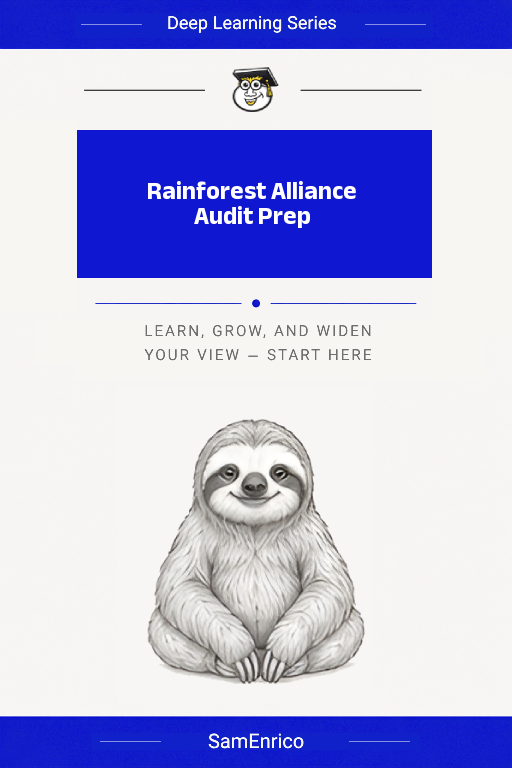
Non-FictionBusiness BriefEnvironmental ComplianceAudit Readiness
Rainforest Alliance Audit Prep eBook
Prepare for sustainable agriculture certification
Prepare for sustainable agriculture certification covering ecosystem protection, worker rights, and farm management for tropical exports.
Formats
Free sample
Chapter 1: Beyond the Green Frog--The first time Maria Vasquez heard the words “major non-conformity,” she was standing in her own coffee processing shed, surrounded by the parchment beans that represented her family’s entire year of work. The auditor from the certification body had just finished reviewing her worker records. Maria remembers the exact sound of the pen clicking shut, the way the auditor wouldn’t meet her eyes, and the sinking realization that the certification she had spent eight months preparing for was about to slip away.“Your housing inspection records don’t match your worker roster,” the auditor said. “And your geodata submission has three plots missing from the polygon file. I’m afraid these are both major NCs.”Maria’s cooperative, a group of 147 smallholder coffee farmers in the Colombian department of Antioquia, had already signed contracts with a European buyer contingent on Rainforest Alliance certification.
The buyer had been clear: no certificate by March 31st, no contract. The audit was on March 15th. She had sixteen days to fix problems she didn’t even know existed until that moment.What Maria didn’t know then—what this entire book will teach you—is that her audit failure was not inevitable. The auditor wasn’t unfair. The standard wasn’t impossibly strict.
Maria had simply prepared for the wrong version of the audit. She had studied the 2020 requirements, worked through checklists designed for Version 1.3, and trained her workers on protocols that had become obsolete three months before her audit date.Maria’s story has a happy ending—she ultimately passed after a grueling 90-day corrective action period, though she lost the European contract and had to sell her cooperative’s harvest at non-certified prices, a loss of nearly $87,000. But her story is also a warning. The rules changed. And if you’re reading this book, you need to know exactly what changed, why it matters, and how to prepare for the audit that actually exists today.This chapter is your wake-up call.
The Rainforest Alliance certification you think you know—the one with checklists and annual audits and a simple pass-fail system—no longer exists. In its place is something more sophisticated, more demanding, and ultimately more valuable: a regenerative agriculture standard that rewards performance, punishes complacency, and requires a fundamentally different approach to preparation.The Day Everything Changed If you have been certified under the Rainforest Alliance or UTZ programs before 2025, you are familiar with the old way of doing things. Version 1.3 of the Sustainable Agriculture Standard, which governed certification from 2020 through 2025, operated on a relatively simple premise. There were core requirements you had to meet. There were improvement requirements you had to work toward.
There were Smart Meters that tracked your progress. And every year, or every two years depending on your risk level, an auditor showed up, checked boxes, and issued a pass or fail.That system is gone.On March 1, 2026, Version 1.4 of the Rainforest Alliance Sustainable Agriculture Standard became fully binding for all certificate holders worldwide -8. This was not a minor update. This was not a few tweaks to the annexes. This was a fundamental restructuring of how the Rainforest Alliance defines sustainable agriculture, measures compliance, and rewards performance.The most important change is philosophical, but it has practical implications that will affect every aspect of your audit preparation.
The Rainforest Alliance has shifted from a sustainability framework to a regenerative agriculture framework -4. What is the difference? Sustainability, as traditionally defined in certification programs, is about doing less harm. It is about maintaining the status quo, reducing negative impacts, and ensuring that farming practices don’t degrade the environment or exploit workers beyond acceptable thresholds.Regenerative agriculture, by contrast, is about creating more good. It is about improving soil health year over year.
It is about increasing biodiversity, not just protecting what remains. It is about building climate resilience, not just adapting to changing conditions. And most importantly for your audit preparation, regenerative agriculture is measured by outcomes, not just by compliance with rules.This shift has profound implications for how auditors evaluate your farm. Under Version 1.3, an auditor might check whether you had a pesticide application log. Under Version 1.4, the auditor checks whether your pesticide use is declining year over year.
Under Version 1.3, the auditor verified that you had a child labor policy. Under Version 1.4, the auditor verifies that you have a remediation system that actually identified and fixed child labor cases. Under Version 1.3, you could pass by meeting the minimum standard. Under Version 1.4, you are rewarded—substantially—for exceeding it.The Rainforest Alliance describes this evolution in straightforward terms: “Sustainability helps us ‘do less harm,’ but regeneration aims to ‘create more good’” -4. For coffee-growing regions, cocoa farms in West Africa, tea estates in Kenya, and palm oil operations in Indonesia, this distinction is enormous.
Healthier soils and restored biodiversity don’t just protect yields. They build resilience into the entire supply chain, from farmer to roaster to retailer.But here is what the Rainforest Alliance’s marketing materials won’t tell you: this shift also makes the audit harder. Much harder. Because outcomes are harder to measure and verify than simple compliance. Because continuous improvement requires documentation that most farms don’t have.
Because the auditors themselves are still learning how to apply the new standard consistently. And because the consequences of failure are more severe than ever before.The Performance-Based Incentives Revolution The single most important change in Version 1.4—the one that will determine how often you are audited, how much the audit costs, and how attractive your certified products are to buyers—is the introduction of performance-based incentives -1.Under Version 1.3, all certified farms were treated essentially the same for audit purposes. Yes, there were different risk classifications that affected sample sizes for group certifications. But the fundamental structure was uniform: you got audited on a schedule, regardless of whether you were an exemplary farm or a farm barely scraping by.Version 1.4 destroys that uniformity. It replaces it with a tiered system that rewards high performers with dramatically reduced audit burdens and punishes low performers with increased scrutiny -5.The system has three performance levels: Good, Great, and Outstanding.
Each level comes with specific benefits and specific requirements to maintain that status.Good performance is the baseline. To qualify, you must have no history of non-certification or cancellation in the last three years. That is it. If you have been certified continuously for three years without major compliance failures, you achieve Good status. The benefit?
You may be allowed to reduce the sample size of your next audit -1. For a group certification involving hundreds of smallholders, this reduction can save thousands of dollars in audit fees.Great performance requires more. In addition to three years of clean history, you must demonstrate no loss of physical traceability in your supply chain. You must have no deforestation or encroachment on protected areas, verified through geospatial data. And you must have no application of prohibited pesticides from the Rainforest Alliance’s Red List -5.
The benefit? You may further reduce your audit sample size and scope. This means fewer member farms inspected, fewer documents reviewed, and a shorter…
This is the end of the free sample. Get the eBook to keep going. Buy now
About this book
Details
- Author
- Jobe Katharine
- Publisher
- SamEnrico
- Language
- English
- Genre
- Non-Fiction, Business Brief, Environmental Compliance, Audit Readiness
- Released
- 2026-06-01
- Pages (approx.)
- 135
- Available as
- eBook, Audiobook

Read better in the ZLOADR app
Your eBooks on your phone or tablet. Sign in with your SamEnrico account and start reading.
More by Jobe Katharine
 The Folding Nap TechniqueJobe Katharine$11.99
 Remote Productivity MythsJobe Katharine$11.99
 Anticipatory Parent Loss GuideJobe Katharine$11.99
 Mercari Listing ComparisonJobe Katharine$11.99
 Bipolar Spectrum WorkbookJobe Katharine$11.99
 Iodine and ThyroidJobe Katharine$11.99
 Alibaba Trade Manager GuideJobe Katharine$11.99
 How To Say No GracefullyJobe Katharine$11.99
 Global Crisis CoordinationJobe Katharine$11.99
 The Great Influenza: How 1918’s Silent Killer Reshaped the WorldJobe Katharine$11.99
 Quetzalcoatl's Serpent Flight: The Feathered Serpent's Divine TestJobe Katharine$11.99
 Ashen Tides: The Volcano That Stole a KingdomJobe Katharine$11.99
You may also like
 Hong Kong Handover 1997Dunn Johnnie$11.99
 Zumba For Postnatal Recovery CourseNeal Christian$11.99
 Zumba for BeginnersLadner Nikia$11.99
 YouTube Comment Mining GuideHumes Pandora$12.99
 Worry Box MeditationCarlin Rudy$11.99
 Workplace Stress MeditationNguyen Lynn$11.99
 Workplace Stress and Sleep RepairHawley Ivory$11.99
 Workplace Perfectionism CureDelaney Jeffry$11.99
 Workplace Injustice Anger GuideWallen Isabelle$11.99
 Work Addiction and Burnout LinkGreenwood Ester$11.99
 Women in Yoga and WellnessBeattie Galina$11.99
 Women in Stand Up ComedyChun Evangeline$11.99