
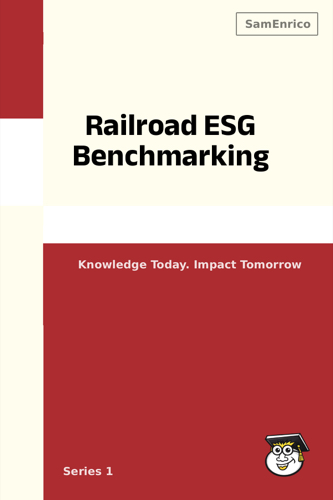
Non-FictionStrategic AtlasRail ESG
Railroad ESG Benchmarking
Evaluate electrification rates and efficiency amon
by Britt Marlen
Evaluate electrification rates and efficiency among North American and European rail firms.
Formats
About this book
Free sample
Chapter 1: The Silent Divergence–- On a cold morning in February 2023, a 12,000-horsepower electric locomotive glided silently out of Rotterdam, its only sound the rhythmic hum of transformers and the soft squeal of steel on rail. That train would cross five countries in eighteen hours, emitting zero tailpipe CO2, drawing power from a grid fed by Dutch offshore wind and German solar. Six thousand kilometers away, an equivalent freight train departed Chicago at the same moment, pulled by two diesel-electric locomotives burning 3,000 gallons of fuel before lunch, its exhaust stacking white against the Illinois sky. Both trains carried intermodal containers. Both moved at comparable speeds.
Both were operated by world-class railroads. And yet, their environmental fingerprints could not have been more different.This is the silent divergence at the heart of modern railroading—a technological chasm that ESG frameworks have largely failed to measure, let alone bridge. The statistic that haunts every sustainability conversation in the industry is simple: North American mainline freight electrification languishes below one percent, while major European corridors average fifty to ninety-five percent electrification. Switzerland achieves one hundred percent. Italy exceeds eighty percent.
Germany approaches sixty percent. The United States, for all its rail innovation and freight efficiency, remains a diesel nation. Canada follows the same pattern. The question is not whether this gap exists—it does—but what it means for investors, policymakers, and railroad executives who must navigate an era of decarbonization mandates, net-zero commitments, and intensifying ESG scrutiny.The Numbers That Demand Explanation Let us begin with precision. According to the European Union Agency for Railways, as of 2024, the EU electrified rail network stands at approximately fifty-four percent of total route kilometers, with heavy-traffic freight corridors exceeding eighty percent in countries like the Netherlands, Switzerland, and Austria.
The International Union of Railways (UIC) reports that electric traction accounts for over sixty percent of all rail traffic in Europe by ton-kilometers. In contrast, the U.S. Federal Railroad Administration (FRA) places mainline freight electrification below one percent—essentially zero when excluding passenger transit systems like Amtrak’s Northeast Corridor, which is a special case. Canadian Pacific Kansas…
This is the end of the free sample. Get the eBook to keep going. Buy now
Contents
- Chapter 1
- Chapter 2
- Chapter 3
- Chapter 4
- Chapter 5
- Chapter 6
- Chapter 7
- Chapter 8
- Chapter 9
- Chapter 10
- Chapter 11
- Chapter 12
Details
- Author
- Britt Marlen
- Publisher
- SamEnrico
- Language
- English
- Genre
- Non-Fiction, Strategic Atlas, Rail ESG
- Released
- 2026-06-06
- Pages (approx.)
- 142
- Available as
- eBook, Audiobook

Read better in the ZLOADR app
Your eBooks on your phone or tablet. Sign in with your SamEnrico account and start reading.
More by Britt Marlen
 Lupus Pregnancy Loss Support CourseBritt Marlen$11.99
 The Kirk Bloodsworth StoryBritt Marlen$11.99
 Metta for InsomniaBritt Marlen$11.99
 The Sales Nonverbal PersuasionBritt Marlen$11.99
 The Enlightenment Sky: How Thinkers Lit the Fuse of ProgressBritt Marlen$11.99
 Planogram SpecialistBritt Marlen$11.99
 10 Ways to Use Dextrose Equivalent (Recipe Book)Britt Marlen$11.99
 Brazil Dropshipping Market GuideBritt Marlen$12.99
 Week Two Mentor Prospect ListBritt Marlen$12.99
 Understanding Schamberg's DiseaseBritt Marlen$17.99
You may also like
 Hong Kong Handover 1997Dunn Johnnie$11.99
 Zumba For Postnatal Recovery CourseNeal Christian$11.99
 Zumba for BeginnersLadner Nikia$11.99
 YouTube Comment Mining GuideHumes Pandora$12.99
 Worry Box MeditationCarlin Rudy$11.99
 Workplace Stress MeditationNguyen Lynn$11.99
 Workplace Stress and Sleep RepairHawley Ivory$11.99
 Workplace Perfectionism CureDelaney Jeffry$11.99
 Workplace Injustice Anger GuideWallen Isabelle$11.99
 Work Addiction and Burnout LinkGreenwood Ester$11.99
 Women in Yoga and WellnessBeattie Galina$11.99
 Women in Stand Up ComedyChun Evangeline$11.99