
Non-FictionSelf-HelpJournaling
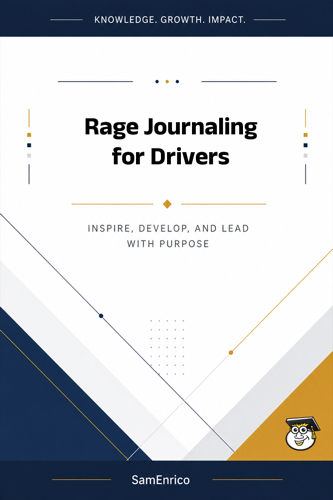
Rage Journaling for Drivers eBook
Records incidents to identify rage patterns.
by Irvine Shyla
Records incidents to identify rage patterns.
Formats
Free sample
Chapter 1: The 1.3 Million Statistic--The first time you lost your temper behind the wheel, you probably didn't think much of it. A muttered curse. A hard press of the horn. A hand gesture you wouldn't want your mother to see. Then you moved on with your day, convinced that nothing had really happened.
The other driver was the problem. The traffic was the problem. The late start, the bad weather, the construction, the poorly timed traffic light—these were the villains. Your anger was just a reasonable response to an unreasonable world.That is the lie this book exists to dismantle.Here is the truth that most drivers will never confront: what you call "getting a little angry" is not a harmless release of steam. It is the first step onto a ladder that ends in arrest, injury, or death.
Not maybe. Not sometimes. Statistically, predictably, and avoidably.Let me show you the number you cannot unsee.The Number That Should Terrify Every Driver Every year, approximately 1.3 million people die on the world's roads. That is not a typo. 1.3 million human beings—fathers, mothers, children, friends, colleagues—die in traffic crashes annually.
To put that number in perspective, it is equivalent to a Boeing 747 crashing every single hour of every single day, 24 hours a day, 365 days a year. It is more than the entire population of cities like Dallas, San Diego, or Berlin. It is the leading cause of death for young people aged five to twenty-nine worldwide.And here is the part the news cycles rarely emphasize: aggressive driving behaviors are a direct contributing factor in a significant percentage of those deaths.The American Automobile Association has tracked road rage incidents for nearly three decades. Their data shows that over that period, the number of fatal crashes involving aggressive driving behaviors has increased every single year. Not plateaued.
Not fluctuated. Increased. In the most recent year with complete data, aggressive driving played a role in more than half of all fatal crashes. That means that on any given day, on any given highway, the person who seems "a little angry" is statistically closer to becoming a killer than they believe themselves to be.But numbers like 1.3 million are abstract. They are too large to feel.
So let me make this personal.The Ladder You Are Already Climbing Here is the critical distinction that most drivers never learn, and that distinction is the difference between a bad habit and a criminal record.Aggressive driving is a behavior. It includes speeding, tailgating, unsafe lane changes, running red lights, blocking other drivers from merging, and failing to yield. These are traffic violations. They are dangerous, they are illegal, and they kill people. But they are not yet road rage.Road rage is a criminal escalation of aggressive driving.
It includes verbal abuse, yelling, threatening gestures, physical assault, using a vehicle as a weapon, chasing another driver, and confrontation after leaving the vehicle. Road rage is not a traffic violation. It is a crime. In most jurisdictions, road rage behaviors can be charged as assault with a deadly weapon, reckless endangerment, menacing, or attempted vehicular homicide.The ladder looks like this:Rung one: Annoyance. You sigh audibly.
You grip the wheel a little tighter.Rung two: Provocation. You honk. You flash your lights. You make a gesture.Rung three: Escalation. You tailgate.
You block someone from merging. You speed up to prevent being passed.Rung four: Confrontation. You yell out the window. You make threatening gestures. You follow someone.Rung five: Assault.
You get out of the car. You use your vehicle as a weapon. You physically confront another driver.Here is what most drivers do not realize: once you take the first step onto this ladder, momentum carries you upward faster than you expect. The driver who honked in frustration last week is the same driver who tailgated last month is the same driver who followed someone off an exit ramp last year. There are no distinct personality types—"honkers" versus "chasers." There is only a ladder, and you are on it.The Science of Why You Cannot "Just Let It Go"You have probably been told to "just let it go" or "don't let them get to you." And you have probably found that advice useless.
That is not because you lack willpower. It is because the person giving that advice does not understand how your brain works.Your brain contains a small, almond-shaped structure called the amygdala. Its job is to detect threats. When the amygdala perceives danger—including social threats like disrespect, humiliation, or being wronged—it initiates what psychologists call the "fight or flight" response. Your heart rate spikes.
Your breathing quickens. Stress hormones (cortisol, adrenaline, norepinephrine) flood your bloodstream. Your prefrontal cortex—the part of your brain responsible for rational thought, impulse control, and long-term planning—is partially suppressed.This response evolved to help you survive predators on the savanna. It is designed for physical threats that require immediate, decisive action. It is not designed for someone merging without signaling.But your amygdala does not know the difference.
To your ancient, survival-oriented brain, being cut off in traffic feels the same as being attacked by a lion. The physiological response is identical. And once that response begins, it takes approximately ninety seconds for the stress hormones to clear your bloodstream. There is no way to turn it off instantly. There is no switch labeled "calm down." There is only the biological reality of ninety seconds.This is not a weakness.
This is not a character flaw. This is human neurobiology. Every single person reading this book has the same ninety-second window between trigger and physiological recovery. The difference between drivers who rage and drivers who remain calm is not the presence or absence of the ninety-second wave. It is what they do during those ninety seconds.Why Your Journal Will Save You (And Your Phone Cannot)This book is called Rage Journaling for Drivers for a reason.
The journaling part is not incidental. It is the entire mechanism of change.Recent research in neuroplasticity—the brain's ability to rewire itself—has demonstrated something remarkable. When you write by hand, you activate neural pathways that remain dormant when you type or speak. Handwriting forces your brain to slow down. It requires you to move from abstract emotion (I feel angry) to concrete language (At 5:15 PM, at the intersection of Main and 5th, a car merged without signaling, and I thought to myself, "He did that on purpose").
That translation from feeling to words is the precise moment when your prefrontal cortex re-engages. It is the moment you step out of the reactive limbic system and into the reasoning brain.You cannot handwrite your way through a rage incident while driving. That is not the suggestion. But you can, within minutes of arriving at your destination, sit down with a dedicated notebook and a pen and document exactly what happened. That act of documentation—not the thinking about it, not the venting about it, but the structured, written recording of it—is the single most effective tool for rewiring your automatic rage response.Why not use a phone app?
Why not type notes? Because typing is too fast. Typing allows you to stay in the reactive, emotional part of…
This is the end of the free sample. Get the eBook to keep going. Buy now
About this book
Details
- Author
- Irvine Shyla
- Publisher
- SamEnrico
- Language
- English
- Genre
- Non-Fiction, Self-Help, Journaling
- Released
- 2026-06-10
- Pages (approx.)
- 129
- Available as
- eBook, Audiobook

Read better in the ZLOADR app
Your eBooks on your phone or tablet. Sign in with your SamEnrico account and start reading.
More by Irvine Shyla
 Living Abroad for SEO SpecialistsIrvine Shyla$11.99
 IBS Social Life GuideIrvine Shyla$11.99
 Scheduling for New ParentsIrvine Shyla$11.99
 The Freelance Skill Upgrade PathIrvine Shyla$11.99
 Inoculation Theory GuideIrvine Shyla$11.99
 Distraction Proof Your Morning GuideIrvine Shyla$11.99
 Pilates for Spinal Stenosis ReliefIrvine Shyla$11.99
 Teen Self Esteem for GirlsIrvine Shyla$11.99
 The Whalebone Hunters: The Forgotten African Mariners of Madagascar (1680-1750)Irvine Shyla$11.99
 Red Dust Rising: The Forgotten Heroines of Mars Mission ControlIrvine Shyla$11.99
 Gold, Lies, and Tape: The 1988 Seoul Olympics Doping ScandalIrvine Shyla$11.99
 How to Start a Radio Commentators - Independent BusinessIrvine Shyla$11.99
You may also like
 Hong Kong Handover 1997Dunn Johnnie$11.99
 Zumba For Postnatal Recovery CourseNeal Christian$11.99
 Zumba for BeginnersLadner Nikia$11.99
 YouTube Comment Mining GuideHumes Pandora$12.99
 Worry Box MeditationCarlin Rudy$11.99
 Workplace Stress MeditationNguyen Lynn$11.99
 Workplace Stress and Sleep RepairHawley Ivory$11.99
 Workplace Perfectionism CureDelaney Jeffry$11.99
 Workplace Injustice Anger GuideWallen Isabelle$11.99
 Work Addiction and Burnout LinkGreenwood Ester$11.99
 Women in Yoga and WellnessBeattie Galina$11.99
 Women in Stand Up ComedyChun Evangeline$11.99