
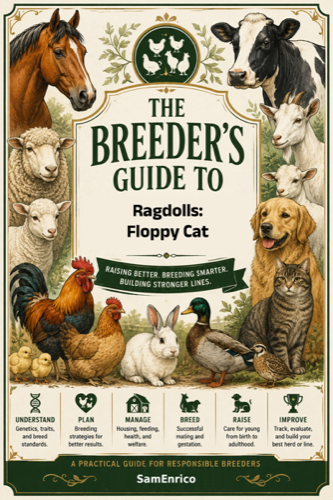
Non-FictionInformativeEducational
Ragdolls: Floppy Cat eBook
This wildlife publication, published by SamEnrico,
This wildlife publication, published by SamEnrico, covers Ragdolls: Floppy Cat
Formats
Free sample
Chapter 1: The Woman Who Trademarked Magic...--The story of the Ragdoll cat does not begin with a scientific paper, a veterinary conference, or an orderly breeding program with color-coded charts and pedigreed lineages. It begins, as so many improbable stories do, in the sprawling suburban heat of Riverside, California, in the mid-1960s, with a woman named Ann Baker who saw something extraordinary in a scrappy white cat with a damaged past. That woman would go on to trademark a breed, feud with the entire cat fancy establishment, and leave behind a legacy so tangled in myth, contradiction, and fierce loyalty that separating fact from folklore has become a detective story in its own right.To understand the Ragdoll—the floppy, dog-like, blue-eyed companion that has captured the hearts of millions—you must first understand Ann Baker. She was not a gentle, grandmotherly breeder content to let her cats speak for themselves. She was, by all accounts, a force of nature: opinionated, secretive, paranoid, and utterly convinced that she had stumbled upon something revolutionary.
Whether she was a genius or a charlatan depends entirely on whom you ask. But one thing is certain: without Ann Baker’s peculiar blend of obsession and showmanship, there would be no Ragdoll.This chapter is not a dry recitation of dates and names. It is an investigation into the foggy, almost mythical origins of the breed—a journey through car accidents and government conspiracies, bitter legal battles, and a schism that split the Ragdoll world into two irreconcilable branches. By the end, you will understand why the Ragdoll’s origin story is as contested as the breed itself, and why the truth—however mundane—is more fascinating than the legend.The Landscape of Mid-Century Cat Breeding Before we meet Ann Baker, we must understand the world she entered. In the 1960s, cat breeding in America was a niche hobby, a quiet pursuit of gentlemen farmers and eccentric widows who kept meticulous records and competed for ribbons at cat shows organized by the Cat Fanciers’ Association (CFA) and, later, The International Cat Association (TICA).
Breeds like the Persian, Siamese, and Burmese dominated the show rings. These were established breeds with long histories, strict standards, and closed gene pools. New breeds were rare, and when they did appear, they emerged through decades of careful, documented line-breeding.Ann Baker was not a typical member of this world. She was a Persian breeder, yes, but she was also something else: a rule-breaker, a conspiracy theorist, and a woman with an unshakable belief in her own vision. While other breeders played by the rules, Baker created her own.
She would not ask permission. She would not submit to the judgment of show judges she considered corrupt. Instead, she would trademark a name, form her own association, and control her cats the way a CEO controls a proprietary formula.This rebellious streak would define her life and the breed she created. It would also guarantee that the Ragdoll’s birth certificate would never be clean.The Cat at the Center of the Storm: Josephine Every origin story needs a protagonist, and for the Ragdoll, that protagonist is a white angora-type cat named Josephine. The details of Josephine’s life are maddeningly vague, and different sources offer dramatically different accounts.
Here is what is generally agreed upon:Josephine was a feral or semi-feral white cat living in the neighborhood of Ann Baker’s Riverside home. She had long, silky fur—more angora than Persian—and a tendency to produce kittens that, by all accounts, were unusually friendly and relaxed. At some point in the mid-1960s, Josephine was hit by a car. She survived, but the accident left her injured. Then something strange happened: after the accident, Josephine’s subsequent litters were said to be even more placid than before.
Her kittens went limp when held, like rag dolls. They followed people around like dogs. They seemed to have no fear.This is the version of the story that Ann Baker promoted. She claimed that the car accident had somehow altered Josephine’s genetics, producing a new kind of cat—a mutation, perhaps, or something more mysterious. She even hinted that government laboratories and genetic experiments might be involved.
In a 1980s interview that has become legendary among Ragdoll enthusiasts, Baker suggested that Josephine had been part of a secret research program and that the “floppy” trait was the result of genetic manipulation.Most people dismissed these claims as nonsense. Geneticists certainly do. A car accident cannot alter a cat’s DNA. A trait that appears after an injury is either coincidental (the cat already carried the genes) or unrelated (the injury had nothing to do with the kittens’ temperament). But Baker’s willingness to entertain—and promote—such theories tells us something important about her character.
She was not content to be a simple breeder. She wanted to be a visionary, a discoverer of secrets that others could not see.The more plausible, if less cinematic, version of the story is this: Josephine was a feral cat who carried a rare combination of recessive genes for pointed coloration, blue eyes, and relaxed muscle tone (hypotonia). These genes were not new; they existed in the general cat population, scattered and unremarkable. What Ann Baker did was not create something from nothing—it was recognize something rare and breed it systematically. That is the quiet miracle of animal husbandry: not invention, but selection.Daddy Warbucks and the First Ragdolls Josephine alone could not found a breed.
She needed a stud, and Baker found him in a large, dark-pointed male she named Daddy Warbucks. The name is fitting: Daddy Warbucks was the wealthy, protective benefactor from the Little Orphan Annie comic strip. In Baker’s breeding program, he would play the same role—the patriarch, the foundation sire, the cat whose descendants would carry the Ragdoll name into the future.Baker bred Josephine to Daddy Warbucks, and the resulting kittens displayed the traits she sought: large size, blue eyes, pointed coloration, and that peculiar limpness when held. She repeated the breeding, then bred the offspring back to Daddy Warbucks and to each other, fixing the traits through selective inbreeding. This is standard practice in the early stages of breed development, though it carries risks of genetic disorders—risks that Ragdoll breeders still manage today through careful health testing and gene pool management.The kittens from these early litters became the foundation of the breed.
Baker gave them whimsical names—Raggedy Ann, Raggedy Andy, and so on—and began selling them to a small circle of buyers. She also did something unprecedented: she trademarked the name “Ragdoll.”Let that sink in. Most cat breeds are named descriptively (Persian, Siamese, Maine Coon) or after their place of origin. No one owns the name “Siamese” or “Persian.” But Ann Baker, with the help of a lawyer, secured a trademark on “Ragdoll,” making it legally her property. This meant that anyone who wanted to call their cat a Ragdoll had to buy from her, sign her contracts, and follow her rules.The Iron Fist of the IRCAIn 1971, Ann Baker founded the International Ragdoll Cat Association (IRCA), a registry that existed…
This is the end of the free sample. Get the eBook to keep going. Buy now
About this book
Details
- Author
- Cassidy Reuben
- Publisher
- SamEnrico
- Language
- English
- Genre
- Non-Fiction, Informative, Educational
- Released
- 2026-05-09
- Pages (approx.)
- 142
- Available as
- eBook, Audiobook

Read better in the ZLOADR app
Your eBooks on your phone or tablet. Sign in with your SamEnrico account and start reading.
More by Cassidy Reuben
 LBO Value Creation DashboardCassidy Reuben$11.99
 EQ Daily Practice GuideCassidy Reuben$11.99
 Circadian Rhythm Sleep WakeCassidy Reuben$11.99
 Financial Services M&A MultiplesCassidy Reuben$11.99
 Emotional Validation for AdopteesCassidy Reuben$11.99
 Senior Dating ConfidenceCassidy Reuben$11.99
 Self Hypnosis for Chronic Pain SleepCassidy Reuben$11.99
 Forensic Odontology TrainingCassidy Reuben$11.99
 The Illuminated Scrolls: How Medieval Monks Laid the Foundation for AnimationCassidy Reuben$11.99
 Madness on Trial: The Birth of the Insanity Defense in Victorian EnglandCassidy Reuben$11.99
 How to Produce a DeckCassidy Reuben$11.99
 How to Produce PET Training PadsCassidy Reuben$11.99
You may also like
 Hong Kong Handover 1997Dunn Johnnie$11.99
 Zumba For Postnatal Recovery CourseNeal Christian$11.99
 Zumba for BeginnersLadner Nikia$11.99
 YouTube Comment Mining GuideHumes Pandora$12.99
 Worry Box MeditationCarlin Rudy$11.99
 Workplace Stress MeditationNguyen Lynn$11.99
 Workplace Stress and Sleep RepairHawley Ivory$11.99
 Workplace Perfectionism CureDelaney Jeffry$11.99
 Workplace Injustice Anger GuideWallen Isabelle$11.99
 Work Addiction and Burnout LinkGreenwood Ester$11.99
 Women in Yoga and WellnessBeattie Galina$11.99
 Women in Stand Up ComedyChun Evangeline$11.99