
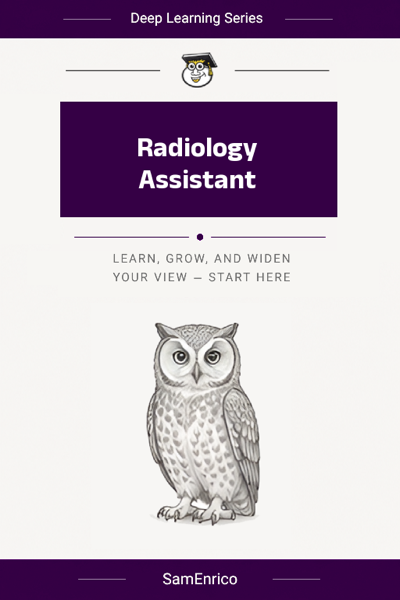
Non-FictionInformativeEducational
Radiology Assistant eBook
A Coursebook on Radiology Assistant
by Casey Nettie
A Coursebook on Radiology Assistant
Formats
Free sample
Chapter 1: Beyond the Button--The image on the screen looked perfect. The lungs were clear, the heart shadow was normal, and the bones were intact. But the patient—a 47-year-old woman who had walked into the emergency department two hours earlier with mild chest discomfort—had just stopped breathing. The Radiology Assistant who had positioned her for that chest X-ray was the last person to see her conscious. The person who pushed the exposure button had no idea that within sixty seconds, they would be performing CPR on the cold, linoleum floor of the X-ray room.
The image was beautiful. The patient was dead. And nobody had asked the one question that might have saved her life.This is not a fictional scenario. It is a composite drawn from real malpractice cases, incident reports, and root cause analyses published across three decades of radiology literature. In every single case, the common thread was not equipment failure, not a lack of technical skill, and not even a missed diagnosis on the image.
The common thread was a breakdown in the most fundamental function of the Radiology Assistant: the ability to see the patient behind the image, to assess the person before pressing the button, and to recognize that a perfect radiograph means nothing if the patient is no longer alive to be diagnosed.Welcome to the real world of radiology. You are about to learn that your stethoscope is just as important as your centering light, that your interview skills will save more lives than your positioning checklists, and that the most dangerous place in the hospital is not the emergency department or the operating room—it is the radiology suite where a busy technologist assumes that someone else has already done the assessment. This chapter will redefine what it means to be a Radiology Assistant, not as a button-pusher or a film-critic, but as a clinical professional whose primary tool is not the X-ray tube but the patient interview.The Myth of the "Simple" X-ray There is a persistent myth in healthcare that radiography is a purely technical field. Medical students rotate through radiology and marvel at the equipment. Surgeons call down to the department and ask for "a quick film." Emergency physicians order portable chest X-rays on unstable patients with the casual assumption that the technologist will "just get the picture." Even some Radiology Assistants internalize this myth, believing that their job begins and ends with positioning, centering, and exposing.This myth is deadly.Consider the following data.
A prospective study of 1,200 consecutive patients referred for outpatient chest X-rays found that 8% had vital sign abnormalities that were not documented on the requisition and had not been communicated to the radiology department. Of those, 2% had findings that required immediate medical intervention—including one patient with a blood pressure of 210/120 who was sent home after the X-ray because no one had checked. Another study examining closed malpractice claims in radiology found that communication failures—not technical errors—accounted for 63% of all preventable adverse events. The most common communication failure was the failure to obtain or communicate critical patient information before the examination.The Radiology Assistant stands at a unique intersection. You are not a nurse, so you may not have formal training in physical assessment.
You are not a physician, so you cannot order interventions. But you are the last person who sees the patient before the image is taken, and in many settings—night shifts, rural hospitals, urgent care centers—you may be the only healthcare professional in the room when the patient deteriorates. Your ability to recognize the difference between a stable outpatient and a patient in occult shock is not a nice-to-have skill. It is the difference between an image that helps and a lawsuit that destroys.Defining the Entry-Level Radiology Assistant The title "Radiology Assistant" means different things in different parts of the world. This book is written for the entry-level practitioner—whether you call yourself an Assistant Practitioner in the United Kingdom, a Radiologic Technologist with expanded duties in the United States, a Medical Radiation Technologist in Canada, or a Radiology Assistant in Australia and parts of Europe.
What unites these roles is a scope of practice that includes patient positioning, image acquisition, basic contrast administration (oral and rectal, with IV administration varying by jurisdiction), and image quality assessment, but does not include primary image interpretation. That critical task remains the domain of the radiologist.The United Kingdom Model. The Assistant Practitioner role emerged in the early 2000s as a direct response to workforce shortages in the National Health Service. These practitioners typically complete a two-year Foundation Degree that combines classroom instruction with supervised clinical practice. They work under the supervision of a registered radiographer, and their scope includes plain film radiography of the chest, extremities, and axial skeleton, assistance with fluoroscopy procedures, and basic patient care.
In most trusts, they cannot sign off on images independently, and they cannot administer intravenous contrast. Their value lies in freeing registered radiographers to perform more complex procedures and image interpretation.The United States Landscape. The United States has no national standard for Radiology Assistants, which creates both opportunities and confusion. Individual states regulate the scope of practice for radiologic technologists through licensure laws. Some states, such as California, Florida, and Texas, have created a distinct "Radiology Assistant" title, usually requiring a bachelor's degree and additional certification from the American Registry of Radiologic Technologists (ARRT).
In other states, the term is used informally for technologists who perform expanded duties under radiologist supervision. To avoid confusion, this book uses "Radiology Assistant" to mean any entry-level practitioner who performs radiographic examinations and patient care under supervision—not the Master's-level advanced practitioner who performs preliminary image reads. If you are pursuing that advanced role, refer to the online supplement referenced at the end of this chapter.Canada and Australia. In Canada, the Medical Radiation Technologist (MRT) completes a three-year or four-year degree and performs the full range of diagnostic imaging. Some provinces have created advanced practice roles similar to the US model, but the entry-level MRT functions much like a senior technologist.
In Australia, the Radiographer is the primary imaging professional, while the "Radiology Assistant" is a newer role that supports radiographers and radiologists. The variations are significant, but the core competencies—patient assessment, positioning, image acquisition, and safety—are universal.What does this mean for you, the student reading this chapter? It means you must learn to be adaptable. The specific tasks you are allowed to perform will vary depending on your employer, your state or provincial regulators, and your supervising radiologist. But the fundamental skills of patient assessment, emergency recognition, and professional communication are universal.
No matter where you practice, no matter what your job title says, you will be expected to recognize a sick patient, escalate appropriately, and protect the patient from harm. A note at the end of this chapter provides a quick reference table summarizing scope variations across major jurisdictions.The Interdisciplinary Team: Knowing Your Place Radiology is not a solo sport. Even in the smallest clinic, you will work alongside other professionals whose roles overlap with yours and whose boundaries you must respect. Understanding these roles is not…
This is the end of the free sample. Get the eBook to keep going. Buy now
About this book
Details
- Author
- Casey Nettie
- Publisher
- SamEnrico
- Language
- English
- Genre
- Non-Fiction, Informative, Educational
- Released
- 2026-06-02
- Pages (approx.)
- 133
- Available as
- eBook, Audiobook

Read better in the ZLOADR app
Your eBooks on your phone or tablet. Sign in with your SamEnrico account and start reading.
More by Casey Nettie
 Harvard Extension School Career OutcomesCasey Nettie$11.99
 Police Nonverbal TrainingCasey Nettie$11.99
 The Furniture Off gassing GuideCasey Nettie$11.99
 Burnout and Creative RecoveryCasey Nettie$11.99
 When the Sky Fell: The Navajo Emergence StoryCasey Nettie$11.99
 How to Produce Bicycle ComputersCasey Nettie$11.99
 How to Start a Nonalcoholic Beverage Bar BusinessCasey Nettie$11.99
 Proposal Revision ChecklistCasey Nettie$12.99
You may also like
 Hong Kong Handover 1997Dunn Johnnie$11.99
 Zumba For Postnatal Recovery CourseNeal Christian$11.99
 Zumba for BeginnersLadner Nikia$11.99
 YouTube Comment Mining GuideHumes Pandora$12.99
 Worry Box MeditationCarlin Rudy$11.99
 Workplace Stress MeditationNguyen Lynn$11.99
 Workplace Stress and Sleep RepairHawley Ivory$11.99
 Workplace Perfectionism CureDelaney Jeffry$11.99
 Workplace Injustice Anger GuideWallen Isabelle$11.99
 Work Addiction and Burnout LinkGreenwood Ester$11.99
 Women in Yoga and WellnessBeattie Galina$11.99
 Women in Stand Up ComedyChun Evangeline$11.99