
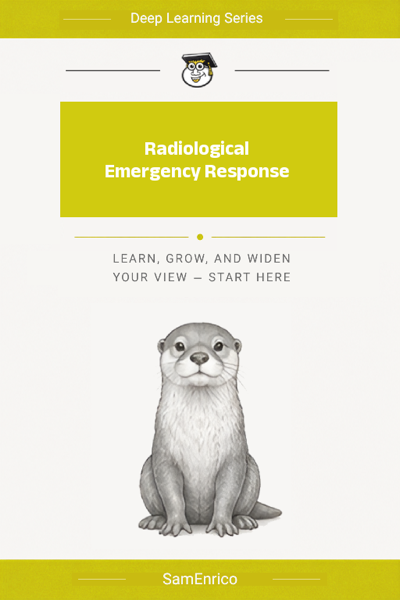
Non-FictionInformativeEducational
Radiological Emergency Response eBook
A Coursebook on Radiological Emergency Response
A Coursebook on Radiological Emergency Response
Formats
Free sample
Chapter 1: The Blue Glow--–- The blue glow was beautiful, the men later said. Like a fluorescent light underwater. Like magic. On the evening of September 13, 1987, two scavengers named Roberto dos Santos Alves and Wagner Mota Pereira broke into an abandoned radiotherapy clinic in Goiânia, Brazil, looking for scrap metal. They found a small, heavy cylinder that hummed with an unnatural warmth.
Inside that cylinder was 93 grams of cesium-137 chloride, a fine powder that shimmered with a pale blue light in the darkness. Roberto pried the cylinder open with a screwdriver. The powder spilled onto his hands. He wiped it off on his pants and kept working.Neither man knew that they had just released one of the most dangerous substances on earth. Cesium-137 is a fission product, created when uranium or plutonium atoms split in nuclear reactors or weapons.
It emits high-energy gamma radiation that can pass through walls, through bodies, through lead if the lead is thin enough. Its half-life is thirty years, which means it will remain dangerously radioactive for longer than a human lifespan. A single gram, if uniformly distributed and inhaled, could theoretically deliver a lethal dose to every person within a kilometer. The cylinder they stole was designed to hold a teletherapy source for cancer treatment, shielded by several centimeters of lead and steel. The men had no idea what they were holding.
They loaded the cylinder onto a wheelbarrow and took it home.Over the next eighteen days, the glowing powder passed from hand to hand. Friends gathered to admire it. A six-year-old girl named Leide das Neves rubbed it on her skin like glitter, fascinated by the light. Her mother brought pieces of the material to show neighbors, unaware that each fragment was a tiny, persistent bomb. By the time the authorities finally recognized the disaster, four people were dead, more than 250 were contaminated, and 112,000 required monitoring.
The woman who owned the house where the cylinder was opened watched her family die one by one. She later said that she could not understand how something so beautiful could be so deadly.The people of Goiânia were not stupid. They were not careless. They were simply unequipped to recognize an enemy they could not see, smell, or taste. Radiation does not announce itself.
It does not cause immediate pain. It does not leave visible wounds, at least not at first. By the time the symptoms appear – nausea, vomiting, diarrhea, fatigue – the damage is already done. The cells that divide most rapidly are the first to die: bone marrow, intestinal lining, hair follicles, skin. The body begins to fail from the inside out.But the tragedy of Goiânia was not inevitable.
If the first responders who arrived at the clinic had known what to look for, if the hospital staff who treated the vomiting patients had recognized the signs, if anyone had possessed a simple radiation detector, the deaths could have been prevented. The knowledge existed. The equipment existed. The training did not.This chapter exists to close that gap. By the time you finish reading, you will understand what radiation actually is, why some types are more dangerous than others, and how to protect yourself using three simple principles.
You will learn to distinguish between being exposed to radiation and being contaminated by it – a distinction that saves lives. You will know how to read a dosimeter, how to calculate your own safety in the field, and when to walk away versus when to act. This is not theoretical physics. This is operational knowledge. It has been tested in real emergencies, from Chernobyl to Fukushima to the dirty bomb simulations in major cities around the world.
It works.Let us begin with the most important truth about radiation: It follows rules. Learn the rules, and you can survive.The Atom That Refuses to Settle Down To understand radiation, you must first understand the atom. Every atom consists of a nucleus – made of protons and neutrons – surrounded by a cloud of electrons. Protons carry a positive charge. Electrons carry a negative charge.
Neutrons carry no charge at all. In a stable atom, the number of protons equals the number of electrons, and the nucleus holds together because the strong nuclear force overcomes the electromagnetic repulsion between the positively charged protons.But not all atoms are stable. Some have too many neutrons. Some have too many protons. Some have an imbalance that makes the nucleus energetic, like a coiled spring waiting to release.
These unstable atoms are called radioisotopes. To become stable, they release energy in the form of particles or waves. That release is radioactive decay.Each radioisotope decays at a characteristic rate called its half-life. The half-life is the time it takes for half of a given amount of the material to decay into a more stable form. Cesium-137, the isotope that poisoned Goiânia, has a half-life of thirty years.
That means if you had one hundred grams of cesium-137 today, in thirty years you would have fifty grams. In sixty years, twenty-five grams. In ninety years, twelve and a half grams. The material will persist for generations, which is why contaminated sites must be sealed off for decades.Some radioisotopes have half-lives measured in seconds. Iodine-131, a major concern in nuclear reactor accidents, has a half-life of eight days.
This is both good news and bad news. The bad news is that iodine-131 is intensely radioactive while it lasts – it decays rapidly, which means it releases its energy quickly. The good news is that after a few months, it is essentially gone. This is why the emergency response to a reactor accident focuses on the first few weeks. After that, the threat diminishes.Other radioisotopes have half-lives measured in thousands or even millions of years.
Plutonium-239, used in nuclear weapons, has a half-life of 24,000 years. It will outlast human civilization as we know it. This is why plutonium contamination is treated with such extraordinary care. Once it is in the environment, it is there forever.The concept of half-life matters for responders because it tells you how long a threat will persist. If you are dealing with a short-lived isotope, time is on your side.
Shelter in place for a few days, and the danger will have decayed significantly. If you are dealing with a long-lived isotope, evacuation and permanent relocation may be necessary. This distinction will reappear throughout this book, particularly in Chapter 5 when we discuss protective action guides and in Chapter 10 when we discuss nuclear fallout.The Four Messengers of Destruction Not all radiation is the same. The four types you will encounter in radiological emergencies behave differently, penetrate differently, and require different protective measures. Think of them as four messengers, each carrying destruction in a different form.Alpha radiation is the heaviest and slowest.
An alpha particle consists of two protons and two neutrons bound together – exactly the nucleus of a helium atom. It travels at about five percent of the speed of light, which sounds fast but is actually quite slow for a subatomic particle. Because alpha particles are large and carry a positive charge, they lose energy quickly when passing through matter.…
This is the end of the free sample. Get the eBook to keep going. Buy now
About this book
Details
- Author
- Marroquin Ola
- Publisher
- SamEnrico
- Language
- English
- Genre
- Non-Fiction, Informative, Educational
- Released
- 2026-05-04
- Pages (approx.)
- 144
- Available as
- eBook, Audiobook

Read better in the ZLOADR app
Your eBooks on your phone or tablet. Sign in with your SamEnrico account and start reading.
More by Marroquin Ola
 IBS Meditation GuideMarroquin Ola$11.99
 TM Sitting Position GuideMarroquin Ola$11.99
 Mayor of the Burning CityMarroquin Ola$11.99
 The Funnel for RestaurantsMarroquin Ola$11.99
 Small Talk for Virtual MeetingsMarroquin Ola$11.99
 Plastic Dreams: The Rise and Fall of the Etch A Sketch EmpireMarroquin Ola$11.99
 The Spy Who Crossed the Color Line: James Armistead Lafayette’s Double GameMarroquin Ola$11.99
 Understanding Cleft Lip Palate EctrodactylyMarroquin Ola$17.99
 How to Become a Chamfering-machine Operator IMarroquin Ola$11.99
 Capacity Resource LevelingMarroquin Ola$12.99
 Business Plan Table Of ContentsMarroquin Ola$12.99
You may also like
 Hong Kong Handover 1997Dunn Johnnie$11.99
 Zumba For Postnatal Recovery CourseNeal Christian$11.99
 Zumba for BeginnersLadner Nikia$11.99
 YouTube Comment Mining GuideHumes Pandora$12.99
 Worry Box MeditationCarlin Rudy$11.99
 Workplace Stress MeditationNguyen Lynn$11.99
 Workplace Stress and Sleep RepairHawley Ivory$11.99
 Workplace Perfectionism CureDelaney Jeffry$11.99
 Workplace Injustice Anger GuideWallen Isabelle$11.99
 Work Addiction and Burnout LinkGreenwood Ester$11.99
 Women in Yoga and WellnessBeattie Galina$11.99
 Women in Stand Up ComedyChun Evangeline$11.99