
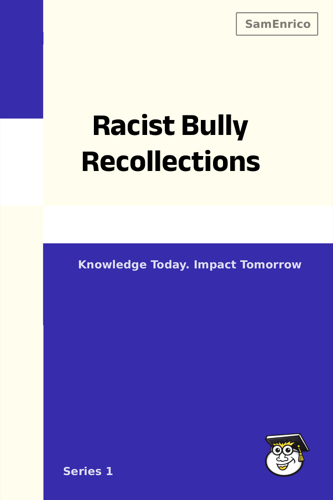
Racist Bully Recollections eBook
Endure slurs and stereotypes while finding unexpec
by Finney Meg
Endure slurs and stereotypes while finding unexpected allies in the schoolyard.
Formats
Free sample
Chapter 1: The Glass Breaking--–- The first time someone calls you a racist name, you don't actually hear the word. Not at first. What you hear is a change in the air—a shift so sudden and wrong that your brain freezes for a full second before the sound decodes into meaning. I was eight years old, playing four-square on a cracked asphalt playground, when a boy from the other fourth-grade class bounced the ball directly at my feet and said something I had only ever heard adults whisper on television news reports about people who lived very far away. He said it with a smile, like he was sharing a joke.
The other kids laughed. I did not know what the word meant, but I knew—with a certainty that had no language—that something had just broken inside the universe, and I would spend the rest of my life trying to find the pieces.That is the thing about the first slur. It does not arrive as an insult. It arrives as a revelation. Before that moment, you were just a kid who liked swings and hated math homework.
After that moment, you are something else: a category, a target, a body marked by history you never lived through but are somehow expected to answer for. The glass breaks, and you spend the rest of your childhood trying to figure out whether you can glue it back together or whether you have to learn to see through the cracks.This chapter is about that moment. Not the bullying that follows—that comes later, in patterns and packs. Not the allies who may or may not appear—they come later too. This chapter is about the first time, the singular moment when racial identity becomes conscious not through pride or culture or family stories, but through the weapon of a word.
We will explore how age shapes the impact of that first slur, why some children seem to shrug it off while others carry it for decades, and what the difference is between a wound that festers and a scar that teaches. We will also begin to answer the question that haunts every survivor of racist bullying: Who was I before the glass broke, and can I ever find that child again?The Anatomy of a Slur Before we go further, we need to understand what a racial slur actually is—not as a dictionary definition, but as a social and psychological weapon. A slur is not simply a bad word. There are plenty of bad words that children shout at each other on playgrounds: "stupid," "ugly," "loser." Those words hurt, but they attack something external—your actions, your appearance, your temporary status. A racial slur is different.
A racial slur attacks your very existence. It says, not "you did something wrong," but "you are something wrong."Linguists call this "performative hate." When someone uses a racial slur, they are not just describing you. They are doing something to you. They are invoking centuries of violence, exclusion, and dehumanization. They are summoning a ghost—the ghost of every person who has ever been called that word and then enslaved, lynched, expelled, or erased.
The slur is a time machine. It brings all of that history into the present moment, and it drops it onto your shoulders.For a child, this is incomprehensible. How can one word carry so much weight? How can a fourth-grader with a missing front tooth wield the power of a plantation owner? The child does not understand the history, but the child feels the weight.
That is the terror of the first slur: you become the endpoint of a long line of violence you never chose to join.The Age of First Contact Children do not all experience the first slur the same way, because children at different ages have radically different cognitive and emotional tools for processing an attack on their identity. Drawing on developmental psychology and the memoir literature—including Trevor Noah's Born a Crime, where he learns that being "mixed" is a crime under apartheid long before he fully understands what apartheid means, and Claudia Rankine's Citizen, where the accumulation of microaggressions becomes unbearable—we can identify three distinct age bands of first impact. These are not rigid categories. Children develop at different rates, and trauma does not follow a calendar. But these bands offer a useful framework for understanding your own experience or the experience of a child you are trying to help.Ages 5 to 8: The Confusion Wound For the youngest children, a racial slur is heard but not understood.
They know the word is bad because of how it is said—the sneer, the laughter from other kids, the way the teacher suddenly goes quiet and looks at the floor. But they cannot define the word. They cannot locate it in history. They cannot tell you why it hurts, only that it does, and that the hurt feels different from the hurt of falling off a bike or losing a game.I interviewed a woman named Priya, now thirty-two, who remembered being called a slur in first grade during a game of tag. She is South Asian, and the slur was one of those words that targets her skin and her family's immigration story.
"I went home and asked my mother what that word meant," she told me. "My mother's face went white. She said, 'Who called you that?' And I said, 'I don't know, a boy. But what does it mean?' My mother didn't answer. She just held me very tight and cried.
So I learned that the word was so terrible that even adults couldn't say it out loud. That's what scared me more than the word itself—the silence after."For children in this age band, the wound is not the slur's definition. The wound is the mystery of the slur. They are given a box labeled "danger" but no key to open it. This creates a specific kind of anxiety: a low-grade, ever-present fear of an unknown threat.
They may start avoiding certain kids or certain parts of the playground without being able to explain why. They may develop stomachaches on school mornings. They may cry more easily, and when asked why, they say, "I don't know," because they genuinely do not know. They just know that something is wrong, and that wrongness has attached itself to them.The confusion wound is dangerous because it is nameless. You cannot fight what you cannot name.
You cannot seek justice for a harm you cannot articulate. Many adults who experienced their first slur between five and eight do not realize, until years later in therapy or in a conversation with a partner, that those early stomachaches were not illnesses—they were the body's first memory of racial trauma. The body knew what the mind could not yet say.Ages 9 to 12: The Historical Horror By pre-adolescence, most children have learned the basic vocabulary of race. They have heard adults talk about racism. They may have learned about slavery, segregation, or immigration discrimination in school—though often in a sanitized, half-hearted way that mentions Martin Luther King Jr.
and then moves on. They know that certain words are forbidden because they carry historical weight. They may have been…
This is the end of the free sample. Get the eBook to keep going. Buy now
About this book
Details
- Author
- Finney Meg
- Publisher
- SamEnrico
- Language
- English
- Genre
- Non-Fiction, Biography
- Released
- 2026-06-08
- Pages (approx.)
- 152
- Available as
- eBook, Audiobook

Read better in the ZLOADR app
Your eBooks on your phone or tablet. Sign in with your SamEnrico account and start reading.
More by Finney Meg
 SAS WW2 Desert RaidersFinney Meg$11.99
 Home Detox Safety GuideFinney Meg$11.99
 Immigrant Parent PressureFinney Meg$11.99
 The Mumbai Murders: When Bollywood Glitter Met Underworld BloodFinney Meg$11.99
 How to Produce Climbing RopeFinney Meg$11.99
 Reference Checking Across CulturesFinney Meg$12.99
 Technical OfficerFinney Meg$11.99
 A Beginners Guide to Punchball (Volume 1)Finney Meg$11.99
You may also like
 Hong Kong Handover 1997Dunn Johnnie$11.99
 Zumba For Postnatal Recovery CourseNeal Christian$11.99
 Zumba for BeginnersLadner Nikia$11.99
 YouTube Comment Mining GuideHumes Pandora$12.99
 Worry Box MeditationCarlin Rudy$11.99
 Workplace Stress MeditationNguyen Lynn$11.99
 Workplace Stress and Sleep RepairHawley Ivory$11.99
 Workplace Perfectionism CureDelaney Jeffry$11.99
 Workplace Injustice Anger GuideWallen Isabelle$11.99
 Work Addiction and Burnout LinkGreenwood Ester$11.99
 Women in Yoga and WellnessBeattie Galina$11.99
 Women in Stand Up ComedyChun Evangeline$11.99