
Non-FictionSelf-HelpRacial Trauma
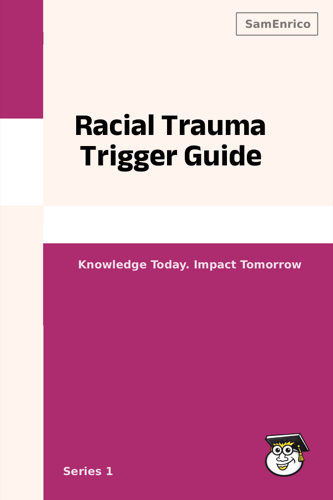
Racial Trauma Trigger Guide eBook
Manage emotional responses to discrimination, micr
Manage emotional responses to discrimination, microaggressions, and systemic racism.
Formats
Free sample
Chapter 1: The Body Keeps Score...--–- The first time you felt it, you might have called it frustration. Or anger. Or maybe you just felt tired—a bone-deep exhaustion that no amount of sleep could fix. You were in a meeting, or a classroom, or a grocery store, or simply walking down the street. Someone said something.
Or didn't say something. Someone looked at you. Or looked through you. Someone followed you. Or assumed you were someone else.
And in that moment, your chest tightened. Your jaw clenched. Your stomach dropped. Your face went hot. And then you went home and told yourself it wasn't that bad.
You told yourself you were being too sensitive. You told yourself to let it go. But your body didn't let it go. It never does.This is not a book about why racism exists. You already know why.
You have lived the why in ways that no textbook, no training video, and no well-meaning ally can fully capture. This is a book about what happens inside you in the seconds, minutes, hours, and days after a racial encounter—and what you can do about it. It is a book about triggers: the moments when the accumulated weight of a lifetime of microaggressions, discrimination, and systemic violence presses down on your nervous system and demands a response. It is a book about the body that keeps score, even when your mind tries to erase the chalkboard.This chapter is called "The Body Keeps Score" because that is the truth that this entire guide rests upon. Before you can manage your responses to racial trauma, you have to understand what racial trauma actually is—and why it is different from ordinary stress, different from standard PTSD, and different from anything the diagnostic manuals were designed to capture.
You have to understand the three specific wounds that this book will help you heal. And you have to understand why the thing everyone keeps telling you to be—resilient—might actually be hurting you more than the racism itself.The First Wound: Microaggressions and the Paper Cut Theory of Trauma Let us begin with the smallest wound, which is not small at all. Microaggressions are the everyday slights, insults, invalidations, and indignities that BIPOC individuals experience dozens—sometimes hundreds—of times per week. They are the "compliment" that feels like a cut ("You're so articulate"). The question that is not a question ("Where are you really from?").
The gesture that is not a gesture (the clutch of the purse, the lock of the car door, the cross of the street). The assumption that is not stated aloud but is loudly communicated ("You must be the janitor, not the professor"). The erasure that pretends to be kindness ("I don't see color").Each microaggression, on its own, is deniable. That is part of their power. The person who delivers one can always say, "I didn't mean it that way," or "You're being too sensitive," or "It was just a joke." And because each individual incident is small, you are socialized to absorb it.
To let it go. To not make a scene. To pick your battles. To be the bigger person.But here is what the research—and your lived experience—knows: microaggressions are not individual events. They are a cumulative exposure.
Think of them as paper cuts. One paper cut is annoying. You notice it, you wince, and then you move on. But what happens when you receive a hundred paper cuts? A thousand?
What happens when they are delivered daily, weekly, yearly, from childhood through adulthood, in schools and workplaces and houses of worship and hospitals and stores and streets and the comments section of every social media post you make? You do not develop calluses. You develop wounds. Open, oozing, overlapping wounds that never fully heal because the next cut arrives before the last one has closed.This is the first wound that standard trauma models miss. The Diagnostic and Statistical Manual of Mental Disorders (DSM-5) defines post-traumatic stress disorder (PTSD) as resulting from exposure to "actual or threatened death, serious injury, or sexual violence." It was designed around single-event traumas: a combat explosion, a car accident, a sexual assault.
It was not designed around chronic, low-grade, ambient toxicity. And yet, study after study shows that the cumulative impact of microaggressions produces symptoms that are indistinguishable from PTSD: hypervigilance, intrusive thoughts, avoidance of triggering spaces, emotional dysregulation, and a persistent sense of threat.The difference is that a combat veteran can eventually leave the war zone. You cannot leave your skin.Dr. Kevin Nadal, a leading researcher on microaggressions, has documented that the mental health impact of cumulative microaggressions is equivalent to—and in some cases worse than—the impact of major discriminatory events. A single act of explicit racism (being denied a job, being called a racial slur, being physically threatened) is undeniably traumatic.
But the daily drip of microaggressions wears down the psyche in ways that are harder to name, harder to prove, and therefore harder to heal. You cannot point to a single incident and say, "That. That is what broke me." Instead, you feel like you are breaking slowly, invisibly, and you cannot tell if the problem is racism or you.It is racism. And it is also you—your perfectly normal, perfectly predictable, perfectly human response to an abnormal environment. There is nothing wrong with you for being exhausted by microaggressions.
There would be something wrong with you if you were not.The Second Wound: Racial Battle Fatigue and the Exhaustion of Anticipation The second wound is closely related to the first, but it operates on a different register. Racial Battle Fatigue (RBF) is a term coined by Dr. William A. Smith to describe the physiological, psychological, and emotional exhaustion that results from constantly anticipating, navigating, and surviving racism. Where microaggressions are the events, RBF is the state—the chronic condition of living in a body that is always, at some level, preparing for the next cut.Think about what it takes to move through a typical day as a BIPOC individual in a predominantly white society.
Before you leave your house, you make calculations that your white counterparts do not even know exist. What should I wear? Will this hoodie make me look threatening? Will this traditional garment invite mockery or worse? Should I code-switch on this phone call?
Should I tone down my voice, my gestures, my opinions? When I get to the store, should I keep my hands visible? Should I put my wallet on the counter instead of reaching into my pocket? When I walk down the street, should I cross to avoid making someone uncomfortable—or stay to avoid looking like I am avoiding? When I enter the meeting, should I speak first to establish presence, or speak later to avoid being seen as aggressive?
When I am interrupted—because I will be interrupted—should I push back or let it go? When I am mistaken for the only other Black person in the office—again—should I correct them or laugh it off?These calculations are not paranoia. They are the product of lived experience. You have been followed.…
This is the end of the free sample. Get the eBook to keep going. Buy now
About this book
Details
- Author
- Vogt Leighann
- Publisher
- SamEnrico
- Language
- English
- Genre
- Non-Fiction, Self-Help, Racial Trauma
- Released
- 2026-06-10
- Pages (approx.)
- 155
- Available as
- eBook, Audiobook

Read better in the ZLOADR app
Your eBooks on your phone or tablet. Sign in with your SamEnrico account and start reading.
More by Vogt Leighann
 Landfill Proximity Health GuideVogt Leighann$11.99
 Pet Loss For Only ChildrenVogt Leighann$11.99
 Alcohol Recovery and PTSDVogt Leighann$11.99
 Sarcopenia Anabolic ResistanceVogt Leighann$11.99
 Quantum Computing CapitalVogt Leighann$11.99
 Pain Management Hypnosis ScriptsVogt Leighann$11.99
 Dreaming for Surgical PracticeVogt Leighann$11.99
 I Feel Statements For AngerVogt Leighann$11.99
 The Last Broadcast: The Mysterious 1938 War of the Worlds PanicVogt Leighann$11.99
 The Snowden Files: A Whistleblower's Digital ShadowsVogt Leighann$11.99
 Growing TrilliumVogt Leighann$11.99
 No-Code Automation with ZapierVogt Leighann$11.99
You may also like
 Hong Kong Handover 1997Dunn Johnnie$11.99
 Zumba For Postnatal Recovery CourseNeal Christian$11.99
 Zumba for BeginnersLadner Nikia$11.99
 YouTube Comment Mining GuideHumes Pandora$12.99
 Worry Box MeditationCarlin Rudy$11.99
 Workplace Stress MeditationNguyen Lynn$11.99
 Workplace Stress and Sleep RepairHawley Ivory$11.99
 Workplace Perfectionism CureDelaney Jeffry$11.99
 Workplace Injustice Anger GuideWallen Isabelle$11.99
 Work Addiction and Burnout LinkGreenwood Ester$11.99
 Women in Yoga and WellnessBeattie Galina$11.99
 Women in Stand Up ComedyChun Evangeline$11.99