
Non-FictionStartup GuideData AnalysisStatistics
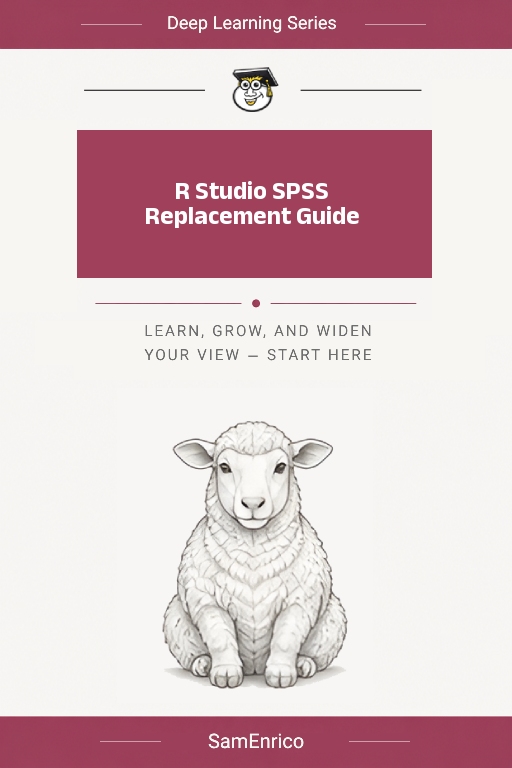
R Studio SPSS Replacement Guide eBook
Analyze data and create statistics with free R Stu
Analyze data and create statistics with free R Studio instead of paying for SPSS or SAS software.
Formats
Free sample
Chapter 1: The $2,000 Lie--Every year, you pay for a statistical software license that costs more than a used car, a semester of community college, or a round-trip flight to Europe. And what do you get in return? A spreadsheet with menus, a point-and-click interface that leaves no trace of your work, and the vague, unspoken promise that you are a "real" researcher because you use the industry standard.Here is the truth that software vendors do not want you to hear: You do not need to pay for statistics. The most powerful, flexible, and widely used statistical software in the world is completely free. It is used by data scientists at Google, analysts at the World Health Organization, and statisticians at every major pharmaceutical company.
It runs on your computer right now, requires no license key, and will never expire.That software is R. And this book will teach you how to use R Studio to replace every single function of SPSS—not as a poor substitute, but as a superior alternative.But before we write a single line of code, before we install anything, before we even open a dataset, we need to address the psychological barrier that keeps thousands of researchers paying thousands of dollars every year for software that is, by almost every objective measure, worse than the free alternative.The Fear of Leaving Let me tell you about a graduate student I once knew. Let us call her Maria. Maria was a third-year doctoral candidate in psychology. She had completed two years of coursework, passed her qualifying exams, and collected six months of experimental data.
She had done everything right. But when she sat down to analyze her results, she faced a problem. Her university had switched SPSS license providers, and her access had lapsed for eleven days during the transition. Eleven days. She could not run a t-test.
She could not create a bar chart. She could not even open her own data file.Maria panicked. She considered paying for a personal license out of pocket—$2,300 for a six-month subscription. She considered delaying her committee meeting. She considered asking her advisor for help, which would mean admitting that eleven days without software had brought her research to a complete stop.Then a friend suggested R.
Maria had heard of R. She had heard it was difficult. She had heard it required programming. She had heard that real researchers use SPSS and that R was for computer scientists, not social scientists. But she was desperate.
She downloaded R and R Studio on a Tuesday afternoon. By Thursday, she had replicated all of her descriptive statistics. By Saturday, she had run her primary analyses and created publication-ready graphs. By Monday, when her SPSS license was restored, she did not bother reinstalling it.Maria is now a professor. She has not opened SPSS in seven years.The story of Maria is not unusual.
It is the story of thousands of researchers who discover that the fear of leaving SPSS is far worse than the reality of learning R. And the biggest reason for that fear is the myth that R is hard.The Myth of Difficulty When SPSS users say "R is hard," what they usually mean is "R is different." And different feels hard because your brain has to build new pathways instead of cruising down familiar ones.Think about the last time you switched from Windows to Mac, or from Android to i Phone. For the first week, everything felt wrong. The menus were in different places. The keyboard shortcuts did not work the same way.
Simple tasks that used to take two seconds suddenly required searching, guessing, and occasional profanity. But after a month, you wondered why you had ever found it difficult. The new system was not harder—it was just unfamiliar.The same principle applies to R. SPSS has trained you to think about data analysis as a series of menu selections. You click "Analyze," then "Compare Means," then "Independent-Samples T-Test." You move variables into boxes.
You click "OK." The output appears. You copy it into a Word document. That process is comfortable because you have done it a thousand times. But is it actually easier than typing t.test(score ~ group, data = mydata)? Or is it just more familiar?The honest answer is that typing a single line of code is objectively easier than navigating three nested menus, moving variables into boxes, and clicking four buttons.
The only reason it does not feel easier is that you have not learned it yet.Here is a promise: By the end of this chapter, you will have written your first R code. By the end of this book, you will be able to perform every statistical test you currently perform in SPSS, plus many that SPSS cannot do at all. And you will never pay for statistical software again.The Financial Case: What You Are Actually Paying For Let me be precise about the costs, because software vendors rely on vagueness to make their prices seem less outrageous.An annual SPSS license for a single user costs approximately 2,300.Thatisnotthe"premium"edition—thatisthestandardedition.Ifyouwantadvancedstatistics(likemixedmodelsorsurvivalanalysis),youpayanadditional2,300. That is not the "premium" edition—that is the standard edition. If you want advanced statistics (like mixed models or survival analysis), you pay an additional 2,300.Thatisnotthe"premium"edition—thatisthestandardedition.Ifyouwantadvancedstatistics(likemixedmodelsorsurvivalanalysis),youpayanadditional1,000 to 2,000peryear.Ifyouwantstructuralequationmodeling(which SPSScannotdoatall,requiringtheseparateprogram AMOS),youpayanother2,000 per year.
If you want structural equation modeling (which SPSS cannot do at all, requiring the separate program AMOS), you pay another 2,000peryear.Ifyouwantstructuralequationmodeling(which SPSScannotdoatall,requiringtheseparateprogram AMOS),youpayanother1,000 annually. A full SPSS suite with all add-ons can easily exceed $5,000 per year.Let us do the math for a typical researcher. Suppose you start using SPSS as a graduate student and continue through a thirty-year career. That is thirty-one years of licenses (counting graduate school). Even at the "discounted" academic rate of approximately 800peryear,youwillpaynearly800 per year, you will pay nearly 800peryear,youwillpaynearly25,000 over your career.
At the commercial rate, you will pay over $70,000.Now let me ask you a question: What else could you do with $25,000? That is a down payment on a house. That is a new car. That is a year of your child's college tuition. That is funding for a research assistant for two years.
That is conference travel for a decade.And what does SPSS give you in return for that $25,000? A product that updates slowly, adds features years after they appear elsewhere, locks your data into a proprietary format, and encourages a workflow that is statistically problematic.R gives you the same core functionality—plus advanced methods, plus full reproducibility, plus an open file format, plus zero cost.The Reproducibility Crisis: Why "Click OK" Is Not OKIn 2015, a project called the Reproducibility Project published a shocking finding. They had attempted to replicate 100 psychology studies published in top journals. Only 39 of the 100 replications succeeded. The other 61 studies had results that could not be reproduced, even when the original authors provided their data and methods.This is not a problem unique to psychology.
Similar projects in economics, biology, medicine, and political science have found replication rates between 40% and 60%. Something is deeply wrong when…
This is the end of the free sample. Get the eBook to keep going. Buy now
About this book
Details
- Author
- Walston Carlee
- Publisher
- SamEnrico
- Language
- English
- Genre
- Non-Fiction, Startup Guide, Data Analysis, Statistics
- Released
- 2026-05-30
- Pages (approx.)
- 148
- Available as
- eBook, Audiobook

Read better in the ZLOADR app
Your eBooks on your phone or tablet. Sign in with your SamEnrico account and start reading.
More by Walston Carlee
 Menstrual Cycle Anger PatternsWalston Carlee$11.99
 Work Addiction Medication OptionsWalston Carlee$11.99
 Trinidadian Energy TalentWalston Carlee$11.99
 Gaming Addiction and Mental HealthWalston Carlee$11.99
 The Deep Mind of the Indian Ocean: Unraveling the Psychology of DiscoveryWalston Carlee$11.99
 Echoes of the Forgotten: The Parallel Life of Nikola TeslaWalston Carlee$11.99
 Real Estate Strategic BuyersWalston Carlee$12.99
 Understanding Chromosome 8Walston Carlee$17.99
 How to Become a Insole BevelerWalston Carlee$11.99
You may also like
 Hong Kong Handover 1997Dunn Johnnie$11.99
 Zumba For Postnatal Recovery CourseNeal Christian$11.99
 Zumba for BeginnersLadner Nikia$11.99
 YouTube Comment Mining GuideHumes Pandora$12.99
 Worry Box MeditationCarlin Rudy$11.99
 Workplace Stress MeditationNguyen Lynn$11.99
 Workplace Stress and Sleep RepairHawley Ivory$11.99
 Workplace Perfectionism CureDelaney Jeffry$11.99
 Workplace Injustice Anger GuideWallen Isabelle$11.99
 Work Addiction and Burnout LinkGreenwood Ester$11.99
 Women in Yoga and WellnessBeattie Galina$11.99
 Women in Stand Up ComedyChun Evangeline$11.99