
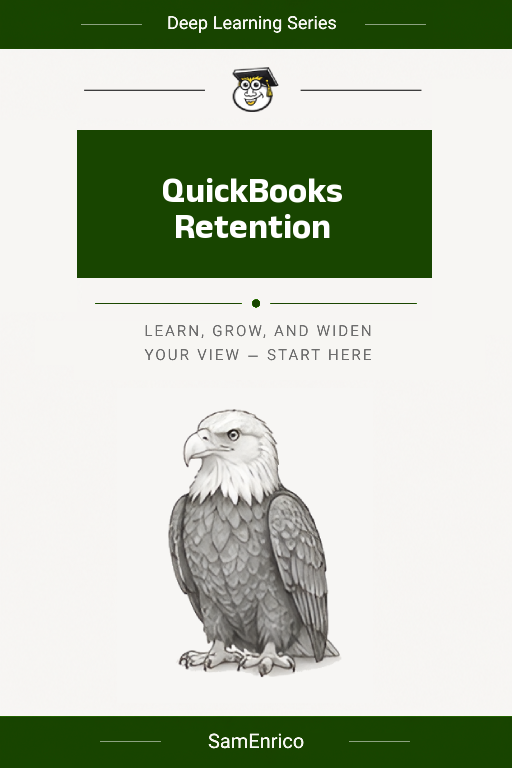
Non-FictionStrategic AtlasRetention Strategy
QuickBooks Retention eBook
Decode tax data, payroll integration, and accounta
Decode tax data, payroll integration, and accountant ecosystem that lock in small business owners.
Formats
Free sample
Chapter 1: The Integration Tax--–- Marian, the owner of a $2.3 million landscaping company, sat across from her CPA of six years and said the words every accountant dreads: “I think we need to part ways.” The CPA, a competent and caring professional named David, was stunned. He had never made a material error on her tax returns. He always answered her emails within twenty-four hours. He even sent her a holiday gift basket every December. By any traditional measure, David was a good accountant.
But Marian was leaving anyway.When David asked why, Marian didn’t cite price. She didn’t cite a mistake. She said, “I spend four hours every Monday morning manually entering payroll data from Gusto into Quick Books because they don’t talk to each other. Then I spend another two hours reconciling credit card receipts that you told me to ‘just put in a spreadsheet for now.’ Then I call you with questions, and you’re great, but by the time we talk, I’ve already wasted half a day. I’m exhausted.
My neighbor uses a bookkeeper who uses some kind of automated system, and she says she never touches her books. I want that.”David lost a client not because he failed at accounting, but because he failed at architecture. Marian was not paying an Integration Tax—she was paying the Integration Tax, and it was bankrupting her patience, her time, and ultimately her loyalty.This chapter introduces the single most misunderstood concept in modern accounting retention: the Integration Tax. It is not a metaphor. It is a measurable, calculable, daily drain on your client’s business that you, the accountant, are being blamed for—whether you created it or not.
We will define what the Integration Tax is, distinguish it from related concepts like switching penalties, introduce the Data Purity Score as your primary retention metric, and set the foundation for every strategy in this book. By the end of this chapter, you will never again mistake “being a good accountant” for “building a lock-in ecosystem.”The Great Misunderstanding: Why Good Accountants Still Lose Clients For decades, the accounting profession has operated under a quiet assumption: if you do accurate work, respond promptly, and charge fairly, clients will stay. This assumption is wrong. Not slightly wrong—catastrophically wrong. According to a 2024 study of 1,200 small business owners who switched accounting firms, only 17 percent cited “errors” as their primary reason for leaving.
Only 12 percent cited “price.” The remaining 71 percent cited variations of the same complaint: “The process was too hard,” “I spent too much time on bookkeeping,” or “Things never quite worked right.”What these clients were describing is friction. Not the friction of a difficult conversation or a complex tax situation, but the friction of disconnected systems. A payroll app that requires manual journal entries. An expense tracker that exports to CSV instead of syncing directly. A CRM that has no idea what the general ledger says.
Each of these disconnections is a tiny pebble in the client’s shoe. Alone, each pebble is bearable. But over months and years, the pebbles become gravel, the gravel becomes a boulder, and the client finally says, “I can’t walk another step.”The accountant, meanwhile, is completely unaware. David, the CPA who lost Marian, had no idea she was spending six hours every Monday on manual data entry. She had never told him.
She assumed he knew. She assumed that because he was the expert, he would have fixed it if it could be fixed. When he didn’t, she concluded that either he was incompetent or the problem was unsolvable. In fact, the problem was solvable. It would have required moving her from Gusto to Quick Books Payroll or adding a middleware layer like Apex.
David never suggested it because he didn’t know to look.This is the great misunderstanding: clients do not distinguish between “your fault” and “your problem.” If the software doesn’t work, if the data doesn’t flow, if the client is spending weekends hunched over a spreadsheet—that is your problem. Because you are the only one who can fix it. And if you don’t, someone else will.Defining the Integration Tax: Daily Friction, Not One-Time Pain Let us be precise. The term “Integration Tax” appears in software and operations literature, but this book defines it uniquely for the accounting profession:Integration Tax (noun): The cumulative daily operational friction a Primary Client experiences when their financial tools do not automatically synchronize with their core accounting system (Quick Books), measured in hours lost, errors introduced, and trust eroded.Notice the key words: daily and cumulative. The Integration Tax is not the cost of switching from one payroll provider to another (we will call that the Switching Penalty, addressed in Chapter 6).
The Integration Tax is the cost of staying in a disconnected state. It is the twenty minutes every morning spent re-typing numbers. It is the Excel spreadsheet that three different people update, each with different numbers. It is the frantic call on April 14th because the tax software doesn’t match the books.To make this concrete, consider a typical small business with:A payroll provider (say, Gusto or ADP)An expense management tool (say, Expensify)A CRM (say, Salesforce or Hub Spot)A bill pay system (say, Bill.com)Quick Books Online as the general ledger If each of these tools requires manual entry or reconciliation, the Integration Tax can be calculated as:(Minutes per manual task × Frequency per week) + (Error correction time per month) + (Client confusion time per month)A conservative estimate for a business with twenty employees and five hundred monthly transactions is 8–12 hours per week. At 100perhouroftheowner’stime(aconservativevaluation),thatis100 per hour of the owner’s time (a conservative valuation), that is 100perhouroftheowner’stime(aconservativevaluation),thatis800–1,200perweek,or1,200 per week, or 1,200perweek,or40,000–$60,000 per year.
That is the Integration Tax. And your client is paying it whether they realize it or not.The Quick Books Ecosystem: Defining the Playing Field Before we can reduce the Integration Tax, we must understand the ecosystem in which it exists. The Quick Books Ecosystem refers to the constellation of Intuit-native and third-party tools that connect to Quick Books Online (QBO) via API. This includes:Quick Books Online Accountant (QBOA): The firm-facing dashboard that manages multiple client files.Quick Books Payroll: Intuit’s native payroll solution, which creates automated journal entries without manual export.Quick Books Time (formerly TSheets): Time tracking that pushes directly to payroll and job costing.Quick Books Tax (powered by Lodgei T): Automated tax workpaper and filing integration.Third-party middleware (Apex, Qount, Finicur): Connectors that allow non-Intuit apps to sync cleanly.Adjacent apps (Expensify, Bill.com, Method, Finale): Tools that maintain two-way sync with QBO.The ecosystem is not a walled garden. You can achieve near-zero Integration Tax without using a single Intuit-native tool, as long as every app maintains a real-time, bidirectional API connection to QBO.
Conversely, you can have a high Integration Tax even while using Intuit products if they are configured incorrectly (for example, if Quick Books Payroll is not mapped to the correct classes or locations).The crucial distinction is between integrated…
This is the end of the free sample. Get the eBook to keep going. Buy now
About this book
Details
- Author
- Olmstead Shantay
- Publisher
- SamEnrico
- Language
- English
- Genre
- Non-Fiction, Strategic Atlas, Retention Strategy
- Released
- 2026-05-30
- Pages (approx.)
- 153
- Available as
- eBook, Audiobook

Read better in the ZLOADR app
Your eBooks on your phone or tablet. Sign in with your SamEnrico account and start reading.
More by Olmstead Shantay
 Nightmare Rescripting For Sleep Terror Disorder GuideOlmstead Shantay$11.99
 Bipolar And Giftedness OverlapOlmstead Shantay$11.99
 Kigali Government Grant GuideOlmstead Shantay$11.99
 Customer Service Anger TriggersOlmstead Shantay$11.99
 Restaurant Calorie Estimation GuideOlmstead Shantay$11.99
 The Alchemist of Timbuktu: The Secret Science of the SoninkeOlmstead Shantay$11.99
 Understanding Prosencephaly Cerebellar DysgenesisOlmstead Shantay$17.99
 Storytelling with Data GuideOlmstead Shantay$12.99
 How to Become a Drier AttendantOlmstead Shantay$11.99
 Data Operations LeadOlmstead Shantay$11.99
You may also like
 Hong Kong Handover 1997Dunn Johnnie$11.99
 Zumba For Postnatal Recovery CourseNeal Christian$11.99
 Zumba for BeginnersLadner Nikia$11.99
 YouTube Comment Mining GuideHumes Pandora$12.99
 Worry Box MeditationCarlin Rudy$11.99
 Workplace Stress MeditationNguyen Lynn$11.99
 Workplace Stress and Sleep RepairHawley Ivory$11.99
 Workplace Perfectionism CureDelaney Jeffry$11.99
 Workplace Injustice Anger GuideWallen Isabelle$11.99
 Work Addiction and Burnout LinkGreenwood Ester$11.99
 Women in Yoga and WellnessBeattie Galina$11.99
 Women in Stand Up ComedyChun Evangeline$11.99