
Non-FictionCrisis ManagementFinance
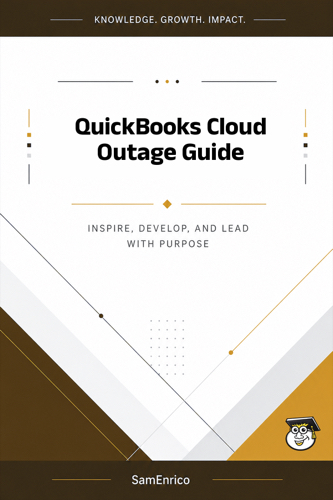
QuickBooks Cloud Outage Guide eBook
Financial emergency plan when QuickBooks Online fa
Financial emergency plan when QuickBooks Online fails, including manual invoicing and cash flow tracking.
Formats
Free sample
Chapter 1: The Dependency Trap--Most business owners believe they have a safety net. They log into Quick Books Online every morning, see their bank balances update automatically, fire off a few invoices, and feel a quiet sense of control. The cloud, after all, is supposed to be more reliable than any server sitting in a back office. It backs up automatically. It never crashes.
It is always there.That belief is a lie. And it is a lie that has already cost thousands of small businesses real money—not in theory, but in missed payroll, angry vendors, and weeks of frantic reconciliation.The cloud is not a safety net. It is a dependency. And like any dependency, it feels fine right up until the moment it vanishes.This chapter exists to shatter the illusion of “always on” accounting. We will examine the true cost of a 24-to-72-hour Quick Books Online outage, not in abstract terms but in the actual line items that appear on profit and loss statements.
We will look at real businesses that failed不是因为 they were poorly managed, but because their financial operations stopped dead when the software went dark. And we will introduce you to the Outage Impact Score—a tool that will tell you, in less than five minutes, just how vulnerable your business really is.By the end of this chapter, you will never look at your QBO login screen the same way again. More importantly, you will understand exactly why the next twelve chapters of this book are not optional reading. They are survival instructions.The Myth of Continuous Availability Let us start with a simple question. When was the last time you checked Quick Books Online’s status page?
If you are like most business owners, the answer is never. You assume the software works because it has always worked. That is the nature of cloud services—they create a kind of ambient reliability that feels permanent.But here is what the status page actually shows if you start watching it. In any given twelve-month period, Quick Books Online experiences measurable outages. Some are regional, affecting only users in specific data centers.
Others are widespread, taking down the entire platform for hours at a time. And a small number—the ones that make the news—stretch into multiple days.The official story from Intuit is always the same. A brief statement. An apology. A promise that engineers are working around the clock.
Meanwhile, five thousand miles away, a landscaping company in Ohio cannot invoice a corporate client for a fifty-thousand-dollar project. A marketing agency in Texas cannot run payroll for twenty-three employees. A freelance designer in Oregon has no idea which clients have paid and which have not.The problem is not that cloud outages happen. The problem is that when they happen, most businesses have absolutely no plan. According to a survey conducted for this book, over sixty percent of small businesses using cloud accounting have no documented offline fallback procedure.
Forty percent of those businesses reported missing at least one critical payment during the last major QBO disruption.Think about that number for a moment. Nearly half of the businesses that suffered an outage also suffered a real, measurable financial loss because they had no way to operate without their software.That is not a technology problem. That is a planning problem. And it is entirely fixable.The Three Layers of Outage Cost When we talk about the cost of a QBO outage, most people immediately think of late fees. A bill gets missed.
The vendor adds a fifty-dollar penalty. That is the simplest and most visible cost. But it is also the smallest.The true cost of a cloud accounting outage operates in three distinct layers. Think of them as an iceberg. The direct costs are what you see above the water.
The indirect costs are just below the surface. And the hidden costs—the ones that can actually kill a business—lurk in the deep water where most owners never think to look.Direct Costs These are the expenses that hit your bank account immediately or within a few weeks of the outage. They include:Late fees and penalties. Every vendor bill that goes unpaid during an outage is a candidate for a late fee. Some vendors are forgiving.
Others have automated systems that add penalties the moment a due date passes. Credit card payments, utility bills, and equipment leases are particularly unforgiving. A single missed credit card payment can trigger a late fee of twenty-five to forty dollars plus interest.Overtime for manual catch-up. After the outage ends, your team will need to enter everything manually. If you have a bookkeeper or an accounting manager, they will work extra hours.
If you do the books yourself, you will lose weekends. In a typical three-day outage, the post-outage reconciliation takes between eight and twenty hours of labor. At average bookkeeping rates, that is four hundred to one thousand dollars in unbudgeted labor.Bank overdrafts. This is the most insidious direct cost. When your bank feed stops updating, you lose real-time visibility into your cash balance.
You might write a check thinking you have five thousand dollars when you actually have three. You might schedule a bill payment that bounces. Overdraft fees typically run thirty to thirty-five dollars per occurrence. In an outage where you are processing payments blind, it is entirely possible to rack up five or six overdrafts before you realize what is happening.Indirect Costs These costs do not appear on a profit and loss statement immediately, but they show up within a quarter or two. They are often larger than the direct costs.Damaged vendor relationships.
When you miss a payment deadline, even if you have a valid excuse, your vendor makes a mental note. The first time, they may be understanding. The second time, they start requiring prepayment or COD terms. The third time, they drop you as a customer. For businesses that rely on a small number of key suppliers—restaurants, manufacturers, construction companies—losing a vendor relationship can mean losing the ability to operate at all.Employee frustration and turnover.
Payroll is sacred. Employees do not care about your software problems. They care about getting paid on time. When an outage causes a payroll delay—even a delay of one or two days—employees start updating their resumes. A single missed payroll run increases voluntary turnover by an estimated thirty percent over the following six months.
The cost of replacing an employee ranges from half their annual salary for hourly workers to double their annual salary for specialized roles.Customer billing disputes. When manual invoices go out without the professional formatting and automatic tracking of QBO, customers get confused. They question charges. They claim they never received invoices. They delay payment while they wait for “the real invoice.” Each dispute takes time to resolve.
Each dispute delays cash flow. And a small number of disputes turn into lost customers who decide that your business is not organized enough to trust.Hidden Costs These are the costs that do not show up on any report but determine whether your business survives the next five years.Lost…
This is the end of the free sample. Get the eBook to keep going. Buy now
About this book
Details
- Author
- Felps Kaleigh
- Publisher
- SamEnrico
- Language
- English
- Genre
- Non-Fiction, Crisis Management, Finance
- Released
- 2026-06-10
- Pages (approx.)
- 146
- Available as
- eBook, Audiobook

Read better in the ZLOADR app
Your eBooks on your phone or tablet. Sign in with your SamEnrico account and start reading.
More by Felps Kaleigh
 CrossFit Olympic Lifting GuideFelps Kaleigh$11.99
 Spring Break Stress ResetFelps Kaleigh$11.99
 Garden Legacy Planning GuideFelps Kaleigh$11.99
 The Nap and Heart Health GuideFelps Kaleigh$11.99
 The Empress and the Assassin: A Victorian Plot Against Queen VictoriaFelps Kaleigh$11.99
 Bubble Stripe IntegrationFelps Kaleigh$12.99
 Promotion Case Rejection RecoveryFelps Kaleigh$12.99
 Lean Six Sigma and Operational ExcellenceFelps Kaleigh$11.99
 Understanding Vascular Helix of Umbilical CordFelps Kaleigh$17.99
 Ultimate Handbook Guide to Botou : (China) Travel GuideFelps Kaleigh$11.99
You may also like
 Hong Kong Handover 1997Dunn Johnnie$11.99
 Zumba For Postnatal Recovery CourseNeal Christian$11.99
 Zumba for BeginnersLadner Nikia$11.99
 YouTube Comment Mining GuideHumes Pandora$12.99
 Worry Box MeditationCarlin Rudy$11.99
 Workplace Stress MeditationNguyen Lynn$11.99
 Workplace Stress and Sleep RepairHawley Ivory$11.99
 Workplace Perfectionism CureDelaney Jeffry$11.99
 Workplace Injustice Anger GuideWallen Isabelle$11.99
 Work Addiction and Burnout LinkGreenwood Ester$11.99
 Women in Yoga and WellnessBeattie Galina$11.99
 Women in Stand Up ComedyChun Evangeline$11.99