
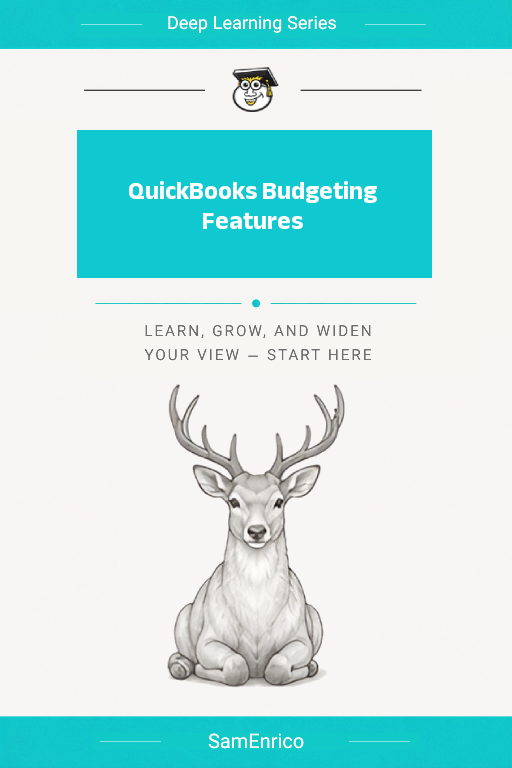
Non-FictionFirst 30 DaysBookkeeping
QuickBooks Budgeting Features eBook
Create budgets in QuickBooks and track actual vs b
Create budgets in QuickBooks and track actual vs budget. Forecast income and expenses for planning.
Formats
Free sample
Chapter 1: The Profit Mirage--–- Most small business owners are accidentally lying to themselves every single time they log into Quick Books. They open the dashboard, see a profit number, feel a wave of relief, and then wonder why there is never enough cash in the bank to pay themselves what they deserve. This disconnect between what the software says and what the checking account shows is not a glitch. It is not bad luck. It is not a temporary phase that will fix itself next quarter.
It is the single most expensive misunderstanding in entrepreneurship today.The problem is not Quick Books. The problem is how almost every owner has been taught to use it. You were shown how to record invoices, match bank transactions, and run a Profit and Loss report for your accountant at tax time. That is the equivalent of buying a Tesla and only using it to hold open the garage door. Quick Books is not a digital checkbook.
It is a strategic command center. But you would never know that from how most people are trained.This book exists to fix that training gap. Specifically, this book will transform how you use Quick Books to plan for the future rather than merely record the past. You will learn to build budgets that actually mean something, forecasts that predict your cash position weeks in advance, and a monthly routine that replaces financial anxiety with calm, confident control. By the time you finish Chapter 12, you will never be surprised by a cash shortfall again.
You will never look at your profit number and wonder where the money went. You will have a system.But before we build that system, we have to tear down the most dangerous myth in small business finance.The Myth That Destroys Businesses Let me tell you about a bakery in Portland, Oregon. The owner, a talented baker named Sarah, had been in business for three years. Her croissants were legendary. Her customer base was loyal and growing.
Her Quick Books Profit and Loss report for the previous year showed $87,000 in net profit. Sarah felt proud. She was finally making real money.Three months later, she could not make payroll.What happened? Did sales collapse? No.
Did a major client go bankrupt? No. Did her costs skyrocket overnight? No.Sarah booked a 40,000cateringcontractforawedding.Thatwasgoodnews.Thecontractrequiredhertopurchase40,000 catering contract for a wedding. That was good news.
The contract required her to purchase 40,000cateringcontractforawedding.Thatwasgoodnews.Thecontractrequiredhertopurchase25,000 in specialty ingredients and hire three temporary staff members. The wedding was in six weeks. The client would pay in full on the day of the event. On paper, Sarah would make $15,000 in profit from this single contract.But here is what her Quick Books dashboard did not tell her: she needed 25,000cashrightnowtobuytheingredients.Shehad25,000 cash right now to buy the ingredients. She had 25,000cashrightnowtobuytheingredients.Shehad12,000 in her checking account.
She borrowed the remaining 13,000onahigh−interestcreditcard.Shepaidthetemporarystaffoutofthatsamecreditcard.Whentheweddingdayarrivedandtheclientpaidher13,000 on a high-interest credit card. She paid the temporary staff out of that same credit card. When the wedding day arrived and the client paid her 13,000onahigh−interestcreditcard.Shepaidthetemporarystaffoutofthatsamecreditcard.Whentheweddingdayarrivedandtheclientpaidher40,000, Sarah was already 18,000 in debt from interest and fees. Her P&L showed a 15,000 profit. Her bank account showed a $6,000 deficit after paying the credit card bill.This is the profit mirage.
Your P&L can show profit while your bank account shows disaster. The two numbers are not the same. They have never been the same. And until you understand why, you will always be one contract away from disaster.Bookkeeping Versus Budgeting: Two Completely Different Activities Here is the fundamental distinction that changes everything. Bookkeeping is looking backward.
Budgeting is looking forward. One records history. The other designs the future. Most owners spend 95 percent of their financial energy on bookkeeping and almost nothing on budgeting. That is like driving a car by constantly checking the rearview mirror while never looking at the windshield.Bookkeeping answers the question: "What happened last month?" Budgeting answers the question: "What will happen next month, and how will we prepare for it?" Neither question is more important than the other.
But they are not interchangeable. You need both. Most owners only have one.I have consulted with hundreds of small business owners across retail, construction, professional services, and e-commerce. When I ask them to show me their budget for the current quarter, the most common response is a blank stare followed by "I think my accountant has something like that." When I ask to see their cash flow forecast for the next four weeks, they often laugh nervously. They have never seen such a thing.
They are running million-dollar businesses on nothing more than a bank balance and a prayer.This book will give you three things that every business needs but almost none have: a fixed annual budget for accountability, a rolling 13-week cash forecast for survival, and a rolling 12-month P&L forecast for strategy. These three tools, working together, will transform your relationship with Quick Books from passive recorder to active commander.The Psychology of Budgeting: Why We Hate What We Need Before we open Quick Books, we need to address something uncomfortable. Most business owners hate budgets. They associate budgets with restriction, deprivation, and failure. They tried budgeting once, gave up after two months, and decided that budgets just do not work for their type of business.I understand this completely.
I have felt it myself. The problem is not that budgets do not work. The problem is that most people build budgets backward.Here is what I mean. A traditional budget is presented as a list of prohibitions. You cannot spend more than this on marketing.
You cannot hire anyone until next quarter. You cannot travel to that conference. This framing turns the budget into an enemy, a parental figure saying no to everything you want.But what if a budget was actually permission to spend? Think about it. Without a budget, every expense feels risky.
Should you buy that new software? Should you sponsor that local event? Should you hire that part-time assistant? You have no framework for deciding, so you either say no to everything (starvation) or yes to everything (bankruptcy).A budget gives you permission. It says: you have allocated $2,000 for marketing this month.
You can spend every dollar of that money without guilt, without second-guessing, without lying awake at night wondering if you made a mistake. The budget is not a straitjacket. It is a spending plan that tells you exactly where your cash can go confidently.That is the psychological reframe that changes everything. From restriction to permission. From fear to confidence.
From reaction to intention.The Two-Track Framework: The Core of This Book Every successful financial system needs both stability and flexibility. You need fixed targets to aim for. You also need the ability to adapt when reality does not match your plan. This is why the entire book is built around a Two-Track Framework.Track One is the Annual Budget. This is your fixed target for the fiscal year.
You build it once, with care and intention. It serves three specific purposes. First, it gives you a goalpost for accountability. You can compare…
This is the end of the free sample. Get the eBook to keep going. Buy now
About this book
Details
- Author
- Gaston Keesha
- Publisher
- SamEnrico
- Language
- English
- Genre
- Non-Fiction, First 30 Days, Bookkeeping
- Released
- 2026-06-01
- Pages (approx.)
- 146
- Available as
- eBook, Audiobook

Read better in the ZLOADR app
Your eBooks on your phone or tablet. Sign in with your SamEnrico account and start reading.
More by Gaston Keesha
 The Traumatic Memory Sleep GuideGaston Keesha$11.99
 Social Media Distraction Detox WorkbookGaston Keesha$11.99
 Political Science Essay GuideGaston Keesha$11.99
 The Frugal VisionaryGaston Keesha$11.99
 Divorce and Credit ScoreGaston Keesha$11.99
 The Bloodbath of El Salvador: The 1872 Prison Massacre That Shocked Latin AmericaGaston Keesha$11.99
 Private Equity Profiles GuideGaston Keesha$12.99
 How to Start a Operating Tables Business (Beginners Guide)Gaston Keesha$11.99
 Understanding PlagueGaston Keesha$17.99
 Attic Stair Installation (Pre-fabricated)Gaston Keesha$11.99
You may also like
 Hong Kong Handover 1997Dunn Johnnie$11.99
 Zumba For Postnatal Recovery CourseNeal Christian$11.99
 Zumba for BeginnersLadner Nikia$11.99
 YouTube Comment Mining GuideHumes Pandora$12.99
 Worry Box MeditationCarlin Rudy$11.99
 Workplace Stress MeditationNguyen Lynn$11.99
 Workplace Stress and Sleep RepairHawley Ivory$11.99
 Workplace Perfectionism CureDelaney Jeffry$11.99
 Workplace Injustice Anger GuideWallen Isabelle$11.99
 Work Addiction and Burnout LinkGreenwood Ester$11.99
 Women in Yoga and WellnessBeattie Galina$11.99
 Women in Stand Up ComedyChun Evangeline$11.99