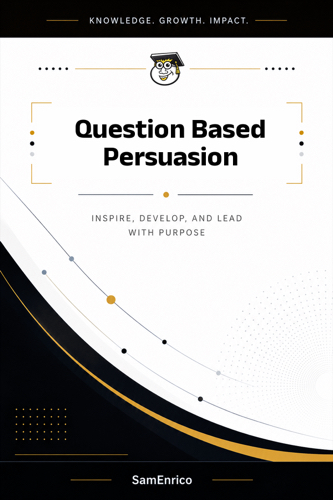
Question Based Persuasion eBook
Guide others to your conclusion through strategic
by Horvath Wai
Guide others to your conclusion through strategic questioning.
Formats
Free sample
Chapter 1: The Million-Dollar Mistake...--I watched my client lose two million dollars in thirty seconds.He had the data. He had the logic. He had the perfect Power Point presentation, rehearsed twelve times, polished until every slide gleamed with inevitability. He had spent three months preparing for this meeting. He knew—knew—that his proposal would save the company millions, streamline operations, and make his boss look like a hero.And then he said eight words that destroyed everything."Here is what you need to do next."The CEO across the table—a woman who had built a nine-figure business from nothing—folded her arms, leaned back in her chair, and smiled the smile of someone who has just decided to say no without saying it."I'll think about it," she said.Which meant no.
Everyone in that room knew it meant no. My client knew it meant no. And yet he had walked in so confident, so certain that the strength of his argument would carry the day, that he had never considered the possibility that how he delivered his conclusion mattered as much as the conclusion itself.Three months later, I ran into that CEO at a conference. Over coffee, I asked her what she remembered about the meeting. She didn't remember the data.
She didn't remember the slides. She remembered the moment he told her what to do."He was probably right," she said. "But he treated me like a child. So I said no."I asked her who eventually solved the problem she had been considering. She named a competitor—a smaller firm, less prestigious, with inferior data.
"They didn't tell me what to do," she said. "They asked me questions. They made me feel smart. They made me feel like the solution was mine."That night, in my hotel room, I wrote down a single sentence that would become the foundation of everything I have taught for the last decade:Never tell people what to think. Ask them questions that lead them to your conclusion—and let them believe they discovered it themselves.The Frustration That Led to This Book Every person reading this book has experienced the same frustration.
You have a brilliant idea. You have the facts on your side. You have prepared meticulously. And yet, when you present your case—clearly, logically, persuasively—the other person resists. They nod along.
They say "interesting." And then they do nothing. Or worse, they do the opposite of what you recommended.You leave the conversation confused and exhausted. Why didn't they see it? It was so obvious. The data was right there.
Anyone with half a brain would have agreed.Here is the uncomfortable truth that most persuasion books will not tell you: Your logic was never the problem. Your data was fine. Your reasoning was sound. The problem was that you triggered a psychological reflex that every human being possesses—a reflex that is hardwired into our brains from millions of years of evolution.When you tell someone what to think, their brain does not evaluate your argument on its merits. Instead, it triggers Reactance Theory—a psychological phenomenon first identified by Jack Brehm in 1966.
Reactance is the uncomfortable emotional state that arises when someone perceives their freedom is being threatened. And nothing threatens freedom quite like being told what to do.Your brilliant argument? Your perfect Power Point? Your irrefutable data? To the other person's brain, it felt like a cage.
And their instinct was to break out.The Science of Why Telling Fails Let me walk you through what happens inside the human brain when you tell someone a conclusion.First, the amygdala—the brain's threat detection center—activates. Not because you are dangerous, but because the brain does not distinguish between physical threats and social threats. Being told what to do registers as a social threat, similar to being excluded, criticized, or dominated. The amygdala sends an alarm signal throughout the nervous system.Second, cortisol—the stress hormone—floods the bloodstream. Cortisol narrows attention, reduces cognitive flexibility, and makes people more defensive.
They are not evaluating your argument; they are preparing to resist it.Third, the prefrontal cortex—the reasoning center—partially shuts down. This is the part of the brain responsible for logical analysis, future planning, and impulse control. When cortisol is high, the prefrontal cortex works less efficiently. The person literally cannot think as clearly as they normally would.Fourth, the brain begins searching for counterarguments. Not because the person is irrational, but because they are protecting their autonomy.
Their inner voice says: "Who are they to tell me what to do? What do they know? What are they not telling me?"By the time you finish your brilliant presentation, the other person has not been persuaded. They have been activated—against you.Here is the cruel irony: the more logical you are, the more data you present, the more certain you are that you are right—the stronger the reactance response becomes. Because a highly logical, data-dense argument leaves no room for the other person's autonomy.
It says: "There is only one reasonable conclusion, and I have just handed it to you."The brain hears: "There is only one reasonable conclusion, and you are not smart enough to find it yourself."No wonder they say no.The Alternative: Pulling Instead of Pushing If telling activates reactance, what deactivates it?The answer is surprisingly simple: questions.When you ask a question, the brain's response is almost the opposite of what happens when you tell.First, the amygdala does not activate. Questions are not perceived as threats because they invite the other person to participate, not comply. They retain their autonomy because they are choosing to answer.Second, cortisol levels remain stable. Without a threat, the stress response does not engage. The person remains calm, open, and curious.Third, the prefrontal cortex activates.
Questions trigger the brain's search engine. When someone asks you a question, you cannot help but begin searching for an answer. Even if you do not answer aloud, your brain starts working. It retrieves memories, connects ideas, and builds mental models.Fourth—and this is the most important part—if the person's search leads them to your conclusion, they will believe they discovered it themselves.Let me repeat that, because it is the central mechanism of this entire book:If the person's search leads them to your conclusion, they will believe they discovered it themselves.And when someone believes they discovered an idea, they will defend it, remember it, and act on it far more reliably than if you had handed it to them. This is not opinion.
This is neuroscience. The brain encodes self-generated information more deeply than received information. It is called the Generation Effect, first documented by cognitive psychologist Norman Slamecka in 1978.When you generate an answer yourself, you own it. When someone gives you an answer, you evaluate it—and often reject it.The Columbo Tactic: Feigned Ignorance as a Superpower The most effective way to deactivate reactance and activate the Generation Effect is a tactic I call the Columbo Tactic, named after the fictional detective played by Peter Falk.For those who do not remember…
This is the end of the free sample. Get the eBook to keep going. Buy now
About this book
Details
- Author
- Horvath Wai
- Publisher
- SamEnrico
- Language
- English
- Genre
- Non-Fiction, Self-Help, Socratic Method
- Released
- 2026-06-10
- Pages (approx.)
- 141
- Available as
- eBook, Audiobook

Read better in the ZLOADR app
Your eBooks on your phone or tablet. Sign in with your SamEnrico account and start reading.
More by Horvath Wai
 Mediterranean for SeniorsHorvath Wai$11.99
 The Reorganization Survival GuideHorvath Wai$11.99
 Values And Mission Alignment Executive Offsite Facilitation HandbookHorvath Wai$11.99Values And Mission Alignment Executive Offsite Facilitation HandbookHorvath Wai$11.99
 The Comparison Creative BlockHorvath Wai$11.99
 The Last Supper of the Lion of the Cape: The Execution of Dingane kaSenzangakhonaHorvath Wai$11.99
 Understanding Trichothiodystrophy Sun SensitivityHorvath Wai$17.99
 Belgian Sheepdog BreedingHorvath Wai$11.99
 Trello Business Plan GuideHorvath Wai$12.99
 Tax Planning for International FranchiseHorvath Wai$12.99
 How to Start a Cigarette Paper In Booklets Business (Beginners Guide)Horvath Wai$11.99