
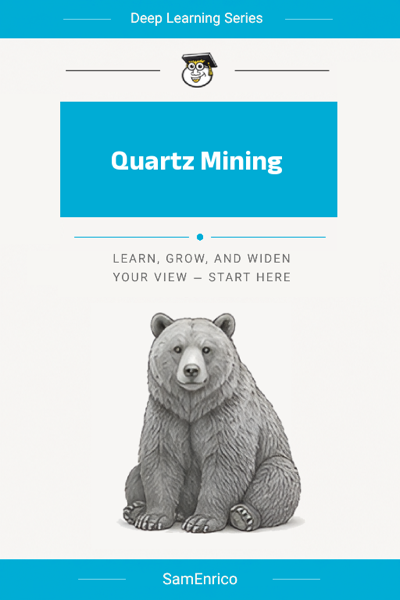
Non-FictionInformativeEducational
Quartz Mining eBook
A Coursebook on Quartz Mining
A Coursebook on Quartz Mining
Formats
Free sample
Chapter 1: The Silicon Bottleneck--–- On a Tuesday morning in March 2023, a factory in Taiwan lost $2 million in less time than it takes to brew a cup of coffee. There was no fire, no cyberattack, no human error. A single crucible—a bowl-shaped vessel about the size of a five-gallon bucket—developed a hairline crack while holding molten silicon at 1,414 degrees Celsius. That crack propagated. The silicon leaked.
The furnace shut down. And somewhere in the mountains of North Carolina, a geologist who had never heard of that factory felt her phone buzz with an urgent question about a batch of quartz she had signed off on six months earlier.The crucible was made of quartz. Not the glittering crystals sold in metaphysical shops, not the clear prisms in old radios, but a specific, rigorously purified form of silicon dioxide (Si O₂) that most people have never heard of and yet interact with within the first sixty seconds of every single day. The screen you are reading this on was manufactured using a quartz crucible. The device itself contains silicon chips that were pulled from a melt inside a quartz crucible.
The fiber optic cables that delivered this text to you were drawn through quartz dies. The solar panels that might charge your next device were made possible by quartz crucibles. Quartz is not merely a component of the modern world. Quartz is the bottle through which all digital civilization pours.And the world is running out of the right kind.The Paradox of Abundance Silicon is the second most abundant element in the Earth's crust, trailing only oxygen. Combined with oxygen to form silicon dioxide—quartz—it makes up nearly sixty percent of the continental crust.
Walk outside. Pick up a rock. There is an excellent chance you are holding quartz or a mineral that contains it. By any measure of raw availability, there should never be a shortage. There are entire mountains composed of little else.
Deserts are full of quartz sand. Beaches are essentially quartz granules polished by waves. The stuff is everywhere.But abundance is a trap.The quartz that matters—the quartz that enables semiconductor manufacturing, solar panel production, and fiber optic networks—is not the quartz you can scoop from a beach. It is not the quartz crushed into concrete or melted into window glass. The quartz that runs the world is a statistical outlier, a geological freak, a material so rare that the entire global supply depends on a handful of mines, two of which sit within a few miles of each other in a single county in western North Carolina.Here is the hierarchy that most people never learn.
Construction aggregate—the gravel and sand that go into concrete and asphalt—sells for about ten to thirty dollars per tonne. It is measured by the trainload and used by the megatonne. Industrial sand, which goes into glass bottles, fiberglass insulation, and foundry molds, sells for fifty to two hundred dollars per tonne. It is a commodity traded on indexes, subject to the usual tides of supply and demand. Above that sits something entirely different.High Purity Quartz, or HPQ, is not a commodity.
It is a specification. And the price reflects that. Industrial-grade HPQ—material that is 99.99 percent pure, meaning total impurities below one hundred parts per million—commands five thousand to eight thousand dollars per tonne. Semiconductor-grade HPQ—99.998 percent pure or better, with total impurities below twenty parts per million—fetches ten thousand to fifteen thousand dollars per tonne. A single ship container of the right quartz, weighing about twenty tonnes, can be worth a quarter of a million dollars.
A year's supply for a single semiconductor fab can run into the tens of millions.The difference between a tonne of beach sand and a tonne of semiconductor-grade HPQ is not just a factor of a thousand in price. It is a difference in geological history, in analytical chemistry, in processing technology, and in luck. The quartz that ends up in a crucible in Taiwan was formed hundreds of millions of years ago, under specific conditions of temperature and pressure, in an environment that excluded aluminum and boron and titanium and lithium and sodium and potassium and a dozen other elements that would later ruin its performance. Then it survived tectonic collisions, hydrothermal alteration, and glacial erosion without developing microscopic fluid inclusions—tiny bubbles of trapped brine or CO₂ that would later explode when heated and devitrify the crucible. Then it was found by a geologist who recognized what it was.
Then it was mined with obsessive care to avoid contamination. Then it was crushed, ground, classified, floated, magnetically separated, thermally treated, and acid-leached to a degree of purity that would be considered absurd in almost any other industrial context. Then it was shipped across an ocean, melted into a crucible, and tested at fourteen hundred degrees Celsius for a hundred hours while a single crystal of silicon was slowly pulled upward to form the wafer that would eventually become a chip.If any of those steps fails—if the quartz came from the wrong vein, if the mine manager allowed dilution with barren rock, if the crusher shed iron particles, if the acid leach was too short, if the fluid inclusions were not fully fractured—nothing else matters. The crucible cracks. The furnace shuts down.
Two million dollars disappear.The Spruce Pine Anomaly To understand why the quartz industry is so fragile, you have to understand Spruce Pine, North Carolina. The town itself is unremarkable—about two thousand people, a few churches, a diner, a hardware store, the kind of Appalachian community that has seen better days and worse. But beneath the surrounding hills lies something that has no equivalent anywhere else on Earth.The Spruce Pine mining district sits atop a geological formation known as the Spruce Pine Pegmatite. Pegmatites are coarsely crystalline igneous rocks that form late in the crystallization sequence of a magma body, when water and incompatible elements concentrate in the remaining melt. The result is a rock with enormous crystals—individual feldspar crystals the size of refrigerators, mica books as big as car hoods, and quartz that, under the right circumstances, grows with exceptional purity.
The Spruce Pine pegmatite is not the only such body in the world. Norway has pegmatites. Brazil has them. Madagascar, Russia, and India have them. But Spruce Pine is special.
The combination of the original magma chemistry, the cooling history, and subsequent metamorphism produced quartz that is unusually low in aluminum and boron—the two elements most destructive to crucible performance. More importantly, the Spruce Pine quartz contains relatively few fluid inclusions. The crystals grew slowly and evenly, trapping little of the surrounding brine.Two companies dominate the district. The Quartz Corporation, a joint venture between Norway's Norsk Mineral and Belgium's Sibelco, operates one set of mines and processing facilities. Sibelco itself operates another.
Between them, they supply an estimated seventy to eighty percent of the world's high-purity quartz for semiconductor and solar applications. The remainder comes from smaller operations in Norway, Russia, India, and Brazil, but no single deposit outside Spruce Pine has matched its combination of volume and…
This is the end of the free sample. Get the eBook to keep going. Buy now
About this book
Details
- Author
- Alfieri Myron
- Publisher
- SamEnrico
- Language
- English
- Genre
- Non-Fiction, Informative, Educational
- Released
- 2026-06-02
- Pages (approx.)
- 140
- Available as
- eBook, Audiobook

Read better in the ZLOADR app
Your eBooks on your phone or tablet. Sign in with your SamEnrico account and start reading.
More by Alfieri Myron
 Chunking Psychology ConceptsAlfieri Myron$11.99
 The Cognitive Interview MethodAlfieri Myron$11.99
 Berber Marabout Saint VenerationAlfieri Myron$11.99
 The Prostate Immunotherapy GuideAlfieri Myron$11.99
 The Ghosts of Thermopylae: Spartans, Gods, and the Persian TideAlfieri Myron$11.99
 Franchise Brand Protection GlobalAlfieri Myron$12.99
 Canadian Masters in AI GuideAlfieri Myron$12.99
 Understanding SclerosteosisAlfieri Myron$17.99
 Ultimate Handbook Guide to Baotou : (China) Travel GuideAlfieri Myron$11.99
You may also like
 Hong Kong Handover 1997Dunn Johnnie$11.99
 Zumba For Postnatal Recovery CourseNeal Christian$11.99
 Zumba for BeginnersLadner Nikia$11.99
 YouTube Comment Mining GuideHumes Pandora$12.99
 Worry Box MeditationCarlin Rudy$11.99
 Workplace Stress MeditationNguyen Lynn$11.99
 Workplace Stress and Sleep RepairHawley Ivory$11.99
 Workplace Perfectionism CureDelaney Jeffry$11.99
 Workplace Injustice Anger GuideWallen Isabelle$11.99
 Work Addiction and Burnout LinkGreenwood Ester$11.99
 Women in Yoga and WellnessBeattie Galina$11.99
 Women in Stand Up ComedyChun Evangeline$11.99