
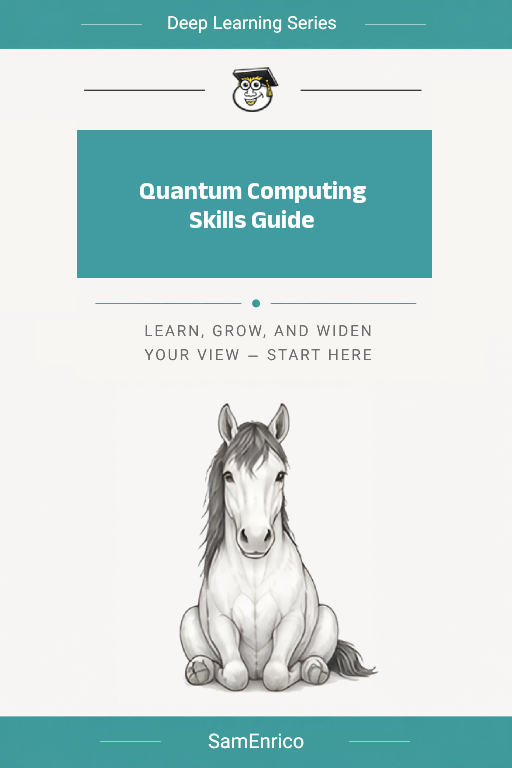
Quantum Computing Skills Guide eBook
Project quantum algorithm, circuit design, and hyb
by Nowlin Alla
Project quantum algorithm, circuit design, and hybrid computing expert demand for 2030.
Formats
Free sample
Chapter 1: The Supremacy Mirage--–- In the sprawling campus of a global investment bank, a team of data scientists recently celebrated a milestone. They had successfully executed a quantum algorithm on a real quantum processing unit – 127 qubits, noisy, unstable, and located in a dilution refrigerator colder than outer space. The algorithm solved a portfolio optimization problem in 37 seconds that would have taken their classical cluster approximately 42 seconds. The head of research declared it a triumph. The chief technology officer asked a simple question: “Which one cost less?” The room fell silent.
That moment captures the single most important lesson for anyone entering the quantum workforce by 2030: supremacy is a headline, but advantage is a paycheck.This chapter dismantles the most seductive myth in quantum computing – that the goal is to beat classical computers at their own game – and replaces it with a practical, career-focused understanding of what will actually matter when you sit down to write hybrid quantum-classical code for a living. You are not here to chase qubit counts or benchmark headlines. You are here to learn how to deploy quantum acceleration that delivers measurable business value despite noisy hardware, limited qubit coherence, and skeptical budget holders. By the end of this chapter, you will understand exactly which industries will pay for quantum skills in 2030, which job role this book prepares you for, and why classical data scientists are suddenly terrified of the words “parameter shift rule.”The great quantum gold rush of the 2020s produced billions in investment, hundreds of startups, and a parade of headlines announcing “supremacy” milestones. Google claimed it in 2019 with Sycamore.
China claimed it with Zuchongzhi. IBM quietly pointed out that all of these demonstrations solved problems with no commercial value. No one needed a random circuit sampling output. No one would pay for it. The race was never about utility.
It was about proving a physics concept. Meanwhile, a different race was running in parallel, quieter and far more relevant to your career: the race to find quantum advantage for actual business problems.Quantum advantage, not supremacy, is the north star of this book. Supremacy means solving a problem that no classical computer can solve, period. Advantage means solving a problem that matters – portfolio optimization, molecular binding energy calculation, supply chain routing – in a way that is faster, cheaper, more accurate, or more energy-efficient than the best classical alternative. Notice the modesty of that definition.
A 10 percent speed improvement on a logistics problem that costs a retailer 100 million dollars annually is a ten-million-dollar quantum advantage. No supremacy required. No hundred-thousand-qubit machine needed. Just a thoughtful, well-orchestrated hybrid algorithm running on a noisy intermediate-scale quantum device – a NISQ machine – that fits inside your existing cloud budget.This distinction shapes everything that follows. The quantum computing industry has spent nearly two decades optimizing for the wrong metric: qubit count alone, without sufficient attention to error rates, coherence times, and the brutal reality that today’s machines cannot sustain quantum states long enough to run Shor’s algorithm or any other fault-tolerant miracle.
The year 2030 will not bring universal fault-tolerant quantum computers despite what the most optimistic roadmaps suggest. It will bring larger NISQ machines – perhaps a few thousand qubits – with better but still imperfect error rates, faster classical control systems, and mature hybrid orchestration layers. The engineers who thrive in that world will not be the ones who can derive the Schrödinger equation from first principles. They will be the ones who can take a noisy 500-qubit machine, design a circuit that fits within its coherence budget, embed that circuit inside a classical optimization loop, and ship the result to production before the hardware calibration drifts out of spec.Let us look at the industries that will fund these roles. The pattern is unmistakable: the earliest and most sustained investment has gone to domains where classical computers are already struggling despite decades of algorithmic innovation.
Pharmaceutical companies cannot accurately simulate protein folding or drug binding using classical methods without heroic approximations that often miss critical quantum effects. The electron configurations in a moderately sized molecule require solving equations that scale exponentially with the number of electrons. Classical supercomputers run for weeks and still fail. This is not a storage problem or a data problem. It is a problem of representing quantum systems with classical bits – a fundamentally mismatched representation.
A quantum computer, built from quantum bits, can represent those same electron configurations naturally, using a number of qubits that grows linearly with the number of electrons rather than exponentially. The challenge is noise. But even noisy, approximate quantum simulations can outperform classical approximations for certain molecular properties. That is why every major pharmaceutical company – Pfizer, Merck, Roche, Novartis – has a quantum computing team today. By 2030, those teams will have grown from research groups into production engineering units, integrated into drug discovery pipelines alongside classical high-performance computing clusters and machine learning models.Financial services followed a similar trajectory but for different reasons.
Banks and hedge funds discovered quantum algorithms for portfolio optimization, risk analysis, and fraud detection in the early 2020s. The appeal was not raw speed but rather the ability to escape local optima – the frustrating reality that classical optimization algorithms, no matter how clever, get trapped in suboptimal solutions when the problem landscape is rugged. Quantum algorithms like QAOA – the Quantum Approximate Optimization Algorithm – explore the solution space using superposition and interference, offering a different search strategy that can, for certain problem structures, find better solutions than classical heuristics. By 2030, high-frequency trading firms will run hybrid quantum-classical anomaly detection on every transaction stream. Asset managers will use quantum annealing for daily portfolio rebalancing.
Risk departments will run quantum Monte Carlo simulations for tail risk analysis. These will not be pure quantum workloads. They will be hybrid workflows where classical code preprocesses data, calls a quantum kernel running on a remote QPU, then post-processes the results. Your job will be to write the glue.Logistics and supply chain optimization present a third front. The traveling salesman problem and its countless variants – vehicle routing, warehouse picking, drone delivery scheduling – have resisted classical optimal solutions for decades.
Businesses rely on approximations that are often 10 to 20 percent worse than the theoretical optimum. For a global shipping company, that gap represents billions in fuel, labor, and missed delivery windows. Quantum algorithms, particularly QAOA and quantum annealing, map naturally onto these problems because they are fundamentally Ising models or quadratic unconstrained binary optimization problems – QUBOs – dressed in logistics terminology. By 2030, major logistics providers will have deployed quantum solvers for their most expensive routing problems, not because quantum computers are universally faster but because they are differently capable, exploring solution spaces that classical solvers miss. The hybrid systems integrator who can translate a business requirement – “minimize fuel cost while maintaining 99.9 percent on-time delivery” – into a QUBO formulation, design a QAOA circuit that fits within hardware constraints, and integrate that circuit into an existing dispatch system will command a salary that reflects their scarcity.Artificial intelligence and machine learning represent the wild card.
Quantum machine learning – QML – promises algorithms that could transform how we train models, generate synthetic data, and represent probability distributions. The connection runs deep: many machine…
This is the end of the free sample. Get the eBook to keep going. Buy now
About this book
Details
- Author
- Nowlin Alla
- Publisher
- SamEnrico
- Language
- English
- Genre
- Non-Fiction, Forecast & Outlook, Quantum Skills
- Released
- 2026-06-01
- Pages (approx.)
- 128
- Available as
- eBook, Audiobook

Read better in the ZLOADR app
Your eBooks on your phone or tablet. Sign in with your SamEnrico account and start reading.
More by Nowlin Alla
 Parent Hobby Rediscovery GuideNowlin Alla$11.99
 Social Confidence BuilderNowlin Alla$11.99
 Fortnite Gaming Compulsion GuideNowlin Alla$11.99
 HGH and Post Surgery RecoveryNowlin Alla$11.99
 Upwork Connects Buying StrategyNowlin Alla$11.99
 The Ballistics of Betrayal: The Sydney Zoo Heist of 1886Nowlin Alla$11.99
 Regulatory SpecialistNowlin Alla$11.99
 Waterfall Project Management GuideNowlin Alla$12.99
 Understanding Melnick–needles OsteodysplastyNowlin Alla$17.99