
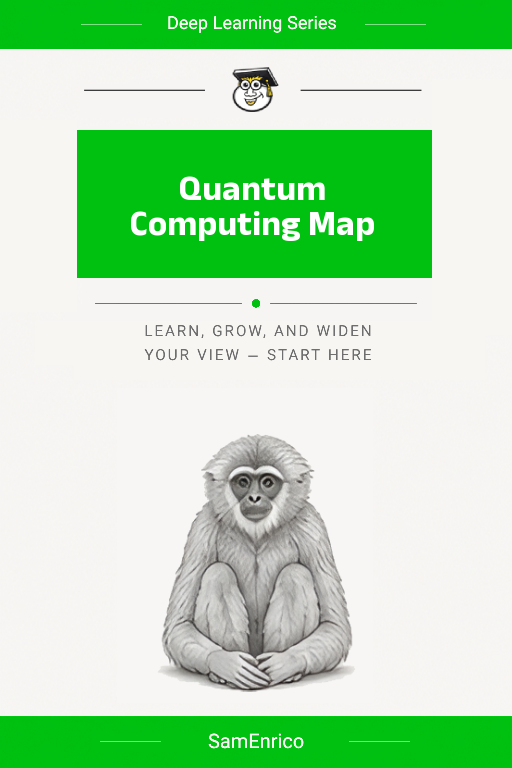
Quantum Computing Map Audiobook
Plot IBM, Google, IonQ, and Rigetti on gate-based
by Cline Tracey
Plot IBM, Google, IonQ, and Rigetti on gate-based versus annealing quantum processor approach.
Formats
Free sample
Chapter 1: The Qubit Duality...--The first thing you need to understand about quantum computing is that there is no such thing as a "standard" qubit. Unlike the classical bit—a transistor either open or closed, a voltage high or low, a magnetic domain pointing north or south—the quantum bit is a chameleon. Its physical embodiment changes everything: how fast it computes, how long it remembers, how often it makes mistakes, and ultimately what problems it can solve. This chapter is not about quantum mechanics in the abstract. It is about the gritty, cold, vacuum-sealed reality of how engineers actually build qubits today.
We will dissect the two dominant physical modalities—superconducting circuits and trapped ions—and lay the foundation for every architecture comparison that follows in this book.If you skip this chapter, the rest of the book will feel like reading a car review without knowing the difference between a gasoline engine and an electric motor. You will hear words like "coherence time," "gate fidelity," and "crosstalk," but you will not understand why Ion Q boasts about 99.99% while Rigetti chases 28-nanosecond gates. By the end of this chapter, you will not only understand those trade-offs—you will be able to predict which architecture wins for which problem.The Two Tribes of Quantum Hardware Walk into any quantum computing conference, and you will notice a quiet cultural divide. On one side, the superconducting camp: engineers who speak in microsecond gate times, dilution refrigerators, and Josephson junctions. On the other side, the trapped ion camp: physicists who think in milliseconds, vacuum chambers, and laser-cooled atoms.
They share coffee, but they do not share hardware roadmaps. And for good reason—the underlying physics forces radically different engineering choices.Superconducting qubits are artificial atoms. You do not find them in nature. You etch them onto sapphire or silicon chips using the same lithography tools that make classical processors. A Josephson junction—a thin insulating barrier sandwiched between two superconductors—creates a nonlinear inductor that behaves like an atom with discrete energy levels.
Tune a microwave pulse to the right frequency, and you can flip that artificial atom between its ground and excited states. That is your qubit. Because these devices are lithographically defined, you can pack hundreds or thousands onto a single chip. The record as of this writing belongs to IBM's Condor: 1,121 superconducting qubits on a single die.Trapped ion qubits…
This is the end of the free sample. Get the Audiobook to keep going. Buy now
About this book
Details
- Author
- Cline Tracey
- Publisher
- SamEnrico
- Language
- English
- Genre
- Non-Fiction, Strategic Atlas, Quantum
- Released
- 2026-06-01
- Pages (approx.)
- 147
- Available as
- eBook, Audiobook

Listen in the VoxFlicks app
Audiobooks and audio dramas wherever you go. Sign in with your SamEnrico account and press play.
More by Cline Tracey
 Metta For Disabled PersonsCline Tracey$11.99
 Road Rage In Carpool LanesCline Tracey$11.99
 The Spanish Inquisition ManualCline Tracey$11.99
 The Assertiveness for Actors GuideCline Tracey$11.99
 Slack Message Rage GuideCline Tracey$11.99
 The Pillars of Heaven: The Gothic Cathedral BuildersCline Tracey$11.99
 Understanding PhthiriophobiaCline Tracey$17.99
 AI-Driven Marketing AutomationCline Tracey$11.99
 VA Training Manual TemplatesCline Tracey$12.99
 How to Start a Buttons Made of Glass Business (Beginners Guide)Cline Tracey$11.99