
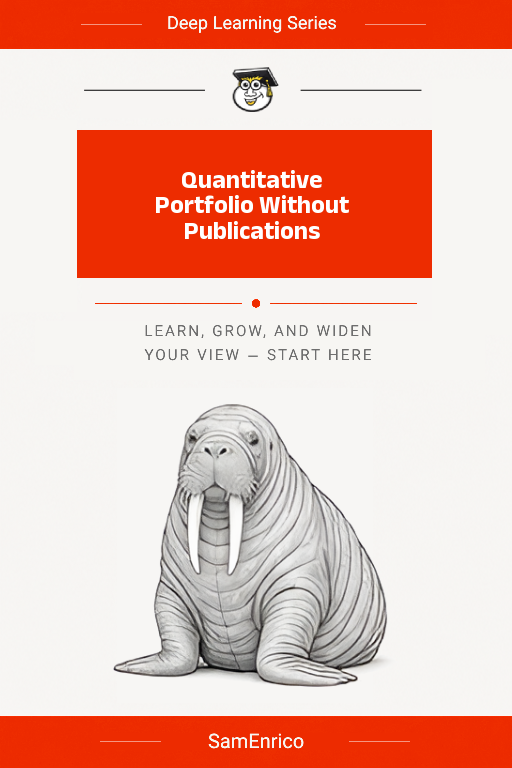
Quantitative Portfolio Without Publications eBook
Share GitHub repositories data analysis samples or
Share GitHub repositories data analysis samples or statistical projects as concrete research evidence.
Formats
Free sample
Chapter 1: The Credentialing Lie--The email arrived on a Tuesday afternoon, and Alex stared at it for a full three minutes before opening it. The subject line read "Application Status – Quantitative Researcher – Citadel." Not a good sign. Offers came by phone. Rejections came by email.When Alex finally clicked, the message was polite and formulaic: "After careful consideration... impressive background...
high volume of qualified candidates... we regret to inform you..." The forty-seventh rejection in fourteen months. Alex had a Ph D in applied mathematics from a top-tier university. Two first-author publications in respectable journals. A perfect GPA.
And forty-seven rejections.The problem wasn't Alex's qualifications. The problem was that everyone had them.The year was 2024, and the quantitative finance industry had reached peak credential inflation. A decade earlier, a master's degree from a good school might have opened doors. By 2024, Ph Ds from Ivy League institutions were a dime a dozen in recruiting pipelines. Every candidate had publications.
Every candidate had a perfect GPA. Every candidate had studied the same interview books, memorized the same brainteasers, and practiced the same option pricing problems until they could recite them in their sleep.Alex's breaking point came during the forty-eighth application, this time to a mid-tier hedge fund that would have been a safety school two years earlier. The application asked for "publication record (attach PDFs)." No field for Git Hub. No field for code repositories. No field for open-source contributions.
Just academic publications—the slowest, least reproducible, most outdated measure of quantitative competence in existence.This book exists because Alex eventually figured out what was broken and how to fix it. But to understand the solution, you first have to understand the scale of the problem.The Publication Myth The belief that academic publications are the gold standard for quantitative competence rests on three assumptions, all of which are demonstrably false.Assumption one: publications prove you can produce original research. This might have been true in 1985, when quantitative finance was young and the gap between academic knowledge and industry practice was wide. Today, the vast majority of finance publications are incremental improvements on existing models—adding a stochastic volatility component here, a jump-diffusion term there—that never translate into trading strategies because they are mathematically elegant but practically useless.Consider the Journal of Finance, one of the most prestigious publications in the field. A typical paper might derive a new pricing formula under exotic assumptions, demonstrate its properties with simulated data, and conclude that it represents a contribution to the literature.
What it almost never does is provide production-ready code, validate the strategy on out-of-sample data with realistic transaction costs, or compare performance against simple benchmarks that would likely do just as well. The incentives of academic publishing reward novelty and mathematical sophistication, not practical utility or robustness.Assumption two: publications prove you can implement complex models. This is laughably false. Most academic papers include no code whatsoever. The ones that do often provide code that is undocumented, untested, and unreproducible.
A 2023 study of finance journals found that fewer than fifteen percent of published papers provided sufficient code and data to reproduce their results. Among those that did, nearly half produced different results when run by independent researchers. In any other scientific field, this would be called fraud. In finance academia, it's called Tuesday.I have personally attempted to replicate results from three prominent finance papers. In one case, the author's code—when I finally obtained it after months of emails—produced different numbers than those reported in the paper.
In another, the code crashed on the first run because of missing dependencies. In the third, the paper described a complex machine learning model but provided no code at all, only a mathematical description that was missing several key details. These are not outliers. This is the norm.Assumption three: publications prove you can succeed in a fast-paced trading environment. This is the most damaging assumption of all.
The average time from submission to publication in top finance journals is eighteen to twenty-four months. In quantitative trading, alpha decays in weeks or months. A strategy that worked two years ago has almost certainly been arbitraged away, or market conditions have shifted, or the statistical edge has eroded. The idea that a two-year-old paper demonstrates current trading competence is absurd on its face, yet hiring committees continue to treat publication records as a primary signal.Let me give you a concrete example. In 2020, a highly cited paper proposed a novel factor that appeared to generate significant risk-adjusted returns.
By the time the paper was published in 2022, the factor had already decayed substantially in real-time trading. By 2023, it was completely flat. The researchers who discovered the factor knew about the decay years before the public did, but by then they had already secured tenure and consulting contracts. The candidates who listed that paper on their resumes were unknowingly advertising a strategy that no longer worked.Here is what academic publications actually prove: you can navigate a slow, political, credential-driven system. You can survive graduate school.
You can produce work that satisfies a small group of anonymous peer reviewers who have their own biases and agendas. You can write in dense mathematical notation that impresses people who value form over function.What publications do not prove: you can write clean, maintainable code. You can avoid look-ahead bias in your backtests. You can handle real-world data with missing values, outliers, and survivorship bias. You can build a system that runs reliably at 9:30 AM when the market opens.
You can explain your model to a portfolio manager who doesn't have a Ph D. You can lose money with grace and adjust your strategy without ego.These are the skills that actually matter in quantitative finance. And they are almost completely uncorrelated with publication count.The Green Book Economy There is a second myth that this book must address, and it is perhaps more insidious than the publication myth. The myth is that interview preparation books like Xinfeng Zhou's "A Practical Guide to Quantitative Finance Interviews"—the infamous Green Book—and Timothy Crack's "Heard on the Street" are somehow testing genuine quantitative ability.Let me be blunt: these books test memorization, not understanding.Consider a typical Green Book question: "What is the Black-Scholes formula for a European call option?" A candidate who has memorized the formula can write it down: C = S·N(d₁) - K·e^(-r T)·N(d₂). A candidate who actually understands option pricing might start by explaining that the formula is derived from the heat equation, that it assumes geometric Brownian motion with constant volatility, that the risk-neutral valuation framework allows discounting at the risk-free rate, and that the N(d) terms represent the probability of exercise under different measures.
But the interviewer doesn't have time for that. The interviewer wants the formula.The result is a bizarre arms race. Candidates memorize solutions to every problem in the Green Book. Interviewers, knowing this, ask more obscure variations. Candidates memorize those too.
Neither side is learning anything about actual quantitative ability. They are participating in a ritual—an elaborate hazing process that has almost nothing to do with building profitable trading strategies.I once interviewed a…
This is the end of the free sample. Get the eBook to keep going. Buy now
About this book
Details
- Author
- Morrison Rodolfo
- Publisher
- SamEnrico
- Language
- English
- Genre
- Non-Fiction, Student's Shortcut
- Released
- 2026-06-01
- Pages (approx.)
- 142
- Available as
- eBook, Audiobook

Read better in the ZLOADR app
Your eBooks on your phone or tablet. Sign in with your SamEnrico account and start reading.
More by Morrison Rodolfo
 HGH Athlete Doping GuideMorrison Rodolfo$11.99
 Team Creative Momentum GuideMorrison Rodolfo$11.99
 Paternity Maternity Leave StressMorrison Rodolfo$11.99
 Kanji Memory PalaceMorrison Rodolfo$11.99
 Diamond Vault Technology FailureMorrison Rodolfo$11.99
 TM for Law StudentsMorrison Rodolfo$11.99
 Spanish Green Tax CreditsMorrison Rodolfo$11.99
 HGH And Pituitary TumorsMorrison Rodolfo$11.99
 Bipolar Cognitive Behavioral GuideMorrison Rodolfo$11.99
 The Blood of the Ancestors: Unlocking the Secrets of the First AmericansMorrison Rodolfo$11.99
 The Vanishing of Flight 19: A Puzzle in the SkyMorrison Rodolfo$11.99
 The Last Dance of the Duke and Duchess: A Royal Split in the SpotlightMorrison Rodolfo$11.99
You may also like
 Hong Kong Handover 1997Dunn Johnnie$11.99
 Zumba For Postnatal Recovery CourseNeal Christian$11.99
 Zumba for BeginnersLadner Nikia$11.99
 YouTube Comment Mining GuideHumes Pandora$12.99
 Worry Box MeditationCarlin Rudy$11.99
 Workplace Stress MeditationNguyen Lynn$11.99
 Workplace Stress and Sleep RepairHawley Ivory$11.99
 Workplace Perfectionism CureDelaney Jeffry$11.99
 Workplace Injustice Anger GuideWallen Isabelle$11.99
 Work Addiction and Burnout LinkGreenwood Ester$11.99
 Women in Yoga and WellnessBeattie Galina$11.99
 Women in Stand Up ComedyChun Evangeline$11.99