
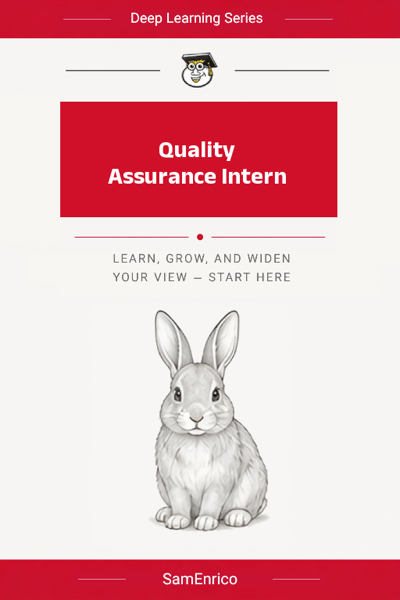
Non-FictionInformativeEducational
Quality Assurance Intern eBook
A Coursebook on Quality Assurance Intern
by Pham Cheryle
A Coursebook on Quality Assurance Intern
Formats
Free sample
Chapter 1: The Perfection Trap...–- Maya Chen stared at her laptop screen, watching the cursor blink in the password field for the forty-seventh time. She had entered “password123” (wrong), “Password123” (still wrong), “P@ssw0rd123” (locked out), and finally the correct credentials her manager had emailed her three hours ago. The login button turned green. The dashboard loaded. And Maya had absolutely no idea what she was supposed to do next.It was her first day as a Quality Assurance Intern at Stay Swift, a mid-sized vacation rental platform that connected property owners with travelers.
She had beaten four hundred other applicants for this position. Her resume listed a computer science minor, a bootcamp certificate in “Agile Fundamentals,” and three glowing recommendations from professors who had clearly overestimated her. The truth, which she had successfully hidden throughout two rounds of interviews, was that she had never written a test case, never logged a bug, and until this morning, had only a vague understanding that QA stood for something other than “Question and Answer.”The desk next to hers belonged to Trevor, a senior QA analyst with seventeen years of experience and the facial expression of a man who had seen every possible way software could fail. He had not spoken to her beyond a grunted “morning” and a pointed look at the coffee machine. The desk on her other side was empty, which felt like a small mercy.Her manager, Priya, had stopped by fifteen minutes ago to say, “Get familiar with the test environment.
We’ll talk at stand-up.” Then she vanished into a conference room. Maya had been clicking through the Stay Swift application ever since, creating fake bookings, canceling them, uploading profile pictures, changing passwords. Everything worked. Nothing broke. She felt useless.The cursor blinked.On the surface, this chapter is about the first hour of an intern’s first day.
But beneath that, it is about a fundamental misunderstanding that almost every new QA professional carries into their first job: the belief that quality assurance is about finding bugs. It is not. Or rather, it is not only about finding bugs. The deeper truth, the one that separates interns who struggle from interns who thrive, is that QA is fundamentally about thinking—specifically, a kind of thinking that most computer science programs never teach and most developers never practice. It is called counterfactual thinking, and it is the single most valuable skill Maya will learn in her entire career.By the end of this chapter, you will understand why “bug-free” is a myth, why your manager does not actually want you to find every bug, and what the payroll disaster of 2017 can teach you about the difference between a typo and a catastrophe.
You will learn the two competing definitions of quality that every software team fights over, and you will discover why finding a bug in the requirements phase costs one dollar while finding the same bug in production costs ten thousand. Most importantly, you will learn the question that separates great testers from mediocre ones: What does the developer assume will never happen, and what happens if it does?Let us start with a story about a payroll system, a decimal point, and the end of a company.The Payroll Disaster That Cost $10,000 Per Employee In 2017, a mid-sized logistics company called Trans Logix implemented a new payroll system. The requirements were straightforward: calculate employee pay based on hours worked, hourly rate, overtime multiplier, and a complex set of regional tax deductions. The development team tested the system thoroughly. Every unit test passed.
Every integration test passed. The QA team signed off. The system went live on a Friday.On Monday, employees received their direct deposits. Some received double their expected pay. Some received half.
A few received nothing. The company’s CFO received a paycheck for negative three thousand dollars—the system had deducted his entire salary plus an additional three thousand from his bank account.The bug, traced back to a single line of code, was absurdly simple. A developer had written:text Copy Downloadnet_pay = gross_pay - (taxes * -1)Instead of subtracting taxes, the code was adding them. The developer had assumed that the tax calculation function would never return a negative number. The tax calculation function, written by a different developer, had been designed to return negative values for specific edge cases involving tax credits.
Neither developer had considered what would happen when their two assumptions collided.The damage was catastrophic. Trans Logix spent the next three weeks manually reconciling paychecks, hiring forensic accountants, and fighting class-action lawsuits. The total cost, including lost productivity, legal fees, and customer churn, exceeded four million dollars. The company folded eighteen months later.Here is the critical insight: every single person involved in that project—the developers, the QA team, the project managers—had done their jobs competently by conventional standards. The unit tests passed because they tested the tax function in isolation.
The integration tests passed because they tested the payroll calculation with positive tax values. The QA team executed their test cases exactly as written. No one was lazy. No one was stupid. They simply failed to ask one question: What does the developer assume will never happen?That question is the heart of quality assurance.The Two Warring Definitions of Quality Before we go any further, we need to agree on what the word “quality” actually means in software.
This is not a philosophical exercise. The definition of quality your team uses determines everything: what you test, how you test it, which bugs you prioritize, and whether you get promoted or fired.There are two competing definitions, and they are almost never in perfect alignment.Definition One: Quality as Conformance to Specifications This is the traditional engineering definition. A piece of software has quality if it does exactly what the requirements document says it should do. Nothing more, nothing less. If the requirement says “the login button shall be blue,” then a green login button is a defect—even if users prefer green.
If the requirement says “the system shall support 500 concurrent users,” then supporting 501 is irrelevant, and supporting 499 is a failure.The advantage of this definition is that it is measurable. You can write a test case for every requirement, run the tests, and generate a pass/fail report. The disadvantage is that requirements are often wrong, incomplete, or contradictory. A system that perfectly conforms to a bad specification is still a bad system.Definition Two: Quality as Fitness for Use This definition, popularized by quality management pioneer Joseph Juran, asks a different question: does the software solve the user’s actual problem? A system can violate its specifications and still be high quality if it meets user needs.
Conversely, a system can perfectly conform to its specifications and still be low quality if those specifications missed the mark.The advantage of this definition is that it focuses on value rather than compliance. The disadvantage is that “fitness for use” is subjective. Different users have different needs. What works for a power user might confuse a beginner. What delights one customer might frustrate another.Maya learned this distinction on her second day…
This is the end of the free sample. Get the eBook to keep going. Buy now
About this book
Details
- Author
- Pham Cheryle
- Publisher
- SamEnrico
- Language
- English
- Genre
- Non-Fiction, Informative, Educational
- Released
- 2026-05-11
- Pages (approx.)
- 155
- Available as
- eBook, Audiobook

Read better in the ZLOADR app
Your eBooks on your phone or tablet. Sign in with your SamEnrico account and start reading.
More by Pham Cheryle
 Anger And Child Anxiety DisordersPham Cheryle$11.99
 Pain Neuroscience Video SeriesPham Cheryle$11.99
 Value Momentum ESG ImpactPham Cheryle$11.99Value Momentum ESG ImpactPham Cheryle$11.99
 Peak Performance Scheduling GuidePham Cheryle$11.99
 Titanium Tides: The Unseen Empire of the Baltic SeaPham Cheryle$11.99
 The Velvet Underground & the Rise of Punk CouturePham Cheryle$11.99
 Understanding Hyperlipoproteinemia Type IvPham Cheryle$17.99
 Sustainability Communications ManualPham Cheryle$12.99
 Quantum Risk Modeling OutlookPham Cheryle$12.99
 How to Become a Chemical PreparerPham Cheryle$11.99
You may also like
 Hong Kong Handover 1997Dunn Johnnie$11.99
 Zumba For Postnatal Recovery CourseNeal Christian$11.99
 Zumba for BeginnersLadner Nikia$11.99
 YouTube Comment Mining GuideHumes Pandora$12.99
 Worry Box MeditationCarlin Rudy$11.99
 Workplace Stress MeditationNguyen Lynn$11.99
 Workplace Stress and Sleep RepairHawley Ivory$11.99
 Workplace Perfectionism CureDelaney Jeffry$11.99
 Workplace Injustice Anger GuideWallen Isabelle$11.99
 Work Addiction and Burnout LinkGreenwood Ester$11.99
 Women in Yoga and WellnessBeattie Galina$11.99
 Women in Stand Up ComedyChun Evangeline$11.99