
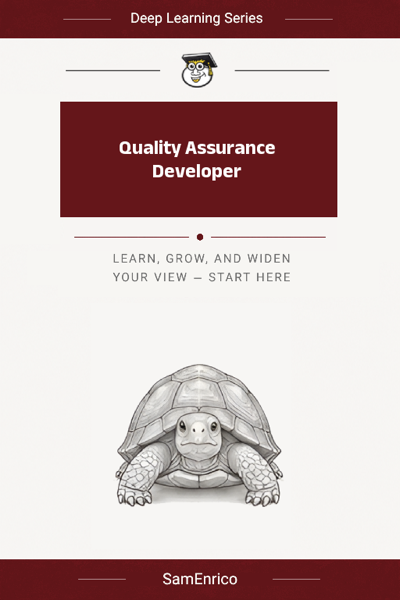
Quality Assurance Developer eBook
A Coursebook on Quality Assurance Developer
A Coursebook on Quality Assurance Developer
Formats
Free sample
Chapter 1: The Destruction Mandate--– The first thing you need to know about quality assurance is that you are not here to prove that software works. You are here to prove that it fails. This single inversion of purpose separates the QA Developer from everyone else at the table. Developers build. Product managers dream.
Users hope. You destroy. And if that word makes you uncomfortable—destruction—then you have already discovered your first cognitive bias. You have been trained your entire professional life to avoid breaking things, to write code that compiles, to ship features that don't crash. But testing is not building.
Testing is the art of intentional destruction, and until you embrace that mandate, you will miss the bugs that matter most.The software industry has a dirty secret. Most testing, across most companies, is performative. Teams run regression suites that haven't found a new bug in six months. They write test cases that verify the login flow works when you type the right password—which everyone already knows. They generate coverage reports that show 85 percent line coverage while gaping security holes sit in the other 15 percent.
This is not testing. This is theater. And it persists because cognitive biases, baked into every human brain, make us terrible at breaking our own assumptions about how things should work.This chapter is an intervention. It will expose the psychological traps that cause even brilliant engineers to miss obvious bugs. It will introduce the dual mindsets of verification and exploration, and it will show you why the latter is where real value lives.
It will explain why running the same tests repeatedly is like spraying pesticide on resistant insects—the weak bugs die, but the strong ones evolve. And it will lay the foundation for everything else in this book by introducing the single most important philosophical shift in modern quality engineering: Shift Left, the practice of moving quality activities earlier into the development lifecycle, where they cost less and prevent more.By the end of this chapter, you will understand why your brain lies to you about what "working software" looks like. You will have a concrete method for forcing yourself to think like an attacker. And you will be ready to move from passive verification to active, intelligent, destructive testing. Let us begin.The Pesticide Paradox: Why Your Regression Suite Is a Graveyard In agriculture, the pesticide paradox is well understood.
You spray a field with insecticide. The weak insects die. The strong ones survive, reproduce, and pass on their resistance. Over time, the same pesticide becomes useless because it has selected for the very bugs you were trying to eliminate. Software testing follows the exact same pattern.When you first write a regression suite, it finds bugs.
That is its job. But as you run it again and again—every night, every week, every sprint—the bugs it was designed to catch get fixed. The tests pass. And they keep passing. Eventually, you have a suite of five hundred tests that all pass reliably, and you feel a warm glow of confidence.
That warmth is a lie. Your regression suite has become a graveyard of dead bugs. The live bugs—the ones that will actually hurt your users—are the ones your tests never anticipated, the edge cases you never thought to write, the combinations of inputs and states that exist only in production under real load.Consider the Knight Capital disaster of 2012. A deployment error caused a piece of obsolete code to be re-enabled. Within forty-five minutes, the company had lost $460 million.
Their regression suite passed. Their unit tests passed. Their integration tests passed. What failed was not any individual test case but the assumption that the testing suite covered the right things. The tests had been written to verify that the system worked as designed.
No one had written a test that asked: "What happens if two incompatible versions of this module run at the same time?"The pesticide paradox has a direct remedy, and it is not "write more regression tests." Writing more of the same kind of tests only accelerates the paradox. The remedy is to constantly introduce new testing strategies, new oracles, new heuristics, and new perspectives. It means you cannot run the same suite forever and expect different results. It means every regression suite has an expiration date, after which it provides only false confidence. The QA Developer's job is to know when to retire a test, when to rewrite a test, and when to replace a suite with an entirely different approach—exploratory sessions, property-based testing, or chaos engineering.The Two Minds of the Tester: Happy Path vs.
Edge Case Every test you write or run falls into one of two categories, and the distinction between them is the single most important concept in this chapter.The Happy Path is the test that verifies the system works under ideal, expected, documented conditions. The user types their correct username and password. The login succeeds. The dashboard loads. This test is necessary but trivial.
It tells you what you already believe to be true. It provides no new information about risk. It is the test that developers write automatically, almost reflexively, because it confirms their assumption that their code works. The Happy Path is the path of least resistance, the path of cognitive ease, the path of System 1 thinking.The Edge Case is the test that explores boundaries, invalid inputs, unexpected sequences, and failure modes. The user types the wrong password.
The user leaves the password blank. The user's account is locked. The user's session expires in the middle of a transaction. The user pastes a 10,000-character string into the name field. The user submits the form twice in rapid succession.
The user's timezone is UTC+14. The user's browser is Internet Explorer 11. The user is a robot. The user is a hacker. The user is a well-intentioned human who accidentally does something the developer never imagined.
Edge cases are uncomfortable. They require imagination, paranoia, and deliberate effort. They are the domain of System 2 thinking.Here is the uncomfortable truth that most testing books dance around: the Happy Path will not save you. Every major production outage, every security breach, every data loss event that makes the news began as an edge case that someone decided was too unlikely to test. The Therac-25 radiation overdoses happened because of a race condition that occurred only when an operator edited data within an extremely narrow time window.
The Heartbleed bug happened because of a missing bounds check that only triggered on specific packet sizes. The 2017 Equifax breach happened because of a vulnerability in a third-party library that was only exploitable under a specific configuration of the Apache web server. Every single one of these catastrophes was an edge case that no one thought to test.The QA Developer does not guess about edge cases. The QA Developer hunts them systematically, using the techniques that will fill the rest of this book: boundary value analysis, equivalence partitioning, state transition tables, combinatorial testing, mutation analysis, and the SFDIpot mnemonic introduced in Chapter 2. But before you can apply any of those techniques, you must first accept a fundamental…
This is the end of the free sample. Get the eBook to keep going. Buy now
About this book
Details
- Author
- Keller Emmett
- Publisher
- SamEnrico
- Language
- English
- Genre
- Non-Fiction, Informative, Educational
- Released
- 2026-05-04
- Pages (approx.)
- 146
- Available as
- eBook, Audiobook

Read better in the ZLOADR app
Your eBooks on your phone or tablet. Sign in with your SamEnrico account and start reading.
More by Keller Emmett
 Parent Solitude Self Care GuideKeller Emmett$11.99
 The HGH Replacement TherapyKeller Emmett$11.99
 The Nepali Immigrant SuccessKeller Emmett$11.99
 AI Experiential Learning PlannerKeller Emmett$11.99
 Multi App Gig Economy Strategy GuideKeller Emmett$11.99
 Sails of Courage: The Portuguese Explorers Who Charted the WorldKeller Emmett$11.99
 Notion Vs Asana Comparison GuideKeller Emmett$12.99
 DevOps CI CD Skills GuideKeller Emmett$12.99
 Understanding Meige SyndromeKeller Emmett$17.99
 Ultimate Handbook Guide to Yangjiang : (China) Travel GuideKeller Emmett$11.99