
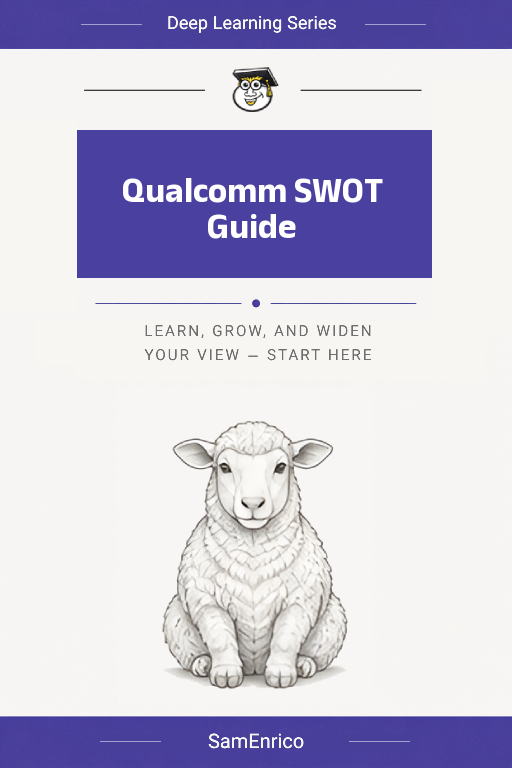
Non-FictionStrategic AtlasSemiconductor
Qualcomm SWOT Guide eBook
Assess 5G licensing, ARM PC entry, smartphone mark
by Mckeown Illa
Assess 5G licensing, ARM PC entry, smartphone market maturity, and Apple modem self-design risk.
Formats
Free sample
Chapter 1: The Toll Road Dynasty...-- In the summer of 1998, a young engineer at Nokia held a prototype phone that would change the world. It was the Nokia 6110, the first mass-market device to run a game called Snake. But inside that plastic shell, buried beneath the rubbery keypad and the monochrome screen, sat a secret that had nothing to do with Finland or mobile gaming. The modem inside that phone—the component that turned radio waves into ringtones and text messages—was designed by a little-known San Diego startup called Qualcomm. And embedded in that modem was a legal landmine that would, over the next twenty-five years, collect more than $100 billion in licensing revenue from virtually every phone manufacturer on Earth.That landmine was not a technology.
It was an idea. The idea that a company could patent the fundamental grammar of wireless communication—not just a specific feature or a clever algorithm, but the very language phones use to talk to towers—and then charge a toll on every single conversation. Irwin Jacobs, Qualcomm's founder, had spent the 1990s perfecting a technology called CDMA (Code Division Multiple Access). It was mathematically elegant, technically superior to the competing GSM standard used in Europe, and legally impregnable. Jacobs didn't just invent a better modem.
He invented a toll road that every phone, regardless of who built it, was forced to travel.This chapter is about how that toll road was built, why it generated 70 percent profit margins for decades, and why the same legal fortress that made Qualcomm one of the most profitable companies in semiconductor history is now under attack from four directions. Understanding the origins of the Qualcomm licensing machine is not a history lesson. It is the only way to understand why the company faces an existential pivot in the next forty-eight months.The Accidental Empire: From Trucking to Telecommunications To understand Qualcomm's licensing model, you must first understand a man named Irwin Jacobs, who never intended to start a patent empire. In the 1960s, Jacobs was a professor of electrical engineering at MIT, where he co-authored a textbook on digital communications that is still assigned in graduate courses today. His specialty was a branch of information theory that most engineers considered too abstract for practical use: how to compress and reconstruct signals in noisy environments.
Jacobs didn't think it was abstract at all. He thought it was the future of mobile communication.In 1985, Jacobs left academia to co-found Qualcomm—short for "Quality Communications." The company's first product had nothing to do with phones. It was a satellite-based trucking tracking system called Omni TRACS, which used a then-obscure technology called CDMA to let fleet managers know where their trucks were. The system worked beautifully, but it was a niche product serving a few thousand trucks. The real breakthrough came when the cellular industry realized that CDMA could support far more simultaneous calls than the competing GSM standard.
By 1993, CDMA had been adopted as a US digital cellular standard, and Qualcomm held the foundational patents.Here is the key insight that most investors miss: Qualcomm did not make its fortune by selling chips. It made its fortune by selling the right to use its ideas. In the early 1990s, the company made a strategic decision that would define its next three decades. Rather than hoarding its CDMA patents for its own handsets, Qualcomm licensed the technology to every handset manufacturer on the planet—Nokia, Motorola, Samsung, LG, and later Apple, Xiaomi, and Oppo. The terms of those licenses were stunningly favorable to Qualcomm.
The company charged a royalty of approximately 5 percent of the wholesale price of every CDMA phone sold. Not 5 percent of the chip value. Five percent of the entire device.Think about the math. A 600smartphonemightcontaina Qualcommmodemworth600 smartphone might contain a Qualcomm modem worth 600smartphonemightcontaina Qualcommmodemworth30. A 5 percent royalty on the full device price is $30—exactly the value of the modem itself.
Qualcomm was effectively charging phone makers the full price of the component just for the right to use its patents. The physical chip was almost free. The license was the product.The Backward Compatibility Moat: Why 3G and 4G Locked In the World The CDMA licensing model would have been vulnerable if the industry had simply switched to a different technology for 3G. But it didn't. When the global telecommunications industry standardized the third generation of mobile networks (3G) in the late 1990s, it chose a technology called WCDMA (Wideband Code Division Multiple Access).
The "CDMA" in that acronym was not a coincidence. The 3G standard was built directly on Qualcomm's foundational patents. The same was true for 4G LTE, which used a technology called OFDMA (Orthogonal Frequency Division Multiple Access). While OFDMA was technically distinct from CDMA, the transition required backward compatibility. Every 4G phone had to fall back to 3G in areas without LTE coverage.
And every 3G phone paid Qualcomm.This is the concept that Chapter 1 will call the "backward compatibility moat." It is the single most important structural feature of Qualcomm's licensing business. Imagine building a toll road that connects every major city. Then imagine that every new highway built must connect to your existing toll road. Then imagine that the government requires that all cars be able to drive on your toll road even if they prefer the new highway. That is the position Qualcomm occupied from 1995 through 2020.
Even a phone that used a modem from Intel, Media Tek, or Huawei still had to include Qualcomm's 3G and 4G patents. There was no way around them.The financial consequences of this moat are staggering. In fiscal year 2024, Qualcomm's licensing segment (called QTL, for Qualcomm Technology Licensing) generated approximately $6 billion in revenue on an asset base of nearly zero physical capital. The operating margins on that revenue consistently exceed 70 percent. To put that in perspective, the average software company has margins of 30 to 40 percent.
The average semiconductor company has margins of 20 to 25 percent. Qualcomm's licensing business is more profitable than Microsoft's Office division, more profitable than Apple's App Store, and more profitable than any major bank. It is a machine that prints money from ideas patented three decades ago.The Math of the Moat: Why 70 Percent Margins Are Not Sustainable But here is the problem that Chapter 1 must confront honestly. The backward compatibility moat is shrinking. It is not shrinking because the patents expire—although some are expiring.
It is shrinking because the industry is building new highways that do not connect to Qualcomm's toll road. And the newer generations of cellular technology—5G and soon 6G—contain fewer of Qualcomm's foundational patents.Let us examine the numbers carefully. In the 3G era, Qualcomm's share of standard-essential patents (SEPs)—the patents necessary to build a compliant device—exceeded 30 percent. That meant that any 3G phone, regardless of manufacturer, owed a substantial portion of its royalty stack to Qualcomm. In the 4G era, Qualcomm's SEP share declined to approximately 25 percent, but backward compatibility preserved the revenue.
In the 5G era, Qualcomm's SEP share has fallen further to approximately 15 to 18 percent. The absolute number of patents has increased, but the competitive field has expanded. Huawei, Samsung, Ericsson, Nokia, and a dozen…
This is the end of the free sample. Get the eBook to keep going. Buy now
About this book
Details
- Author
- Mckeown Illa
- Publisher
- SamEnrico
- Language
- English
- Genre
- Non-Fiction, Strategic Atlas, Semiconductor
- Released
- 2026-05-29
- Pages (approx.)
- 142
- Available as
- eBook, Audiobook

Read better in the ZLOADR app
Your eBooks on your phone or tablet. Sign in with your SamEnrico account and start reading.
More by Mckeown Illa
 TM For Shift Workers CourseMckeown Illa$11.99
 EQ for Entrepreneurs GuideMckeown Illa$11.99
 Payday Loan Trap DoorMckeown Illa$11.99
 The Joy of EnoughMckeown Illa$11.99
 Self Esteem for Partners With Different LibidoMckeown Illa$11.99
 The Olmec Voyagers: Navigators of the Ancient AmericasMckeown Illa$11.99
 Account CoordinatorMckeown Illa$11.99
 Depreciation Formula GuideMckeown Illa$12.99
 Understanding MyelofibrosisMckeown Illa$17.99
 How to Become a Spotter IiMckeown Illa$11.99
You may also like
 Hong Kong Handover 1997Dunn Johnnie$11.99
 Zumba For Postnatal Recovery CourseNeal Christian$11.99
 Zumba for BeginnersLadner Nikia$11.99
 YouTube Comment Mining GuideHumes Pandora$12.99
 Worry Box MeditationCarlin Rudy$11.99
 Workplace Stress MeditationNguyen Lynn$11.99
 Workplace Stress and Sleep RepairHawley Ivory$11.99
 Workplace Perfectionism CureDelaney Jeffry$11.99
 Workplace Injustice Anger GuideWallen Isabelle$11.99
 Work Addiction and Burnout LinkGreenwood Ester$11.99
 Women in Yoga and WellnessBeattie Galina$11.99
 Women in Stand Up ComedyChun Evangeline$11.99