
Non-FictionInformativeEducational
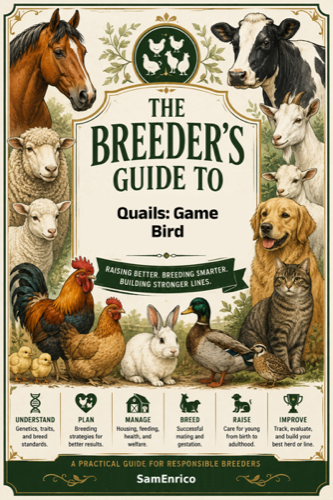
Quails: Game Bird eBook
This wildlife publication, published by SamEnrico,
This wildlife publication, published by SamEnrico, covers Quails: Game Bird
Formats
Free sample
Chapter 1: The Prince’s Call...--The first time I heard a bobwhite quail call from the edge of a dew-heavy hayfield, I was seven years old, perched on the tailgate of my grandfather’s dusty Ford pickup. The sun had just begun its slow melt into the Georgia pines, painting the sky in shades of bruised purple and burnt orange. My grandfather, a man who measured his life in seasons rather than years, held up his hand in the universal signal for silence. Then it came: a clear, piercing whistle that seemed to cut through the thickening dusk like a needle through velvet. “Bob-white.
Bob-white.” I didn’t know it then, but that two-note call would become the soundtrack of my hunting life—a sound that, once heard, never fully leaves you.That call was not merely a bird announcing its presence. It was a declaration of place, a confirmation that the world was still in order. In the decades since that evening, I have chased that sound across nine states, from the longleaf pine forests of Florida to the mesquite thickets of West Texas, from the agricultural steppes of Kansas to the chaparral canyons of California. I have crossed paths with biologists who can read a covey’s social structure from scattered feathers and dust baths, and with octogenarian hunters who can identify a bird’s sex by the sound of its flush alone. I have seen quail thrive in places where the land is treated as a sacred trust, and I have seen them vanish from farms where the soil is treated as nothing more than a medium for chemicals.
This book is the story of what I have learned, and what we stand to lose if we do not listen more carefully to the prince’s call.The Two Lineages: A Tale of Two Hemispheres Before we can understand the quail as a game bird, a conservation challenge, and a cultural icon, we must first understand the fundamental split that defines the very concept of “quail” itself. Most people, including many hunters, use the word quail as if it describes a single, coherent family of birds. The truth is far more interesting, and far more consequential for anyone who hopes to hunt, raise, or conserve them.The world of quail divides cleanly into two great lineages, separated not only by oceans but by millions of years of evolutionary history. On one side stand the New World quail, members of the family Odontophoridae. These are the birds that most American hunters imagine when they close their eyes and dream of a perfect upland morning: the Northern Bobwhite with its crisp white throat and unapologetic call; the California Quail with its elegant, teardrop-shaped topknot that bounces like a metronome as it walks; the Gambel’s Quail with its warm buff belly and the jaunty black plume that curves forward like a feather on a Venetian gondolier’s hat.
New World quail are distinguished by their complex social structures—which we will explore in depth in Chapter 4—their explosive, heart-stopping flight, and their tendency to form tight coveys in the autumn and winter months. They are, with very few exceptions, non-migratory. The bobwhite that flushes from a Georgia fence row in December is the same bird that nested in that same hundred-acre patch the previous spring.On the other side of this avian divide stand the Old World quail, members of the family Phasianidae, which makes them closer cousins to pheasants, partridges, and domestic chickens than to the New World species that share their common name. The most important representative for our purposes is the Common Quail (Coturnix coturnix) and its domesticated derivative, the Japanese Quail (Coturnix japonica). These birds are smaller, more secretive, and fundamentally different in their ecological strategies.
Unlike their New World counterparts, wild Old World quail are migratory, undertaking remarkable seasonal movements across Europe, Asia, and Africa. They do not form stable coveys in the same way; their social bonds are looser, more transient. And crucially for the modern game bird industry, the domesticated Japanese quail—which has largely lost its migratory instincts through centuries of selective breeding—has become the backbone of commercial egg and meat production worldwide. When you buy quail eggs at a farmers market or order grilled quail at a restaurant, you are almost certainly eating a descendant of Coturnix japonica, not a wild New World bird.Why does this distinction matter? It matters because the two lineages require fundamentally different approaches to hunting, management, and conservation.
A hunter chasing bobwhite in Alabama is engaging with a territorial, covey-oriented bird that spends its entire life within a square mile. A hunter walking up Coturnix on a commercial preserve is engaging with a domesticated animal that bears only a passing resemblance to its wild ancestors. A biologist trying to restore California Quail to a degraded landscape cannot simply import the habitat management playbook written for Kansas bobwhite; the species respond differently to fire, to drought, to fragmentation. Throughout this book, I will be careful to distinguish between these lineages. When I speak broadly of “quail,” I will be referring mainly to the New World species that define the sporting tradition in North America.
But the Old World species will appear when we discuss aviculture, commercial production, and the ethics of put-and-take hunting preserves. Understanding the difference is the first step toward becoming a knowledgeable quail enthusiast.The Prince of Game Birds: Why Quail Stand Alone Among the constellation of North American upland game birds, the quail occupies a singular, almost mythic position. The ring-necked pheasant, for all its beauty and brawn, is an introduced species from Asia—a spectacular transplant that thrived in the agricultural landscapes of the Midwest but lacks the deep, ancient claim to the continent that defines native game. The ruffed grouse, that thunderous explosion of wings and adrenaline, is the undisputed king of northern hardwoods, but its range is limited and its hunting style is a solitary, almost monastic pursuit. The wild turkey, the great comeback story of 20th-century conservation, is a bird of the big woods and open fields, but its size and wariness make it a different kind of challenge—more chess than checkers.The quail, particularly the Northern Bobwhite, occupies a sweeter spot.
It is small enough that a limit of birds fits comfortably in a game bag, yet fast enough that it can embarrass even the most accomplished wingshooter. It lives in close proximity to human settlement—along fencerows, in fallow fields, at the edges of suburban developments—yet it remains wild and elusive. It forms coveys that function as miniature societies, complete with sentinels, social hierarchies, and even what might generously be called a culture, passed down from experienced elders to naïve young birds.The phrase “The Prince of Game Birds” is most closely associated with the legendary outdoor writer Charlie Elliott, whose essays from the mid-20th century captured the essence of bobwhite hunting with a warmth and precision that has never been surpassed. Elliott understood something that many modern hunters, raised on a diet of high-tech gear and fast-paced television shows, have lost sight of: quail hunting is not primarily about the shooting. It is about…
This is the end of the free sample. Get the eBook to keep going. Buy now
About this book
Details
- Author
- Wharton Alease
- Publisher
- SamEnrico
- Language
- English
- Genre
- Non-Fiction, Informative, Educational
- Released
- 2026-05-11
- Pages (approx.)
- 141
- Available as
- eBook, Audiobook

Read better in the ZLOADR app
Your eBooks on your phone or tablet. Sign in with your SamEnrico account and start reading.
More by Wharton Alease
 Time Blocking Habit TrackerWharton Alease$11.99
 Student Visa Dubai ProcessWharton Alease$11.99
 Parenting With EQ GuideWharton Alease$11.99
 LBO Value Realization GuideWharton Alease$11.99
 Self Hypnosis for Breathing SleepWharton Alease$11.99
 Reconstruction of HyperthermiaWharton Alease$11.99
 OKR For Health GoalsWharton Alease$11.99
 Emotional Validation for UnemployedWharton Alease$11.99
 The Witch Hunts of 21st Century: Modern Inquisitions and Mass HysteriaWharton Alease$11.99
 The Iron Storm: The Birth of the Tank in the Great War's Mud and BloodWharton Alease$11.99
 How to Produce DartsWharton Alease$11.99
 A Collector's Handbook to the Volkswagen 1600teWharton Alease$11.99
You may also like
 Hong Kong Handover 1997Dunn Johnnie$11.99
 Zumba For Postnatal Recovery CourseNeal Christian$11.99
 Zumba for BeginnersLadner Nikia$11.99
 YouTube Comment Mining GuideHumes Pandora$12.99
 Worry Box MeditationCarlin Rudy$11.99
 Workplace Stress MeditationNguyen Lynn$11.99
 Workplace Stress and Sleep RepairHawley Ivory$11.99
 Workplace Perfectionism CureDelaney Jeffry$11.99
 Workplace Injustice Anger GuideWallen Isabelle$11.99
 Work Addiction and Burnout LinkGreenwood Ester$11.99
 Women in Yoga and WellnessBeattie Galina$11.99
 Women in Stand Up ComedyChun Evangeline$11.99