
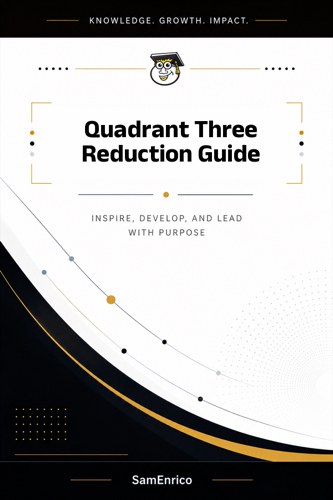
Quadrant Three Reduction Guide eBook
Minimize time spent on urgent but unimportant inte
by Kern Nicki
Minimize time spent on urgent but unimportant interruptions and distractions.
Formats
Free sample
Chapter 1: The Itch You Cannot Name...--–- You are reading this because somewhere, right now, there is something you are supposed to be doing. Not a small thing—a real thing. A project with a deadline. A conversation you have been avoiding. A piece of work that only you can do, the kind that moves the needle on your career, your business, or your life.
And instead of doing that thing, you are reading a book about why you are not doing that thing. That is not an accident. That is a symptom.The gap between what you know you should be doing and what you actually do is not a character flaw. It is not laziness, nor is it a lack of ambition. It is the predictable result of a brain that evolved to survive on the savanna colliding with a technological environment designed by a thousand engineers whose paycheck depends on your inability to focus.
This chapter is about the first and most deceptive layer of that collision: the internal trigger. Before a notification ever buzzes your phone, before a colleague ever appears at your desk, before an email ever lands in your inbox, there is a feeling. That feeling is the real enemy. And until you learn to recognize it, name it, and sit with it, no calendar system, no app, and no productivity hack will save you.The average knowledge worker switches tasks every eleven minutes. Over the course of a day, that adds up to more than sixty interruptions—most of them self-inflicted.
You check email not because something important has arrived but because you feel a flicker of boredom. You open social media not because you need information but because you feel a twinge of anxiety. You reorganize your desktop folders not because the files are disorganized but because the task in front of you is hard and uncertainty is uncomfortable. These are internal triggers: uncomfortable emotional states that your brain has learned to escape by seeking distraction. The itch you cannot name is not a mystery.
It is biology.This chapter will give you a new lens through which to see every moment of unwanted task-switching. You will learn why time management is actually pain management. You will learn the single most effective technique for breaking the cycle of reactive distraction—a technique that requires no software, no permission, and no money. And you will learn where this technique fits in the larger arc of this book: as the first rung on a ladder that begins with self-awareness and ends with precommitment. But before we get to the fix, we must understand the disease.The Discovery That Changes Everything In the early 2010s, a Stanford psychologist named B.J.
Fogg was studying why people fail to change their habits. His conclusion upended the conventional wisdom. Most people assume that bad habits persist because of weak willpower or a lack of motivation. Fogg discovered something stranger: bad habits persist because they work. They provide immediate relief from discomfort.
When you are anxious, checking your phone reduces that anxiety—temporarily. When you are bored, scrolling through news headlines provides a jolt of novelty. When you are uncertain about how to proceed on a difficult task, switching to email gives you the feeling of productivity without the risk of failure.Each time you perform a distracting action in response to an uncomfortable feeling, your brain learns a simple equation: discomfort plus distraction equals relief. That equation gets written into your neural circuitry. Over time, the relief becomes the goal.
You no longer check email because you expect an important message. You check email because the act of checking has become a conditioned response to the feeling of wanting to escape whatever you are currently doing.Nir Eyal, in his book Indistractable, called these uncomfortable states "internal triggers." He identified the most common ones: boredom, anxiety, loneliness, fatigue, uncertainty, and hunger. Note what is missing from that list. Urgency is not there. Importance is not there.
The things that drive your distraction are not external demands but internal states. The phone did not ring. You picked it up because you felt a void and wanted to fill it.This insight is liberating because it shifts the locus of control. If distraction were caused by external triggers—notifications, pings, interruptions—you would be at the mercy of your environment. But if distraction is caused by internal triggers, you have agency.
You cannot control whether a Slack message arrives, but you can control how you respond to the feeling of discomfort that makes you want to check that message. The battle is not against your devices. The battle is against your own biology.Why the Urgent Feels Urgent (Even When It Is Not)To understand why internal triggers are so powerful, we must understand the evolutionary mismatch at the heart of modern work. Your brain evolved in an environment where urgency was a reliable signal of threat. A rustle in the grass was urgent because it might be a predator.
A sudden drop in temperature was urgent because it might mean exposure. In that environment, responding immediately to anything that felt urgent was a survival advantage. The humans who stopped to ask "Is this really urgent?" were eaten.That wiring remains intact. When an email arrives with a red exclamation mark, your brain treats it like a rustle in the grass. When a Slack message pings, your brain treats it like a sudden drop in temperature.
The problem is that the modern world is full of fake urgency—signals that feel pressing but have no real consequence for your survival or your long-term goals. The red exclamation mark might mean "please review this by end of day." The Slack ping might mean "quick question when you have a moment." Neither is a predator. Neither is a threat. But your brain does not know the difference.This is why the Eisenhower Matrix—the tool that gives this book its title—is so useful. The matrix divides tasks into four quadrants:Quadrant I: Urgent and Important (crises, deadlines, emergencies)Quadrant II: Not Urgent but Important (strategy, planning, deep work, relationships)Quadrant III: Urgent but Not Important (most emails, most Slack messages, other people's minor requests)Quadrant IV: Not Urgent and Not Important (mindless scrolling, gossip, trivia)Most people spend their days in Quadrant I (reacting to fires) and Quadrant III (responding to fake urgency).
The Quadrant III tasks are the most deceptive because they feel productive. You answer an email. You reply to a message. You attend a "quick sync." At the end of the day, you have done many things—but you have not done anything that matters. The internal trigger is what pulls you into Quadrant III.
The itch says, "Do something, anything, to avoid the discomfort of this hard thing." And you obey.The 10-Minute Rule: Your First Tool The most effective technique for resisting internal triggers is also the simplest. It is called the 10-Minute Rule. Here is how it works: when you feel the urge to switch to a distracting activity—checking email, opening social media, looking at the news, getting a snack—you do not fight the…
This is the end of the free sample. Get the eBook to keep going. Buy now
About this book
Details
- Author
- Kern Nicki
- Publisher
- SamEnrico
- Language
- English
- Genre
- Non-Fiction, Self-Help, Interruptions, Distractions
- Released
- 2026-06-10
- Pages (approx.)
- 135
- Available as
- eBook, Audiobook

Read better in the ZLOADR app
Your eBooks on your phone or tablet. Sign in with your SamEnrico account and start reading.
More by Kern Nicki
 Hospital Gown Fear Pre Change PlanKern Nicki$11.99
 Norwegian Night School SabotageKern Nicki$11.99
 Among Us Social Gaming BalanceKern Nicki$11.99
 The Stress TMJ Disorder GuideKern Nicki$11.99
 Nefertiti's Lost Exodus: The Forgotten Pharaoh's Secret JourneyKern Nicki$11.99
 Understanding Mast Cell DiseaseKern Nicki$17.99
 Executive Calendar Blocking GuideKern Nicki$12.99
 Remote Review For High PerformersKern Nicki$12.99
 Overnight CleanerKern Nicki$11.99
 How to Start a Pearl Drilling Business (Beginners Guide)Kern Nicki$11.99