
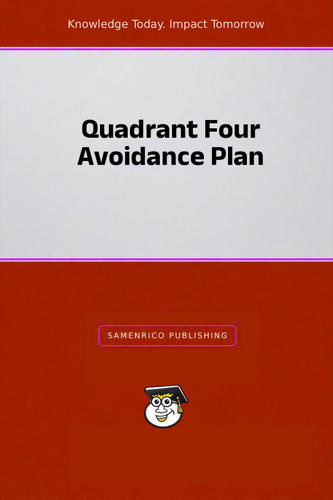
Quadrant Four Avoidance Plan eBook
Recognizes and eliminates time-wasting activities
Recognizes and eliminates time-wasting activities that provide false productivity.
Formats
Free sample
Chapter 1: The Dopamine Lie–- You are not lazy. Let’s get that straight from the first sentence. Lazy people know they are being lazy. They feel no guilt about scrolling through social media for three hours because they never intended to work in the first place. You are different.
You opened your laptop at 8 a.m. with genuine intention. You had a plan. You were going to write that proposal, finish that client presentation, or finally make progress on the project that has been hanging over your head for weeks. And then something happened.
You checked email “just once.” You noticed that your desktop folders were a mess, so you spent forty-five minutes renaming and reorganizing them. You told yourself this was “essential maintenance.” You felt productive. You felt busy. And at 5 p.m., you closed your laptop with tired eyes and the unsettling realization that you had not actually done the thing that mattered. The proposal is still blank.
The presentation still has no conclusion. The project is still stuck.This is the most dangerous form of procrastination. It is not avoidance through pleasure—it is avoidance through effort. You are not watching cat videos. You are working.
You are emailing, organizing, researching, planning, cleaning, and optimizing. You are doing things that look and feel like work. But none of them move the needle on what actually matters. This is false productivity. This is Quadrant Four.
And you have been trained to prefer it.The Productivity Mask: Why Hard Work Feels Easier Than Important Work Let me tell you about a client I’ll call Sarah. Sarah was a senior marketing manager at a mid-sized tech company. She arrived at the office every day at 7:30 a.m., before anyone else. She stayed until 6:30 p.m., often after her boss had left. Her calendar was color-coded.
Her email inbox had forty-seven folders, each meticulously labeled. She took detailed notes in every meeting and followed up with bullet-point summaries within the hour. By every external measure, Sarah was a model employee. She was busy. She was responsive.
She was always, always working.But Sarah had a problem. For eighteen months, she had been trying to launch a new customer retention program. It was her signature initiative—the project that would define her career. Every quarter, she promised her boss she would deliver the pilot. And every quarter, she pushed the deadline.
Not because she was avoiding the project. On the contrary, she spent hours on it every week. She researched retention strategies. She read case studies. She created detailed spreadsheets comparing different customer segments.
She designed a logo for the program. She wrote a thirty-page project plan with Gantt charts. She never launched a single thing.When I asked Sarah why she thought the project wasn’t moving forward, she said, “I’m just not ready yet. There’s more research to do. I need to make sure the plan is perfect before we execute.” Sarah truly believed this.
She was not lying to me. She was lying to herself. And that is precisely what makes Quadrant Four so insidious. The mask of productivity is not worn intentionally. You believe you are working.
Your brain believes you are working. But the part of your mind that craves safety, control, and immediate gratification has hijacked your good intentions and redirected them toward tasks that feel productive but produce nothing.Sarah’s story ended well—eventually. After we identified her hidden Q4 behaviors (excessive research, over-planning, logo design, and file organization), she eliminated them one by one. Within six weeks, she launched the pilot program. Within three months, retention increased by 12 percent.
She got promoted. But here is what haunts me: Sarah had spent eighteen months doing the wrong things perfectly. She was not lazy. She was not unmotivated. She was trapped.The Three Psychological Drivers of False Productivity Why do we do this?
Why do smart, ambitious, hardworking people consistently choose low-impact tasks over high-impact ones? The answer lies in three psychological drivers that operate beneath the surface of your conscious decision-making. Once you understand them, you cannot unsee them. And once you cannot unsee them, you can begin to fight back.Driver One: Anxiety Disguised as Diligence The first driver is anxiety. When you face a large, ambiguous, or high-stakes task, your brain registers it as a threat.
The proposal that could win or lose a client. The difficult conversation with an employee. The creative project with no clear path forward. These tasks trigger your amygdala—the ancient part of your brain responsible for detecting danger. Your heart rate increases.
Your palms sweat. You feel a knot in your stomach. This is not weakness; it is biology. Your brain is trying to protect you from perceived social or professional harm.Here is the twist: your brain does not distinguish between “dangerous” and “difficult.” It only knows that the task feels bad. And because you are a capable, functional adult, you do not run away from the bad feeling.
Instead, you pivot to a task that does not trigger the threat response. You check email. Email is safe. You organize files. Files do not reject you.
You research best practices. Research cannot fail. These tasks feel productive because they involve effort and produce visible results. But they are not the important task. They are a detour.
Your brain has successfully replaced an anxiety-provoking goal with an anxiety-reducing activity, and it has dressed the activity in the clothes of productivity so you do not question the substitution.A study from the University of Chicago titled “The Procrastination Economy” found that knowledge workers spend an average of 41 percent of their time on low-value, discretionary tasks that they themselves admit are not important. When researchers asked participants why they chose those tasks, the most common response was not “I was distracted” or “I was lazy.” It was “I needed to feel like I was making progress.” Anxiety drives us toward visible, checkable, low-stakes work because visible progress is an antidote to the discomfort of ambiguity. But visible progress on the wrong things is not progress at all. It is a sedative.Driver Two: Perfectionism as a Shield The second driver is perfectionism, and it is the most socially acceptable form of self-sabotage in the modern workplace. Let me be clear about what I mean by perfectionism, because the word is often misunderstood.
Perfectionism is not a commitment to excellence. Excellence is adaptive. It says, “I will do the best I can within reasonable constraints, and then I will ship.” Perfectionism is maladaptive. It says, “I will not ship until I am certain there are no flaws, which means I will never ship, because there are always flaws.”Perfectionism is fear masquerading as standards. The perfectionist does not complete the report because the formatting is not quite right.
The perfectionist does not launch the website because the copy could be stronger. The perfectionist does not pitch the idea because there might be one more data point that would make the argument more compelling. To the outside observer, the perfectionist appears meticulous, dedicated, and high-quality. To the perfectionist, every unfinished project is a tragedy of “not…
This is the end of the free sample. Get the eBook to keep going. Buy now
About this book
Details
- Author
- Culpepper Jeniffer
- Publisher
- SamEnrico
- Language
- English
- Genre
- Non-Fiction, Self-Help, Procrastination
- Released
- 2026-06-08
- Pages (approx.)
- 144
- Available as
- eBook, Audiobook

Read better in the ZLOADR app
Your eBooks on your phone or tablet. Sign in with your SamEnrico account and start reading.
More by Culpepper Jeniffer
 Loftie Alarm Clock GuideCulpepper Jeniffer$11.99
 Endometriosis Ultrasound GuideCulpepper Jeniffer$11.99
 Assertiveness For Survivors Of Abuse WorkbookCulpepper Jeniffer$11.99
 The Elizabeth Short Biography GuideCulpepper Jeniffer$11.99
 The Blood and Gold of Cajamarca: How a Dozen Conquistadors Captured an EmpireCulpepper Jeniffer$11.99
 Understanding Rh DiseaseCulpepper Jeniffer$17.99
 Remote Turnover Prevention GuideCulpepper Jeniffer$12.99
 Student Rights in TurkeyCulpepper Jeniffer$12.99
 Machine Maintenance MechanicCulpepper Jeniffer$11.99
You may also like
 Imposter Syndrome and ProcrastinationSigler Lorean$11.99
 The Procrastination FixNieto Danille$11.99
 Procrastination Without ShameDunne Loree$11.99
 Procrastination Study SolutionsHyatt Miguelina$11.99
 Procrastination Script GuideTejada Catrice$11.99
 Procrastination Habit FixSchulze Selma$11.99
 Procrastination Breaking Academic GuideLord Laurette$11.99
 Mindfulness for ProcrastinationHand Nyla$11.99
 Loving Kindness For ProcrastinationLowell Joshua$11.99
 Goal Setting for ProcrastinationPalumbo Loraine$11.99
 Rewire Procrastination TalkMorales Jack$11.99
 Guilt Induced ProcrastinationClanton Hyacinth$11.99