
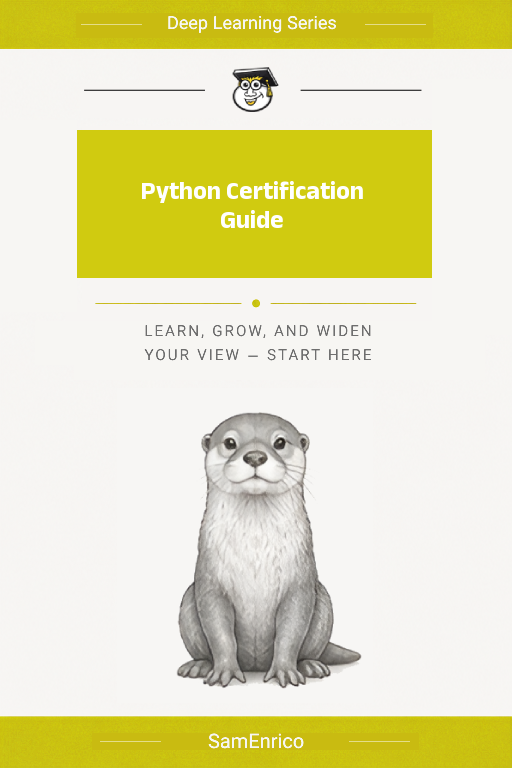
Python Certification Guide eBook
Earn Python certifications from edX, Coursera, or
by Schott Cody
Earn Python certifications from edX, Coursera, or DataCamp for programming roles.
Formats
Free sample
Chapter 1: The 47-Cert Trap--I had forty-seven certifications and zero job offers.Let me repeat that, because it still sounds absurd when I say it out loud. Forty-seven. That wasn't a typo. I had completed twelve Coursera specializations, fourteen Data Camp tracks, nine ed X courses, and a dozen random certificates from sites I can no longer remember. My Linked In profile looked like a diploma mill exploded.
And after four months of applying to Python developer roles, I had received exactly zero interview invitations. Not one.The rejection email from the sixty-eighth application finally broke something in me. Not because it was harsh—it was actually polite, the kind of automated "we've decided to move forward with other candidates" that you learn to skim after the fortieth time. What broke me was the realization that I had spent sixteen months of evenings and weekends, hundreds of dollars on course fees, and an embarrassing amount of emotional energy on something that was supposed to be my ticket out of retail. And it had delivered absolutely nothing.I was working the overnight shift at a warehouse distribution center, making $18.43 an hour, scanning barcodes from midnight until eight in the morning.
My hands smelled like cardboard and packing tape. My back ached from lifting boxes that weighed more than I did. And every night, between two and four AM when the conveyor belt slowed down, I would pull out my phone and complete another coding exercise on Data Camp or watch another lecture on Coursera. I told myself I was being strategic. I told myself that employers would see my dedication, my relentless pursuit of knowledge, my long list of verified credentials.
I told myself that any day now, the offers would start rolling in.They didn't.The Night Everything Changed The night that changed everything wasn't dramatic. There was no explosion, no dramatic confrontation, no mentor figure appearing with a cryptic warning. I was sitting in my car after my shift, parked outside a twenty-four-hour diner, scrolling through yet another round of job postings. A junior Python developer role at a logistics company caught my eye. The salary range was posted: 72,000to72,000 to 72,000to88,000.
That was nearly twice what I was making. I started reading the requirements carefully, the way you study a map before a long trip."Bachelor's degree in Computer Science or related field preferred." I didn't have that."2+ years of professional programming experience preferred." I didn't have that either."PCEP or PCAP certification strongly preferred."That last line stopped me. I had seen certification preferences before, but this one was different. It wasn't buried at the bottom of the job description under "nice to have." It was right there, in the main requirements column, right after the degree and experience that I lacked. For the first time, I saw a certification not as a decoration but as a signal.
A signal that said: This person has been tested. This person has proven they know the basics. This person is worth interviewing even without a degree.I looked at my forty-seven certificates. Not a single one was a proctored exam. Not one came from the Python Institute.
Every single one was a course completion badge—a participation trophy, essentially. I had been collecting the equivalent of gold stars on a kindergarten chart while employers were looking for a driver's license.The Great Certification Illusion Here is the uncomfortable truth that nobody tells you when you're starting out: course completion badges are not certifications. They are receipts. They prove that you watched the videos, that you clicked through the exercises, that you stayed until the end. They do not prove that you can write Python code from memory, under pressure, without hints or autocomplete or the ability to rewind the lecture.
They certainly do not prove that you can debug a function at two in the morning when a production system is down and your boss is standing behind you.I learned this the hard way. In fact, I learned it twice—once when I failed to get any interviews, and again when I finally took the PCEP exam and failed spectacularly.The PCEP, for those who don't know, is the Python Institute's Certified Entry-Level Python Programmer exam. It costs $59. It contains seventy questions. You have sixty-five minutes.
It is proctored live by Pearson VUE, meaning someone watches you through your webcam to make sure you're not cheating. You cannot look at your notes. You cannot open another browser tab. You cannot ask for a hint. You sit in a quiet room with your webcam on, and you answer questions about Python syntax, data types, control flow, functions, exceptions, and basic data structures.
That's it. That's the entry-level exam.I scored fifty-eight percent. The passing score is seventy percent.I had forty-seven certificates and I failed an entry-level exam. Let that sink in.Why Certifications Actually Matter Before we go any further, I need to address the elephant in the room. There is a vocal contingent of programmers who will tell you that certifications are worthless.
They will say that your Git Hub portfolio is all that matters, that your open-source contributions speak louder than any exam, that the only certification that counts is the one you earn by shipping code. And to some extent, they are right. A portfolio of real projects is more valuable than a thousand certificates.But here is what those programmers often forget: they already have jobs. They already have degrees. They already have networks.
They have the luxury of ignoring certifications because they have other signals that prove their competence. If you are reading this book, you probably do not have those luxuries. You are likely self-taught, or career-switching, or returning to the workforce after a long break, or trying to break into tech without a computer science degree. For people like us, certifications are not optional. They are the difference between getting past the automated resume filter and being deleted before a human ever sees your application.The data backs this up.
In 2026, the average salary for Python roles that explicitly list a certification requirement is $128,000. That's not a typo either. Job postings from companies like IBM, Google, Accenture, and thousands of mid-sized firms show a clear pattern: when a certification is listed as preferred or required, the salary band is higher, the application volume is lower, and the candidate who holds that certification is statistically more likely to get an interview. The reason is simple. Hiring managers are drowning in applications.
For a single junior Python role, they might receive five hundred applications. They need shortcuts. They need signals. A proctored certification from a respected organization is one of the strongest signals available.But here is the catch—and this is crucial—most people use certifications wrong. They treat them as the destination.
They think "I have the certification, now I deserve the job." That is backwards. A certification is not the end of your journey. It is the beginning. It is the proof that you have mastered the fundamentals. It is the key that unlocks the door to the interview room.
What you do once you're inside—that depends on your portfolio, your communication skills, and your ability to solve problems under…
This is the end of the free sample. Get the eBook to keep going. Buy now
About this book
Details
- Author
- Schott Cody
- Publisher
- SamEnrico
- Language
- English
- Genre
- Non-Fiction, Student's Shortcut, Python Skills
- Released
- 2026-06-01
- Pages (approx.)
- 131
- Available as
- eBook, Audiobook

Read better in the ZLOADR app
Your eBooks on your phone or tablet. Sign in with your SamEnrico account and start reading.
More by Schott Cody
 Meditation for Endometriosis PainSchott Cody$11.99
 Spin Class Music Selection CourseSchott Cody$11.99
 Flood Insurance Agency DatabaseSchott Cody$11.99
 Community Building From ScratchSchott Cody$11.99
 Beginner Rowing Machine GuideSchott Cody$11.99
 The Frozen Gambit: Hudson's Bay and the Birth of Arctic EngineeringSchott Cody$11.99
 Blood & Ink: The Pulitzer Prize Feud That Shook AmericaSchott Cody$11.99
 LLC BOI Reporting GuideSchott Cody$12.99
 Understanding Desbuquois SyndromeSchott Cody$17.99
 Systems Software DeveloperSchott Cody$11.99
 How to Become a Charger IiSchott Cody$11.99