
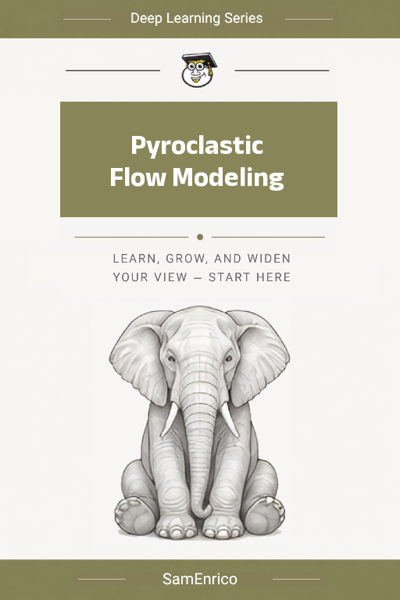
Non-FictionInformativeEducational
Pyroclastic Flow Modeling Audiobook
A Coursebook on Pyroclastic Flow Modeling
A Coursebook on Pyroclastic Flow Modeling
Formats
Free sample
Chapter 1: The Glass Brains--– On a warm August night in the year 79, a young man named Pliny the Younger watched his uncle sail away from the safety of Misenum toward a mountain that had begun to tear itself apart. The elder Pliny, commander of the Roman fleet, was not fleeing. He was a naturalist, a man of insatiable curiosity, and he intended to get closer. What he found on the shores of Stabiae, across the Bay of Naples from the erupting Vesuvius, was not a spectacle for scientific observation. It was a slaughter.
He died there, reportedly of suffocation from volcanic fumes, though the exact cause of his death has been debated for nearly two thousand years.The younger Pliny survived to write two letters that became the first eyewitness account of a volcanic eruption in the Western literary tradition. He described a column of ash and pumice rising “like an umbrella pine,” tall and branching, white at the top and dirty gray at its base. He described darkness at midday, falling pumice, and a strange cloud that rolled down the mountain like a flood. He did not understand what that cloud was. For nineteen centuries, neither did anyone else.Historians and scientists assumed that the people of Pompeii and Herculaneum died slowly, suffocated by falling ash, their poses preserved in the cavities left by decomposed bodies.
That assumption was wrong. And that mistake—a mistake repeated in textbooks, museum exhibits, and documentaries for generations—matters deeply for anyone who wants to understand pyroclastic flows. If you misunderstand how these phenomena kill, you will misunderstand how to model them, how to map their hazards, and how to survive them.The truth, uncovered in the early 2000s by the Italian volcanologist Giuseppe Mastrolorenzo and his colleagues, is far more disturbing. The people of Herculaneum did not suffocate. They were incinerated.
The first pyroclastic surge that hit the town was traveling at more than one hundred kilometers per hour, and its temperature exceeded five hundred degrees Celsius. That is hotter than the interior of a pizza oven. That is hot enough to melt glass. And indeed, when researchers examined the charred remains found in the boathouses along Herculaneum’s ancient shoreline, they found something that should have been impossible: the victims’ brains had turned to glass.Vitrification of organic tissue requires instantaneous heating to above five hundred degrees followed by rapid cooling. There is…
This is the end of the free sample. Get the Audiobook to keep going. Buy now
About this book
Details
- Author
- Gregory Ginger
- Publisher
- SamEnrico
- Language
- English
- Genre
- Non-Fiction, Informative, Educational
- Released
- 2026-05-06
- Pages (approx.)
- 154
- Available as
- eBook, Audiobook

Listen in the VoxFlicks app
Audiobooks and audio dramas wherever you go. Sign in with your SamEnrico account and press play.
More by Gregory Ginger
 Immigrant Real Estate TycoonsGregory Ginger$11.99
 Digital Citizenship AI LessonsGregory Ginger$11.99
 MBSR for Chronic Pain WorkbookGregory Ginger$11.99
 HGH and Chemotherapy RecoveryGregory Ginger$11.99
 Fiverr Gig Economy Earnings HandbookGregory Ginger$11.99
 The Bronze Guardians: Sculpting the Legacy of the Nok PeopleGregory Ginger$11.99
 Ultimate Handbook Guide to Xishan : (China) Travel GuideGregory Ginger$11.99
 Skilled Trades Shortage GuideGregory Ginger$12.99
 Trello Kanban Project Management GuideGregory Ginger$12.99
 Understanding Mehta–Lewis–patton SyndromeGregory Ginger$17.99
You may also like
 Hong Kong Handover 1997Dunn Johnnie$11.99
 Zumba For Postnatal Recovery CourseNeal Christian$11.99
 Zumba for BeginnersLadner Nikia$11.99
 YouTube Comment Mining GuideHumes Pandora$12.99
 Worry Box MeditationCarlin Rudy$11.99
 Workplace Stress MeditationNguyen Lynn$11.99
 Workplace Stress and Sleep RepairHawley Ivory$11.99
 Workplace Perfectionism CureDelaney Jeffry$11.99
 Workplace Injustice Anger GuideWallen Isabelle$11.99
 Work Addiction and Burnout LinkGreenwood Ester$11.99
 Women in Yoga and WellnessBeattie Galina$11.99
 Women in Stand Up ComedyChun Evangeline$11.99