
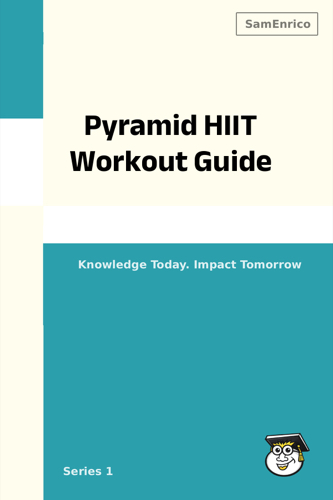
Non-FictionHealth & WellnessPyramid Training
Pyramid HIIT Workout Guide eBook
Vary interval lengths from 15 to 60 seconds and ba
by Miller Steve
Vary interval lengths from 15 to 60 seconds and back down for varied challenge.
Formats
Free sample
Chapter 1: The Plateau Killer--You have been lied to about cardio.Not maliciously. Not by any single person or company. But by a fitness culture that has spent decades repeating the same two assumptions: that longer is better, and that harder is only for athletes. The result is that millions of people grind through thirty-minute jogs, forty-five-minute cycling classes, and hour-long elliptical sessions, only to wonder why their bodies stopped changing months ago. They blame their diet.
They blame their genetics. They blame their lack of willpower. But the problem is not their effort. The problem is the structure of their effort.This book exists because that structure is about to change for you.Let us start with a simple question that most fitness books are afraid to ask: If steady-state cardio works so well, why do so many people quit? The statistics are sobering.
According to the Sports & Fitness Industry Association, nearly fifty percent of people who join a gym or start a new cardio routine abandon it within six months. The most common reason cited is not injury, not lack of time, and not even boredom—though boredom is a close second. The most common reason is what exercise psychologists call "the plateau of diminishing returns." People stop seeing results, so they stop showing up.Here is what is happening inside your body during those long, steady jogs. After approximately six to eight weeks of consistent steady-state cardio, your body adapts. It becomes more efficient—which sounds good but is actually terrible for calorie burn and fitness gains.
Your heart pumps more blood per beat, your mitochondria multiply, and your muscles learn to use oxygen more effectively. These are all positive adaptations for health and longevity. But for weight loss? For athletic performance? For visible results that keep you motivated?
Efficiency is the enemy. A more efficient body burns fewer calories doing the same amount of work. That means the thirty-minute jog that burned three hundred calories in week one might burn only two hundred and fifty calories by week eight. You are working just as hard, but your results are shrinking.This is the plateau. And it is not your fault.
It is biology.Traditional High-Intensity Interval Training, or HIIT, emerged as the solution to this problem. The logic was elegant: instead of jogging steadily for thirty minutes, you could sprint for thirty seconds, rest for thirty seconds, and repeat. The metabolic disturbance would be greater, the calorie burn higher, and the time commitment lower. And for a while, this worked brilliantly. Studies from Mc Master University and the American College of Sports Medicine showed that just fifteen minutes of HIIT produced similar or superior cardiovascular benefits to sixty minutes of steady-state cardio.
The fitness industry celebrated. HIIT classes popped up in every gym. Apps and timers proliferated.But then something predictable happened. The body adapted again. Not to the intensity—the intensity of HIIT remains genuinely challenging.
But the body adapted to the predictability. When every interval is exactly thirty seconds on and thirty seconds off, your nervous system learns the rhythm. It knows when the rest is coming. It down-regulates your sympathetic nervous system activation in anticipation. The result is that the metabolic spike that made HIIT so effective in week one becomes a metabolic hill by week twelve.
You are still suffering—HIIT is never easy—but you are suffering inside a structure your body has learned to manage.This is where the pyramid enters.The pyramid structure—intervals that increase in duration to a peak and then decrease symmetrically—solves both problems simultaneously. It solves the efficiency problem of steady-state cardio by keeping intensity high and metabolic disturbance maximal. And it solves the predictability problem of standard HIIT by varying the interval length with every single repetition. Your body cannot anticipate a pattern that is always changing. The fifteen-second sprint demands one energy system.
The thirty-second interval transitions to another. The forty-five-second push taps into your lactate threshold. The sixty-second peak challenges your mental and physical limits simultaneously. And then, just when you think you cannot sustain another long interval, the pyramid descends. But do not be fooled by the descending numbers.
The forty-five-second interval on the way down is harder than the sixty-second interval on the way up, because you are carrying fatigue with you. This is the secret that most pyramid training explanations miss, and it is the reason this specific ladder works.The 15-30-45-60-45-30-15 second ladder is not arbitrary. It is the product of decades of exercise physiology research, elite athletic programming, and thousands of hours of real-world testing with real people—not just athletes. Let us break down why each rung exists.The fifteen-second sprint is an all-out effort powered almost exclusively by your ATP-CP system. This is your body's immediate energy currency, stored in small amounts directly inside your muscle cells.
It lasts for approximately eight to twelve seconds of maximal effort. By making the sprint fifteen seconds, we push just past the limits of that system, forcing a transition toward the glycolytic pathway. This transition is uncomfortable. It is supposed to be. It is where adaptation happens.The thirty-second interval bridges the gap between pure power and sustained effort.
By thirty seconds, your ATP-CP stores are depleted, and your body is relying heavily on glycolysis—the breakdown of carbohydrates without oxygen. This produces lactic acid, which creates that familiar burning sensation in your muscles. The thirty-second interval is where most people make their first mistake: they treat it like a longer sprint. They should not. The thirty-second interval should be hard but controlled, setting up the longer efforts to come.The forty-five-second interval is the metabolic bridge.
At forty-five seconds, you are fully in the glycolytic zone. Your breathing is heavy. Your muscles are burning. Your brain is beginning to negotiate with itself about whether to continue. This is where mental toughness is built.
The forty-five-second interval is also where many pyramid programs fail, because they assume the sixty-second peak is the hardest part. It is not. The forty-five-second interval on the descending half—after you have already survived the peak—is the hardest part of the entire ladder. We will devote significant attention to this phenomenon later in the book.The sixty-second peak is the summit. It is the longest interval, but counterintuitively, it is not the most intense.
At sixty seconds, you cannot sustain an all-out sprint. No human can. The sixty-second effort should be what exercise physiologists call "maximally sustainable"—approximately eight out of ten on the Rate of Perceived Exertion scale for advanced users, lower for beginners. The sixty-second peak is where you learn pacing. It is where you discover that you can suffer longer than you thought possible if you suffer intelligently.The descending half of the ladder—forty-five, thirty, fifteen seconds—is where the pyramid earns its reputation.
Most interval training gets easier as you approach the end. The pyramid does the opposite. Because you are carrying fatigue from the longer intervals, each descending interval feels harder than its ascending counterpart. The forty-five-second descent is harder than the forty-five-second ascent. The thirty-second descent is harder than the…
This is the end of the free sample. Get the eBook to keep going. Buy now
About this book
Details
- Author
- Miller Steve
- Publisher
- SamEnrico
- Language
- English
- Genre
- Non-Fiction, Health & Wellness, Pyramid Training
- Released
- 2026-06-08
- Pages (approx.)
- 144
- Available as
- eBook, Audiobook

Read better in the ZLOADR app
Your eBooks on your phone or tablet. Sign in with your SamEnrico account and start reading.
More by Miller Steve
 Nonviolent Communication EmpathyMiller Steve$11.99
 Twelve Step for ProfessionalsMiller Steve$11.99
 The New Parent Anger GuideMiller Steve$11.99
 The Retainer Pricing Model GuideMiller Steve$11.99
 The Montreal Cartel: Canada's Hidden War Crimes NetworkMiller Steve$11.99
 How to Start a Blueprinting Service BusinessMiller Steve$11.99
 Data Driven PR TacticsMiller Steve$12.99
 High Volume Retention GuideMiller Steve$12.99
 The Breeder's Guide to Magpie DucksMiller Steve$11.99
 JukskeiMiller Steve$11.99
You may also like
 Hong Kong Handover 1997Dunn Johnnie$11.99
 Zumba For Postnatal Recovery CourseNeal Christian$11.99
 Zumba for BeginnersLadner Nikia$11.99
 YouTube Comment Mining GuideHumes Pandora$12.99
 Worry Box MeditationCarlin Rudy$11.99
 Workplace Stress MeditationNguyen Lynn$11.99
 Workplace Stress and Sleep RepairHawley Ivory$11.99
 Workplace Perfectionism CureDelaney Jeffry$11.99
 Workplace Injustice Anger GuideWallen Isabelle$11.99
 Work Addiction and Burnout LinkGreenwood Ester$11.99
 Women in Yoga and WellnessBeattie Galina$11.99
 Women in Stand Up ComedyChun Evangeline$11.99