
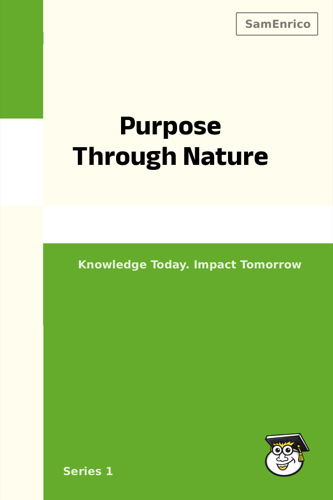
Purpose Through Nature eBook
Connect with wild spaces to clarify your why.
by Vega Crystal
Connect with wild spaces to clarify your why.
Formats
Free sample
Chapter 1: The Indoor Hominid--–- You are reading this book indoors. Pause for a moment and look around. Count the number of surfaces that are flat, manufactured, and rectangular. Count the number of light sources that are not the sun. Count the number of screens within your immediate field of vision.
Now ask yourself a question that sounds simple but is, in fact, the most subversive thing you will consider today: What would your great‑great‑great‑grandmother think of this room?Not your grandmother from the twentieth century, who had a television and a refrigerator. Go further back. Go back ten thousand years. Go back to a woman who woke every morning to the sound of birds and wind, who knew the name of every plant within a day’s walk, whose purpose was not a question to be solved but a fabric she wove moment by moment through the acts of gathering water, building fire, tending children, and reading the weather in the shape of clouds. If you could bring that woman into your living room, she would not be impressed by your technology.
She would be confused by your silence, alarmed by your isolation, and profoundly disoriented by the absence of the sky. She would look at you—sitting alone in a climate‑controlled box, staring at a rectangle of light, surrounded by food you did not hunt, water you did not carry, and warmth you did not build—and she would not envy you. She would pity you. And she would ask, with genuine bewilderment: Why are you living like this?That question is the starting point of this book. Because until you understand why you feel lost, anxious, and directionless despite having more comfort, safety, and information than any humans in history, you will continue to search for purpose in all the wrong places.
You will chase promotions, followers, certifications, and possessions, mistaking accumulation for meaning. You will blame yourself for feeling empty, assuming you are broken rather than displaced. You will read books like this one hoping for a magic formula, when what you actually need is not a formula but a return—a homecoming to the only environment in which your nervous system, your attention, and your sense of purpose ever made sense.This chapter is a diagnosis. Before we can build, we must name the sickness. Before we can return to the wild, we must understand why we left and what we lost along the way.The 93 Percent Problem Let us begin with a number: ninety‑three.
According to the Environmental Protection Agency, the average American spends approximately 93 percent of their life indoors. Seven percent is all that remains for the outdoors, and most of that seven percent is transitional—walking to a car, crossing a parking lot, moving between climate‑controlled boxes. If you live to eighty years old, you will spend roughly seventy‑four of those years inside. You will breathe filtered air, walk on manufactured surfaces, sleep under artificial light, and look at screens for more than half of your waking hours.This is not normal. This is not what your body evolved to do.To understand why this matters, we need to travel back not ten thousand years but three hundred thousand years—the approximate span of anatomically modern humans.
For 99.9 percent of that history, humans lived outdoors. We slept under stars, walked on uneven ground, tracked animals across savannahs, gathered plants along riverbanks, and coordinated our survival in small, interdependent bands. The human brain, the human nervous system, and the human sense of meaning were all forged in this crucible. We are, in the most literal sense, wild animals who have built ourselves cages of drywall and glass.The field of ecopsychology, popularized in works like The Findhorn Book of Connecting with Nature, names this condition nature‑deficit disorder—not a clinical diagnosis but a useful description of a systematic deprivation. When humans are removed from natural environments, predictable psychological symptoms emerge: increased anxiety, reduced attention span, diminished creativity, elevated stress hormones, and a pervasive sense of meaninglessness.
These are not character flaws. They are the predictable outcomes of placing a savannah‑adapted brain inside a sealed box for seventy‑four years.Consider the physiology of stress. Your body’s stress response—the famous “fight or flight” system—evolved to handle acute, short‑term threats: a predator behind a bush, a rival from a neighboring band, a sudden storm. In the presence of such a threat, cortisol and adrenaline surge, you respond, and then, when the threat passes, your system returns to baseline. But what happens when the threat never passes?
What happens when the stressors are low‑grade and chronic: fluorescent lights humming, email notifications pinging, traffic noise rumbling, social media feeds feeding anxiety, and the endless, gnawing sense that you are not doing enough, not being enough, not becoming enough? The stress response remains activated. Cortisol lingers. And your brain, designed for acute threats, cannot distinguish between a lion and a deadline.This is the Indoor Brain: a neurological state of chronic low‑grade threat and attentional exhaustion. The Indoor Brain is not lazy or weak.
It is doing exactly what evolution designed it to do—scanning for danger, conserving resources, staying vigilant. The problem is that it is scanning for dangers that do not exist, in an environment it does not recognize, using algorithms that worked perfectly on the savannah but malfunction in the cubicle. The result is the peculiar modern condition of feeling lost while being perfectly safe.The Myth of the Lone Hero But physiological mismatch is only half the story. The other half is cultural. We have not only placed ourselves in unnatural environments; we have also filled those environments with stories that actively undermine our ability to find purpose.The most damaging of these stories is what I call the Myth of the Lone Hero.
You know this story. A young person leaves home, faces trials, overcomes obstacles, and returns victorious—having found their purpose through solitary struggle. Luke Skywalker leaving Tatooine. Harry Potter leaving the Dursleys. Every superhero origin story ever written.
The message is seductive: purpose is out there, waiting to be conquered, and the path is solitary.But as the novelist Ursula K. Le Guin pointed out in her brilliant essay “The Carrier Bag Theory of Fiction,” this is not the only story humans have ever told. Before the hero’s journey, there was another kind of story: the gathering story. Not the narrative of the hunter who kills the mammoth, but the narrative of the woman who carries the basket. Not conquest, but collection.
Not the spear, but the bag. Most of human life, Le Guin argues, was not about heroic action but about the slow, communal work of gathering, carrying, sharing, and preserving. Purpose was not a prize won in battle. It was a basket filled over time, with the help of others, using the materials at hand.The Lone Hero myth has done incalculable damage to our search for meaning. It has taught us to feel ashamed of dependence, to mistake isolation for strength, and to believe that if we cannot find purpose alone, we…
This is the end of the free sample. Get the eBook to keep going. Buy now
About this book
Details
- Author
- Vega Crystal
- Publisher
- SamEnrico
- Language
- English
- Genre
- Non-Fiction, Self-Help, Nature
- Released
- 2026-06-09
- Pages (approx.)
- 125
- Available as
- eBook, Audiobook

Read better in the ZLOADR app
Your eBooks on your phone or tablet. Sign in with your SamEnrico account and start reading.
More by Vega Crystal
 The Amends Letter Writing GuideVega Crystal$11.99
 Plateau Self CompassionVega Crystal$11.99
 IBS For Women GuideVega Crystal$11.99
 Shift Work Chronotype GuideVega Crystal$11.99
 Radical Responsibility ShiftVega Crystal$11.99
 Parent of Special Needs ChildVega Crystal$11.99Parent of Special Needs ChildVega Crystal$11.99
 Elizabeth Privy Council ManagementVega Crystal$11.99
 The Druid Queen of Eriu: Love and Legends of the Celtic DawnVega Crystal$11.99
 Cosmic Jellyfish: The Glowing Guardians of the DeepVega Crystal$11.99
 How to Produce ToysVega Crystal$11.99
 Portfolio Career Income GoalsVega Crystal$12.99
You may also like
 Hong Kong Handover 1997Dunn Johnnie$11.99
 Zumba For Postnatal Recovery CourseNeal Christian$11.99
 Zumba for BeginnersLadner Nikia$11.99
 YouTube Comment Mining GuideHumes Pandora$12.99
 Worry Box MeditationCarlin Rudy$11.99
 Workplace Stress MeditationNguyen Lynn$11.99
 Workplace Stress and Sleep RepairHawley Ivory$11.99
 Workplace Perfectionism CureDelaney Jeffry$11.99
 Workplace Injustice Anger GuideWallen Isabelle$11.99
 Work Addiction and Burnout LinkGreenwood Ester$11.99
 Women in Yoga and WellnessBeattie Galina$11.99
 Women in Stand Up ComedyChun Evangeline$11.99