
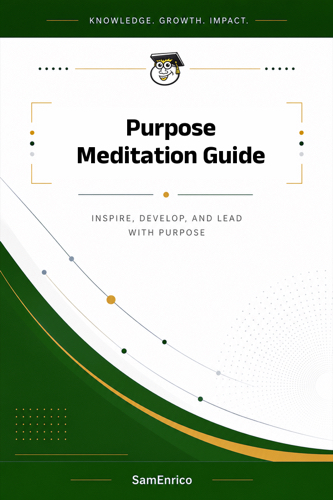
Non-FictionSelf-HelpMeditation
Purpose Meditation Guide eBook
Mindfulness practices to connect with deeper meani
Mindfulness practices to connect with deeper meaning.
Formats
Free sample
Chapter 1: The Witness Awakens--You are not your resume. You are not your job title, your last failure, your proudest achievement, or the story you tell yourself at 2 a.m. about why you haven't figured things out yet. This chapter is not about teaching you to meditate—not yet. First, it must dismantle the single most dangerous obstacle to finding your purpose: the belief that you are the noise in your head.If you have ever lost a job and felt the ground disappear beneath you, received criticism and spiraled for days, or achieved a long-sought goal only to feel strangely empty, you have experienced the trap.
The trap is identification. You have mistaken the contents of your consciousness for consciousness itself. You have believed that the voice commenting on your life is you. And that mistake is why purpose feels so impossibly distant.Purpose is not a destination. It is a signal.
But you cannot hear a signal when you are drowning in static. The static is the ego—the relentless narrator that confuses your social roles, your possessions, your failures, and your fantasies with your actual self. This chapter will teach you to recognize that narrator, to stop believing everything it says, and to discover the one who is listening. That listener is the Witness. And the Witness is where purpose begins.The Great Confusion: Ego as Impostor Let us begin with a simple experiment.
Read the following sentence slowly:I am a failure.Notice what happened in your body as you read those words. Did your chest tighten? Did your stomach drop? Did a familiar voice add commentary—"See? You knew it already"?
Now read this sentence:I am having the thought that I am a failure.Notice the difference. The first statement collapsed you into an identity. The second statement created a small space between you and the thought. In that space—barely a millimeter wide—lies your freedom.Most people spend their entire lives living in the first sentence. They receive a critical email and think, "I am inadequate." They make a mistake and think, "I am stupid." They lose a relationship and think, "I am unlovable." Notice the pattern: a temporary event becomes a permanent identity.
The mind takes a verb—failing, making a mistake, losing—and freezes it into a noun: failure, mistake, loser.This is the ego's primary trick. The ego is not your enemy; it is a survival mechanism that evolved to keep you safe by creating a stable sense of self. But that stability comes at a cost. The ego cannot distinguish between a threat to your body and a threat to your story. When someone criticizes your work, your ego activates the same fight-or-flight response as if a tiger were charging.
The result is chronic, low-grade suffering that masquerades as normal life.Drawing from Eckhart Tolle's A New Earth, we can recognize the ego as the "false self" built on identification with form—your body, your roles, your possessions, your opinions. None of these are bad. The problem is not that you have a job or a reputation. The problem is that you believe you are your job and your reputation. When those forms change—as they inevitably do—the ego experiences death.
And because you think you are the ego, you experience that death as your own.Tara Brach, in Radical Acceptance, calls this the "trance of unworthiness." The trance whispers: "You are not enough. You need to achieve more, be more, have more, and then—then—you will be worthy." The tragedy is that the trance can never be satisfied. No achievement is final because the ego immediately resets the goalpost. Win the promotion, and the ego asks, "Why not the next level?" Find the partner, and the ego asks, "Why not a better one?" The trance is a machine that converts accomplishment into anxiety.Purpose cannot be found inside this machine because the machine is designed to seek, not to arrive. Purpose requires arrival—not a final destination, but a resting in the present.
The ego cannot rest. Rest feels like death to the ego. So the ego keeps you running, searching, striving, and suffering.The Story of Sarah: A Case Study in Identification Sarah was a forty-two-year-old marketing executive who came to mindfulness after a panic attack in her car. On paper, she had everything: a six-figure salary, a corner office, a beautiful home, and a family that loved her. But internally, she was drowning.
Her days were a blur of back-to-back meetings, urgent emails, and a running mental checklist of everything she hadn't done yet. She woke up tired and went to bed anxious.The trigger for her panic attack was seemingly trivial: her boss sent an email saying, "We need to talk about your Q3 numbers." Sarah's mind instantly spun a story: "I'm going to be fired. Everyone knows I'm a fraud. I've been faking it for years. If I lose this job, I lose everything.
I'll be nothing."Notice the chain. An external event (an email) triggered a thought ("I'm going to be fired"). That thought triggered an emotion (fear). That emotion triggered a physical response (racing heart, shallow breathing). And within seconds, Sarah had gone from reading an email to experiencing a full-body survival response—all because her ego had identified its survival with her job title.When Sarah and I began working together, I asked her a simple question: "Who would you be without your job title?"She stared at me for a long time.
Then she started to cry. "I don't know," she whispered. "I don't know who I am without it."This is the answer that breaks hearts and opens doors simultaneously. Sarah did not know who she was without her resume because she had spent twenty years building her identity on shifting sand. The sand had felt solid—promotions, bonuses, praise—but it was sand nonetheless.
Any wave could wash it away.The good news is that the question "Who am I without my story?" is not a void. It is a doorway.The Witness: Your True Self Let us introduce the core distinction of this book, and the foundation of every practice that follows.You have thoughts. You have emotions. You have sensations in your body. You have roles, relationships, memories, and plans.
But you are not any of those things. You are the one experiencing those things.Think of it this way: a movie screen is not the movie. The movie can be tragic, hilarious, terrifying, or boring. The screen remains unchanged, merely displaying whatever passes across it. You are the screen.
Your thoughts, emotions, and roles are the movie.Most people are so absorbed in the movie that they forget the screen exists. They weep at the tragedy, laugh at the comedy, and cower at the horror, never realizing that they are the awareness in which all of this appears and disappears.This awareness is what we call the Witness. The Witness does not judge, analyze, or comment. It simply observes. It is the part of you that notices you are thinking without becoming lost in the thinking.
It is the part of you that feels sadness without collapsing into despair. It is the part of you that…
This is the end of the free sample. Get the eBook to keep going. Buy now
About this book
Details
- Author
- Guevara Barton
- Publisher
- SamEnrico
- Language
- English
- Genre
- Non-Fiction, Self-Help, Meditation
- Released
- 2026-06-07
- Pages (approx.)
- 144
- Available as
- eBook, Audiobook

Read better in the ZLOADR app
Your eBooks on your phone or tablet. Sign in with your SamEnrico account and start reading.
More by Guevara Barton
 Mindful Leadership MBSRGuevara Barton$11.99
 Self Esteem And Ghosting RecoveryGuevara Barton$11.99
 Crypto Gambling Addiction GuideGuevara Barton$11.99
 The Pacific's Radioactive Secret: The Forgotten Pioneers of Atomic DiscoveryGuevara Barton$11.99
 Whispers of the Forgotten: The Lost Expedition of the FranklinGuevara Barton$11.99
 Understanding Hemorrhagic Fever With Renal SyndromeGuevara Barton$17.99
 How to Become a Kettle Tender IiGuevara Barton$11.99
 E-Commerce Data Privacy OutlookGuevara Barton$12.99
 Free Certificate Career Upgrade HandbookGuevara Barton$12.99
 RacquetballGuevara Barton$11.99
You may also like
 Hong Kong Handover 1997Dunn Johnnie$11.99
 Zumba For Postnatal Recovery CourseNeal Christian$11.99
 Zumba for BeginnersLadner Nikia$11.99
 YouTube Comment Mining GuideHumes Pandora$12.99
 Worry Box MeditationCarlin Rudy$11.99
 Workplace Stress MeditationNguyen Lynn$11.99
 Workplace Stress and Sleep RepairHawley Ivory$11.99
 Workplace Perfectionism CureDelaney Jeffry$11.99
 Workplace Injustice Anger GuideWallen Isabelle$11.99
 Work Addiction and Burnout LinkGreenwood Ester$11.99
 Women in Yoga and WellnessBeattie Galina$11.99
 Women in Stand Up ComedyChun Evangeline$11.99