
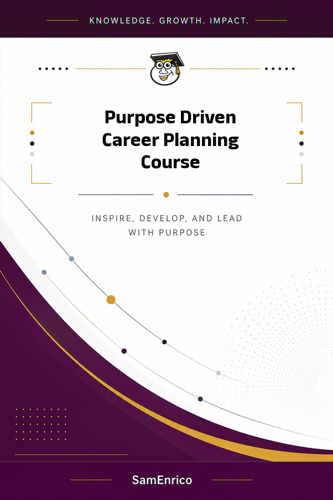
Non-FictionSelf-HelpCareer Planning
Purpose Driven Career Planning Course eBook
Aligns professional choices with personal values a
by Folsom Chery
Aligns professional choices with personal values and mission.
Formats
Free sample
Chapter 1: The Sunday Night Funeral--–- Every Sunday evening, sometime between the last bite of dinner and the moment you check your work email “just to be prepared,” something happens inside you. It might be a heavy feeling in your chest. It might be a short temper with your partner or kids. It might be the sudden urge to clean the garage at 9 PM—anything to delay the inevitable. You are not alone.
Millions of professionals around the world hold a quiet funeral every seven days. They grieve the work life they wanted, mourn the Monday morning ahead, and bury another week of their one wild career. This book is the autopsy and the resurrection.The Sunday Night Funeral has no officiant, no eulogy, and no mourners except the person who dies a little inside. But it is real. According to a 2023 survey by the American Psychological Association, 62% of employed adults report feeling “dread” or “anxiety” specifically on Sunday afternoons and evenings—not on Friday nights, not on Saturday mornings.
Sunday is the day we remember what we have lost. It is the day we measure the gap between the life we are living and the life we wanted.If you have ever felt that Sunday weight, you have two options. The first is to accept it as normal—to tell yourself that work is not supposed to be joyful, that purpose is for poets and monks, that your job is just a paycheck. This is the path of resignation. It works for a while.
It might work for years. But resignation has a cost: a slow, quiet erosion of your energy, your curiosity, and eventually your health. The second option is to ask a different question. Not “How do I escape my job?” but “What would it take for my Sunday nights to feel like anticipation instead of grief?”This chapter is the case for choosing the second option. It is not a self-help pep talk.
It is a practical argument, grounded in decades of research, that waiting for external validation—a promotion, a raise, a corner office, retirement—is a failed strategy for fulfillment. The evidence is clear: the drivers of a satisfying career are not the things you accumulate. They are the conditions you create. And those conditions are available to you long before you change your job title.The 90,000-Hour Question Let us begin with a number that will either liberate you or terrify you. The average person spends approximately 90,000 hours at work over a lifetime.
That is roughly one-third of your waking life. If you sleep eight hours a night, work consumes half of your conscious existence.Now ask yourself a question that most people never ask: What do you want from those 90,000 hours?If your answer is “money,” that is honest but incomplete. Money buys safety, comfort, and options. But once your basic needs are met—once you can pay rent, buy food, and afford the occasional dinner out—additional money has a diminishing return on well-being. The Princeton researchers Daniel Kahneman and Angus Deaton found that emotional well-being rises with income up to about $75,000 per year (adjusted for inflation, roughly $95,000 today) and then flatlines.
Beyond that threshold, more money does not make your Sunday nights any lighter.If your answer is “security,” that is understandable. A steady job feels like a life raft. But security without purpose becomes a prison. You have met the person who has worked at the same company for twenty years, has a gold watch and a 401(k), and looks at you with dead eyes when you ask how they are doing. Security kept them safe.
Security also kept them small.If your answer is “I don’t know,” that is the most honest answer of all. Most people have never been asked what they want from their 90,000 hours. They have been asked what they are good at. They have been asked what pays well. They have been asked what their parents would approve of.
But they have rarely been asked what would make them feel alive.This chapter exists to ask that question and to give you permission to answer it.The Myth of the Golden Future Before we can build a purpose-driven career, we must dismantle the most seductive lie in professional life: the myth of the Golden Future.The Golden Future sounds like this: “I will be happy when I get the promotion.” “I will feel fulfilled after I finish this project.” “I will have purpose once I retire and finally have time for what matters.” The Golden Future is always just over the horizon. It is the carrot on the stick that keeps you running. And it never arrives.The psychologist Daniel Gilbert, in his book Stumbling on Happiness, demonstrated a phenomenon called “impact bias.” Human beings are terrible at predicting what will make them happy. We overestimate the intensity and duration of positive emotions from future events. That promotion you are chasing?
Research shows that the happiness bump lasts about three months. Then you adapt. Then you need something new. Then the Golden Future moves again.Purpose-driven career planning rejects the Golden Future entirely. It argues that alignment is not something you achieve after years of sacrifice.
It is something you practice every week, every day, every hour. The question is not “When will I finally be happy?” The question is “Am I willing to pursue happiness now, in the conditions I actually have?”This is not an argument for recklessness. It is not telling you to quit your job tomorrow and become a potter in the woods (unless that is genuinely your calling). It is an argument for a specific kind of attention: the willingness to notice the gap between your current reality and your values, and then to close that gap by one millimeter at a time.The Three Pillars of Intrinsic Motivation The most influential research on what makes work satisfying comes from the psychologist Daniel Pink. In his book Drive: The Surprising Truth About What Motivates Us, Pink synthesized decades of behavioral science into a simple, powerful framework.
He argued that once basic salary and fair treatment are in place, three drivers determine whether you will love or hate your work: Autonomy, Mastery, and Purpose.Let us define each one carefully, because these words are often used as slogans rather than tools.Autonomy: The Need to Direct Your Own Life Autonomy is not the same as independence. Independence means working alone. Autonomy means having control over how you do your work, when you do it, where you do it, and who you do it with. It is the difference between being told exactly what to do and being given a goal and the freedom to figure out the path.Research on autonomy is overwhelming. Studies of call center workers, software engineers, teachers, and factory workers all point to the same conclusion: when people have even a small amount of control over their work, their satisfaction, creativity, and productivity increase.
A famous study of nursing homes found that giving elderly residents control over a single plant—just a plant—improved their health and longevity. Control over a plant. Imagine what control over your…
This is the end of the free sample. Get the eBook to keep going. Buy now
About this book
Details
- Author
- Folsom Chery
- Publisher
- SamEnrico
- Language
- English
- Genre
- Non-Fiction, Self-Help, Career Planning
- Released
- 2026-06-08
- Pages (approx.)
- 128
- Available as
- eBook, Audiobook

Read better in the ZLOADR app
Your eBooks on your phone or tablet. Sign in with your SamEnrico account and start reading.
More by Folsom Chery
 The Spin Class Survival GuideFolsom Chery$11.99
 Self Talk AssessmentFolsom Chery$11.99
 The Influencer Story Disclosure GuideFolsom Chery$11.99
 Canadian Business NegotiationFolsom Chery$11.99
 The Alchemists of Alexandria: Black Scholars in the Golden Age of ScienceFolsom Chery$11.99
 Understanding Usher SyndromeFolsom Chery$17.99
 Certification Outlook 2026Folsom Chery$12.99
 BOP Rural Customer GuideFolsom Chery$12.99
 Hemodialysis Catheter CareFolsom Chery$11.99
 How to Start a Domino Club Business (Beginners Guide)Folsom Chery$11.99
You may also like
 Hong Kong Handover 1997Dunn Johnnie$11.99
 Zumba For Postnatal Recovery CourseNeal Christian$11.99
 Zumba for BeginnersLadner Nikia$11.99
 YouTube Comment Mining GuideHumes Pandora$12.99
 Worry Box MeditationCarlin Rudy$11.99
 Workplace Stress MeditationNguyen Lynn$11.99
 Workplace Stress and Sleep RepairHawley Ivory$11.99
 Workplace Perfectionism CureDelaney Jeffry$11.99
 Workplace Injustice Anger GuideWallen Isabelle$11.99
 Work Addiction and Burnout LinkGreenwood Ester$11.99
 Women in Yoga and WellnessBeattie Galina$11.99
 Women in Stand Up ComedyChun Evangeline$11.99