
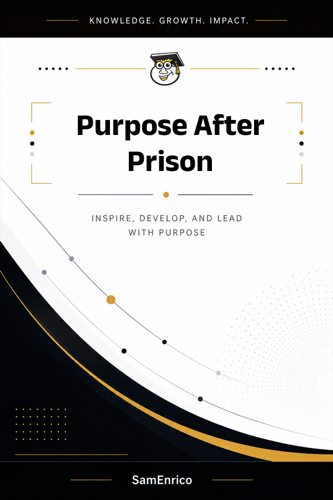
Purpose After Prison eBook
Rebuild meaning and contribution after incarcerati
Rebuild meaning and contribution after incarceration.
Formats
Free sample
Chapter 1: The Mirror Test--–- The morning after release, Marcus sat on the edge of a motel bed that smelled like bleach and old cigarettes. He had been free for eleven hours. His parole officer had given him sixty dollars, a bus pass, and a piece of paper with the motel's address. Marcus had not slept. He had not eaten.
He had been sitting in the same position since 3:00 AM, staring at the television but not watching it, because the television was the only thing in the room that made noise. Silence, for Marcus, was a kind of drowning.He had spent fourteen years inside. Fourteen years of being told when to wake up, when to stand in line, when to eat, when to sit, when to sleep. Fourteen years of a voice through a loudspeaker telling him what to do with his body. And now, in this cheap motel room with a flickering light and a bed that sagged in the middle, no one was telling him anything.
The absence of command was not freedom. It was vertigo.Marcus looked in the bathroom mirror. The face looking back was forty-two years old, but it moved like a younger man's face—twitchy, uncertain, scanning for threats. His eyes kept checking the corners of the reflection, looking for the blind spots. That habit had saved his life inside.
It would destroy him outside. He did not know that yet. He only knew that the man in the mirror was a stranger."You look like you're waiting for someone to hit you," he whispered to himself.The mirror said nothing back. That was the problem.The Identity Earthquake Everyone talks about release day as a celebration. The movies show a man walking out of the gates, squinting into the sun, embraced by a tearful family.
The news shows a statistic. The politicians talk about second chances in the abstract, as if a second chance were a thing you could hold in your hand like a bus pass.No one talks about the morning after.No one talks about the moment when the door closes behind you at the motel, and you realize that every structure that held you up for years—however brutal, however dehumanizing—has vanished. The routine is gone. The walls are gone. The loudspeaker is gone.
And in its place is a terrifying, sprawling, infinite thing called choice.What do you want to eat? Anything. Everything. The grocery store has forty-seven kinds of cereal. Forty-seven.
Marcus stood in front of the cereal aisle for twelve minutes on his first trip to a store, paralyzed, until a teenager asked him if he was okay. He said he was fine. He was not fine. He left without buying anything and ate a bag of chips from a vending machine.This is not weakness. This is the institutionalized personality—a term criminologists use to describe the learned helplessness and hyper-vigilance that keeps a person alive in prison but makes them dysfunctional in the world.
Prison rewards compliance. It punishes initiative. After enough years, your brain rewires itself to survive that environment. It stops asking "What do I want?" and starts asking "What will keep me safe?"The tragedy is that the answer to both questions is different outside the walls. But your brain does not know that yet.This chapter is about the first collision between the person you became inside and the person you are trying to become outside.
It is not about fixing anything—not yet. It is about naming the earthquake so you stop thinking you are the only one shaking.The Prison That Lives in Your Posture Here is something the self-help books never tell you: prison changes your body before it changes your mind.Watch a man who has done serious time walk into a room. He does not enter. He scans. His eyes go to the exits first, then to the corners, then to the hands of the people nearest him.
His shoulders are slightly rolled forward, protecting his chest and throat. His weight is on the balls of his feet, ready to move. He does not smile immediately because smiling shows submission in an environment where submission means victim.This is not paranoia. This is survival architecture. And it worked.
It kept him alive.But now he is in a halfway house or a motel or his mother's living room, and that posture signals something else entirely. It signals threat. It signals instability. It signals a person who is not safe to be around, even if he has never been safer in his adult life.The tragedy of reentry is that the very mechanisms that protected you inside become the mechanisms that isolate you outside. People read your body before they hear your words.
Your hyper-vigilance reads to them as aggression. Your silence reads to them as dishonesty. Your inability to make small talk—because small talk was a luxury that could get you killed in a cell block—reads to them as social deficiency.One of the most powerful frameworks to emerge from modern reentry literature comes from a book called The Quiet Cell, which draws on cognitive behavioral therapy to address exactly this problem. The author argues that the institutionalized personality is not a moral failure. It is a learned response to a specific environment.
And what has been learned can be unlearned. Not quickly. Not easily. But systematically.The first step is simply to notice. To watch your own body without judgment.
To see your own eyes scanning the room and say, "That is not me being crazy. That is me being safe. And I am safe now. I can put my shoulders down."The Two Lies You Believe Before Breakfast In the first weeks after release, your mind will tell you two lies. They will feel like truths.
They will feel like gravity. They are not.Lie Number One: "I am fundamentally broken."This is the voice that says you are different from other people—not in your history, but in your essence. It says that what you did was not an action but an identity. It says that beneath the surface, under the skin, in the DNA, you are a monster wearing a human suit. This voice is loudest at 3:00 AM, in the motel room, when the television is the only thing keeping you from listening to yourself think.Lie Number Two: "Nothing I do will matter."This is the voice of learned helplessness.
It says that every attempt at change will fail, because the system is rigged, because your record follows you, because you have already been judged. It says why bother looking for a job when the felony box is right there? Why bother calling your daughter when she has not answered the last twenty times? Why bother getting sober when you will probably relapse anyway?These lies are not your fault. They are the residue of a system designed to convince you that you are worthless.
But they are still lies. And the first act of reconstruction is learning to recognize a lie when you hear one.A Crucial Distinction: The Difference Between Guilt and Shame This is…
This is the end of the free sample. Get the eBook to keep going. Buy now
About this book
Details
- Author
- Delatorre Takako
- Publisher
- SamEnrico
- Language
- English
- Genre
- Non-Fiction, Self-Help, Reentry
- Released
- 2026-06-08
- Pages (approx.)
- 134
- Available as
- eBook, Audiobook

Read better in the ZLOADR app
Your eBooks on your phone or tablet. Sign in with your SamEnrico account and start reading.
More by Delatorre Takako
 IBS Trigger Identification WorkbookDelatorre Takako$11.99
 The Emotional Regulation WorkbookDelatorre Takako$11.99
 Drinking and Smoking ConnectionDelatorre Takako$11.99
 Teresas Obedience to ConfessorsDelatorre Takako$11.99
 NVC for End of LifeDelatorre Takako$11.99
 Graveyard Shift Sleep PlanDelatorre Takako$11.99
 Managing School and WorkDelatorre Takako$11.99
 The Hollow Men of Tir na nÓg: The Fairies' Forgotten WarDelatorre Takako$11.99
 The Last Stand of the Ironwood GiantsDelatorre Takako$11.99
 How to Produce Inspection MirrorsDelatorre Takako$11.99
 A Collector's Handbook to the Hudson Greater EightDelatorre Takako$11.99
 How to Produce Toy RobotsDelatorre Takako$11.99
You may also like
 Assertiveness for Ex PrisonersButts Leeann$11.99
 Purpose After Incarceration GuideMccabe Lynwood$11.99
 Loving Kindness for Reentry ProgramsHimes Arcelia$11.99
 Formerly Incarcerated EsteemShore Wes$11.99
 Incarceration Reentry GuideFernandes Cheryll$11.99
 Emotional Intelligence for Reentry After PrisonMclaurin Elvera$11.99
 DBT For Incarceration ReentryScanlon Rema$11.99
 The Gambling Addiction After Prison GuideLemus Mirella$11.99
 Self Esteem For Incarcerated ReturningBarrow Norene$11.99